
Close Menu
    Facebook X (Twitter) Instagram
    SciTechDaily
    • Biology
    • Chemistry
    • Earth
    • Health
    • Physics
    • Science
    • Space
    • Technology
    Facebook X (Twitter) Pinterest YouTube RSS
    SciTechDaily
    Home»Health»Computer Designed Synthetic Antiviral Proteins Inhibit SARS-CoV-2 / COVID-19 in Human Cells
    Health

    Computer Designed Synthetic Antiviral Proteins Inhibit SARS-CoV-2 / COVID-19 in Human Cells

    By SciTechDailySeptember 13, 2020No Comments4 Mins Read
    Facebook Twitter Pinterest Telegram LinkedIn WhatsApp Email Reddit
    Share
    Facebook Twitter LinkedIn Pinterest Telegram Email Reddit
    Computer Designed COVID-19 Antivirals
    An artists’ conception of how small synthetic proteins, built from scratch from computer designs, can have an antiviral effect by binding with Spike proteins on SARS-CoV-2. The binding interferes with the infectivity mechanism of the virus to try to keep it from latching onto and entering cells. Credit: UW Medicine Institute for Protein Design

    Computer design of synthetic proteins is creating potent, stable antivirals that block infection at least as well as monoclonal antibodies.

    Computer-designed small proteins have now been shown to protect lab-grown human cells from SARS-CoV-2, the coronavirus that causes COVID-19.

    The findings were reported on September 9, 2020, in the journal Science

    In the experiments, the lead antiviral candidate, named LCB1, rivaled the best-known SARS-CoV-2 neutralizing antibodies in its protective actions. LCB1 is currently being evaluated in rodents.

    Coronaviruses are studded with so-called Spike proteins. These latch onto human cells to enable the virus to break in and infect them. The development of drugs that interfere with this entry mechanism could lead to treatment of or even prevention of infection.

    Institute for Protein Design researchers at the University of Washington School of Medicine used computers to originate new proteins that bind tightly to SARS-CoV-2 Spike protein and obstruct it from infecting cells.

    Beginning in January, more than two million candidate Spike-binding proteins were designed on the computer. Over 118,000 were then produced and tested in the lab.

    “Although extensive clinical testing is still needed, we believe the best of these computer-generated antivirals are quite promising,” said lead author Longxing Cao, a postdoctoral scholar at the Institute for Protein Design.

    “They appear to block SARS-CoV-2 infection at least as well as monoclonal antibodies, but are much easier to produce and far more stable, potentially eliminating the need for refrigeration,” he added.

    The researchers created antiviral proteins through two approaches. First, a segment of the ACE2 receptor, which SARS-CoV-2 naturally binds to on the surface of human cells, was incorporated into a series of small protein scaffolds.

    Second, completely synthetic proteins were designed from scratch. The latter method produced the most potent antivirals, including LCB1, which is roughly six times more potent on a per mass basis than the most effective monoclonal antibodies reported thus far.
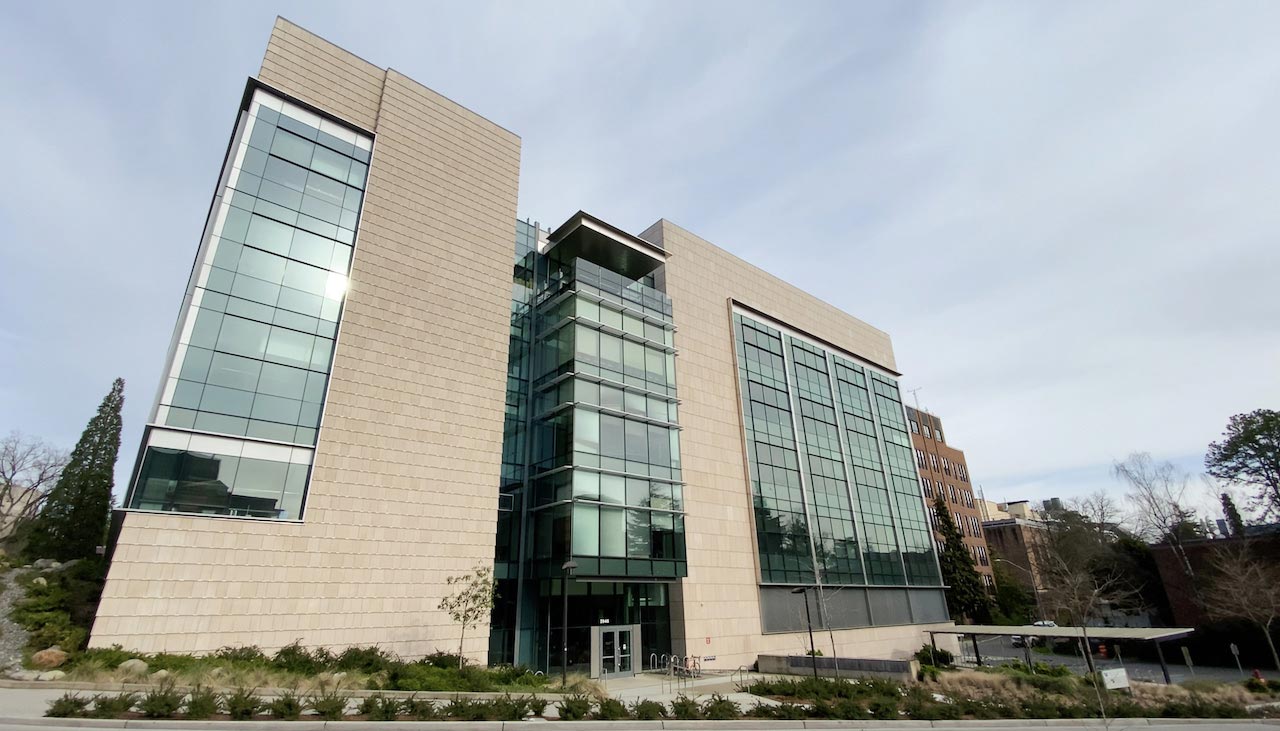
    UW Medicine Institute for Protein Design
    The building that houses the UW Medicine Institute for Protein Design is located on the main Seattle campus of the University of Washington. Credit: UW Medicine Protein Design

    Scientists from the University of Washington School of Medicine in Seattle and Washington University School of Medicine in St. Louis collaborated on this work.

    “Our success in designing high-affinity antiviral proteins from scratch is further proof that computational protein design can be used to create promising drug candidates,” said senior author and Howard Hughes Medical Institute Investigator David Baker, professor of biochemistry at the UW School of Medicine and head of the Institute for Protein Design. In 2019, Baker gave a TED talk on how protein design might be used to stop viruses.

    To confirm that the new antiviral proteins attached to the coronavirus Spike protein were as intended, the team collected snapshots of the two molecules interacting by using cryo-electron microscopy. These experiments were performed by researchers in the laboratories of David Veesler, assistant professor of biochemistry at the UW School of Medicine, and Michael S. Diamond, the Herbert S. Gasser Professor in the Division of Infectious Diseases at Washington University School of Medicine in St. Louis.

    “The hyperstable minibinders provide promising starting points for new SARS-CoV-2 therapeutics,” the antiviral research team wrote in their study pre-print, “and illustrate the power of computational protein design for rapidly generating potential therapeutic candidates against pandemic threats.”

    Reference: “De novo design of picomolar SARS-CoV-2 miniprotein inhibitors” by Longxing Cao, Inna Goreshnik, Brian Coventry, James Brett Case, Lauren Miller, Lisa Kozodoy, Rita E. Chen, Lauren Carter, Alexandra C. Walls, Young-Jun Park, Eva-Maria Strauch, Lance Stewart, Michael S. Diamond, David Veesler and David Baker, 9 September 2020, Science.
    DOI: 10.1126/science.abd9909

    This news release was written by Ian Haydon of the UW Medicine Institute for Protein Design.

    Never miss a breakthrough: Join the SciTechDaily newsletter.
    Follow us on Google and Google News.

    Biochemistry Biotechnology COVID-19 Infectious Diseases University of Washington Virology
    Share. Facebook Twitter Pinterest LinkedIn Email Reddit

    Related Articles

    New Biosensors Quickly Detect COVID-19 Coronavirus Proteins and Antibodies

    Decoy Receptor Neutralizes SARS-CoV-2 / COVID-19 Coronavirus in Cell Cultures

    COVID-19 Vaccine Innovation Could Massively Speed Up Worldwide Production

    COVID-19 Breakthrough: Scientists Identify Possible “Achilles’ Heel” of SARS-CoV-2 Virus

    Potent Neutralizing Antibodies Isolated From COVID-19 Patients – Could Be Mass-Produced to Suppress Virus

    Compounds Identified That Halt COVID-19 Virus Replication by Targeting Key Viral Enzyme

    Open Source All-Atom Models of Full-Length COVID-19 ‘S’ Protein Produced by Scientists

    Antibody Neutralizes SARS and COVID-19 Coronaviruses – On Accelerated Path Toward Clinical Trials

    Team of Biochemists and Virologists Discover Potential Targets for COVID-19 Therapy

    Leave A Reply Cancel Reply

    • Facebook
    • Twitter
    • Pinterest
    • YouTube

    Don't Miss a Discovery

    Subscribe for the Latest in Science & Tech!

    Trending News

    New Study Reveals Why Ozempic Works Better for Some People Than Others

    Climate Change Is Altering a Key Greenhouse Gas in a Way Scientists Didn’t Expect

    New Study Suggests Gravitational Waves May Have Created Dark Matter

    Scientists Discover Why the Brain Gets Stuck in Schizophrenia

    Scientists Engineer “Tumor-Eating” Bacteria That Devour Cancer From Within

    Even “Failed” Diets May Deliver Long-Term Health Gains, Study Finds

    NIH Scientists Discover Powerful New Opioid That Relieves Pain Without Dangerous Side Effects

    Collapsing Plasma May Hold the Key to Cosmic Magnetism

    Follow SciTechDaily
    • Facebook
    • Twitter
    • YouTube
    • Pinterest
    • Newsletter
    • RSS
    SciTech News
    • Biology News
    • Chemistry News
    • Earth News
    • Health News
    • Physics News
    • Science News
    • Space News
    • Technology News
    Recent Posts
    • The Surprising Reason You Might Want To Sleep Without a Pillow
    • Household Cats Could Hold the Secret to Fighting Breast Cancer
    • Scientists Say This Natural Hormone Reverses Obesity by Targeting the Brain
    • This 15,000-Year-Old Discovery Changes What We Know About Early Human Creativity
    • 35-Million-Year-Old Mystery: Strange Arachnid Discovered Preserved in Amber
    Copyright © 1998 - 2026 SciTechDaily. All Rights Reserved.
    • Science News
    • About
    • Contact
    • Editorial Board
    • Privacy Policy
    • Terms of Use

    Type above and press Enter to search. Press Esc to cancel.