
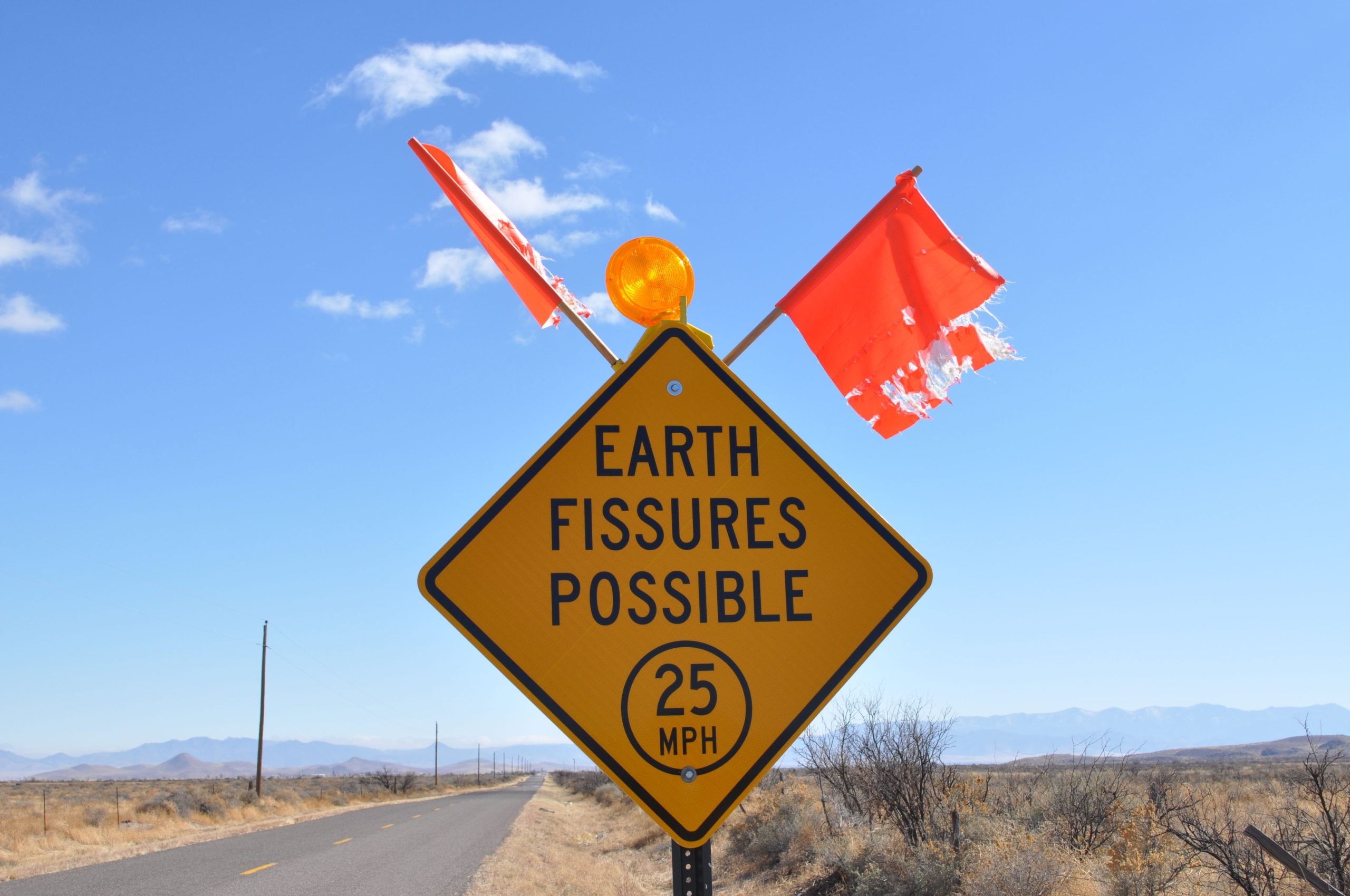
Groundwater extraction for irrigation is leading to rapid subsidence, though effective state management could help slow the process.
In Arizona’s Willcox Basin, located just over an hour east of Tucson, the ground is literally breaking apart. Cracks spread across the surface, wells are running dry, and unusual flooding appears after heavy rains. The reason is straightforward: large-scale farms are extracting vast amounts of groundwater for irrigation, causing the water table to drop and the land itself to subside.
“For a long time,” says Dr. Danielle Smilovsky, a geospatial research scientist at the Conrad Blucher Institute, “there were no water regulations there.”
Smilovsky recently presented new findings at GSA Connects 2025 in San Antonio, Texas, detailing how much the region has sunk. Her five-year study, covering 2017–2021, used satellite observations to track subtle ground movements. The data revealed that some parts of the basin are sinking by as much as six inches per year—nearly three feet over the study period. Since the 1950s, the ground in some areas has dropped by up to 12 feet. The Willcox Basin now shows the fastest rate of subsidence in Arizona, although the issue extends across much of the state.
Why the Ground Is Collapsing
This sinking happens when groundwater is pumped out faster than it can naturally recharge. As water levels decline, the tiny spaces between underground sediment grains lose the pressure that once kept them open. Water normally acts like a cushion, supporting the surrounding material and balancing the weight of everything above. When that pressure disappears, the sediments compact, and the surface gradually sinks.
“Over time, those pore spaces that were once being held open by water pressure start to collapse,” says Brian Conway, a geophysicist at the Arizona Department of Water Resources, “and that causes the overlying surface to sink because of the compaction that’s happening in the subsurface.”
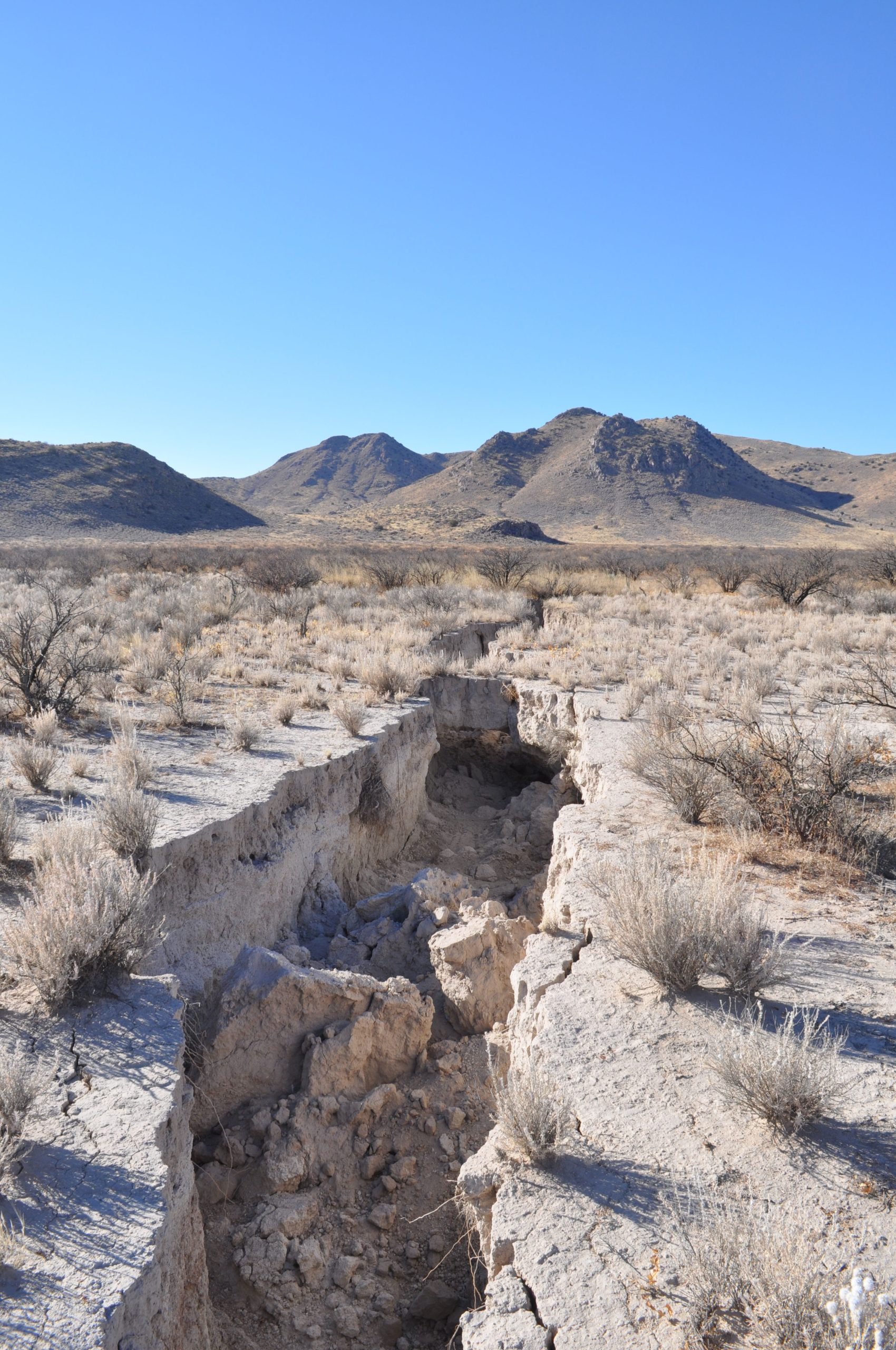
According to Conway, not only does this subsidence cause noticeable impacts on the surface like those fissures, it also creates a more pernicious problem. Once the sediment compacts, the change is permanent. Even if the groundwater is recharged, that storage space is lost forever. In a desert setting, every bit of water storage helps and a permanent loss of aquifer space makes sustainable water use even more difficult.
In the winter of 2022–2023, above-average precipitation and a buildup of a significant snowpack in the mountains gave officials and local residents hope that groundwater recharge might help stop the subsidence. Smilovsky found, however, that the hot, dry summer that followed mitigated any long-term benefits. While the subsidence rates did temporarily slow in the Willcox Basin, it was insufficient to stop the sinking.
Regulating for Recovery
Even so, there is hope that subsidence in the area could soon improve. One tool policymakers have to manage groundwater levels and prevent further subsidence is to declare a region an Active Management Area, or AMA. This year, they did just that after a ballot initiative in 2022 to do so failed. While the details of the regulation are still being worked out, AMAs have helped significantly in other Arizona basins experiencing subsidence.
“Especially in the Phoenix and Tucson areas, groundwater levels are recovering, and we’ve seen subsidence rates decrease quite a bit,” says Conway. “In the Tucson area, we’re not even seeing subsidence anymore with the groundwater management.”
But, the changes that have happened already in the Willcox Basin are locked in. “It needs to not be a desert” with such high demand for groundwater to significantly recover water levels, says Smilovsky. “I don’t think subsidence will ever stop, but an AMA might slow it down a bit.”
Reference: “Recharged but Not Recovered: InSAR Observations of Persistent Land Subsidence in Arizona’s Willcox Basin” by Danielle Smilovsky, 20 October 2025, Connects 2025.
Never miss a breakthrough: Join the SciTechDaily newsletter.
Follow us on Google and Google News.
5 Comments
When will they start regulating the water taken out of the Ogalalla reservoir? There’s a good chance that when that’s been drawn down enough it could happen all at once. Ordinary people are already finding they can’t afford to drill deep enough to reach water, but the Arab oil magnates who own large amounts of irrigated alfalfa fields use large amounts of water to grow alfalfa hay to send to countries in the middle east. Do those water rights still apply after that water has been mined to a point where it can’t recharge in the next 50 years? FYI the Ogalalla aquifer is huge, but has an extremely slow recharge rate. If that land starts to subside, the Nebraska grassland could become no more than a series of potholes (nearly all of Nebraska).
Does anyone think that continuing to sell American property to other countries so they can grow whatever they want on OUR lands and use OUR water then harvest those crops and send the crops back to their own countries. . . . is a good idea?
Big corporations rule, without any ethical or moral consideration for the planet or our children. They corrupt political representatives and make trillions out of war and killing . Weep for humanity…
Fort Huachuca is an Army installation alongside Sierra Vista, AZ., where I lived and owned 4 acres back in the mid 1990’s. It was beautiful! I loved living in the Sierra Vista area. When we built our home we shared a well with a neighbor with 4 acres of land as well. Life was so simple and our needs were very little as living in Cochise County, so rich in history, was magnificent.
Unfortunately, people from other parts of Arizona as well as dissatisfied Californians began to recognize the beauty as well. These individuals were more interested in building large, elegant homes on small lots. Then Walmart came along and I knew our private, simple and comfortable way of life was going to change but not for the good.
Obviously if those who wanted to make money (including local individuals) recognized the gold mine of Sierra Vista there would be much growth. I could see into the future even then that there would be a need for water beyond what the area could provide. In those days you could put articles in the local newspaper and express concerns about such matters which I did. I addressed those on planning boards to please consider the future of our town and do not allow it to become another ‘Tucson’ which lost it’s underground water use due to overgrowth and became dependent on the River supply. It was a sickening nightmare for a long time in Tucson!
Did Sierra Vista heed any of this? No!! Our beautiful town became a mecca for all kinds of business people who wanted to make money (not excluding local groups)! The town of Benson has faced ridicule through the years from trying to prevent the same nightmare as Sierra Vista where they are regularly tested by outsiders and some inside groups as well to ‘expand’. I pray they do not.
Looking at Sierra Vista today I do not recognize the beautiful town it once was. I do not object to certain growth to ensure buildings and homes remain safe and livable but it has become a place that is using more water than it can possibly expect nature to restore.
It all comes down to MONEY!! The Bible tells us ‘the LOVE of money is the root of all evil’. There is nothing wrong with wealth but when it is gained at the expense of wisdom concerning our rich heritage and our future generations’ quality of life, it is wrong!
I pray we are forgiven by the LORD, and that Arizonans will assume responsibility for tomorrow’s life as well as today’s life in Cochise County. Money does not equal happiness!
We were in the Wilcox basin in 2024 to visit the Chiricahuas and stayed at an AirBnB whose owner told us of the ground water being used up by Arab-owned farms growing alfalfa to export abroad (as Cheryl above similarly mentioned). We’re literally allowing our country’s precious resources to be STOLEN – sold to foreign interests by greedy corporate landowners who have no stake in the local economy. Exactly as Rossco above said: “Weep for humanity…” Same old story…