
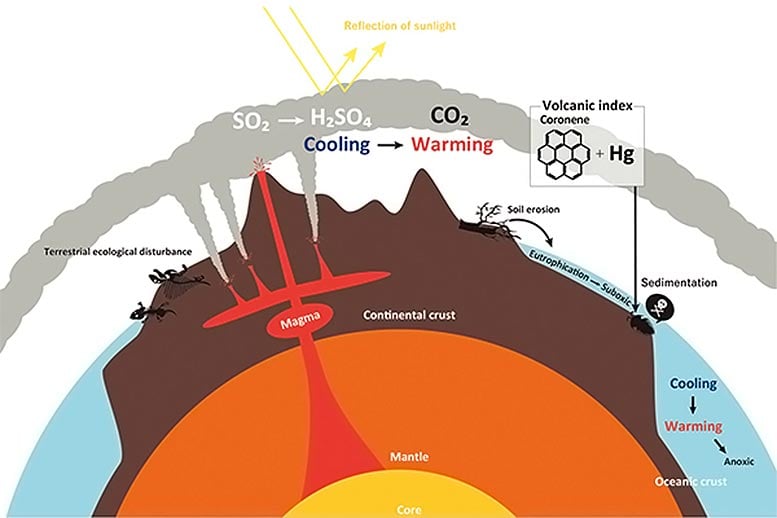
Researchers in Japan, the US, and China say they have found more concrete evidence of the volcanic cause of the largest mass extinction of life. Their research looked at two discrete eruption events: one that was previously unknown to researchers, and the other that resulted in large swaths of terrestrial and marine life going extinct.
There have been five mass extinctions since the divergent evolution of early animals 450 – 600 million years ago. The third was the largest one and is thought to have been triggered by the eruption of the Siberian Traps — a large region of volcanic rock known as a large igneous province. But the correlation between the eruption and mass extinction has not yet been clarified.
Sedimentary mercury enrichments, proxies for massive volcanic events, have been detected in dozens of sedimentary rocks from the end of the Permian. These rocks have been found deposited inland, in shallow seas, and central oceans, but uncertainty remains as to their interpretation. Mercury can be sourced from either direct atmospheric deposition from volcanic emissions or riverine inputs from terrestrial organic matter oxidation when land/plant devastation — referred to as terrestrial ecological disturbance — occurs.
The largest mass extinction occurred at the end of the Permian — roughly 252 million years ago. This mass extinction was marked by the transition from the divergence of the Paleozoic reptiles and marine animals like brachiopods and trilobites to Mesozoic dinosaurs and marine animals such as mollusks. Approximately 90% of species disappeared at the end of the Permian.
Current professor emeritus at Tohoku University, Kunio Kaiho led a team that looked into possible triggers of the largest mass extinction. They took sedimentary rock samples from two places — southern China and Italy — and analyzed the organic molecules and mercury (Hg) in them. They found two discrete coronene-Hg enrichments coinciding with the first terrestrial ecological disturbance and the following mass extinction in both areas.
“We believe this to be the product of large volcanic eruptions because the coronene anomaly was formed by abnormally high temperature combustion,” says professor Kaiho. “High temperature magma or asteroid/comet impacts can make such a coronene enrichment.
From the volcanic aspect, this could have occurred because of the higher temperature combustion of living and fossil organic matter from lava flows and horizontally intruded magma (sill) into the sedimentary coal and oil. The different magnitude of the two coronene-mercury enrichments shows that the terrestrial ecosystem was disrupted by smaller global environmental changes than the marine ecosystem. The duration between the two volcanic events is tens of thousands of years.”
Huge volcanic eruptions can produce sulfuric acid aerosols in the stratosphere and carbon dioxide in the atmosphere, which causes global climate changes. This rapid climate change is believed to be behind the loss of land and marine creatures as seen in Fig. 1.
Coronene is a highly condensed six-ring polycyclic aromatic hydrocarbon, which requires significantly higher energy to form as compared to smaller PAHs. Therefore, high temperature volcanic combustion can cause the coronene enrichments. This means that high temperature combustion of hydrocarbons in the sedimentary rocks by lateral intrusion of magmas formed CO2 and CH4 causing high pressure and eruption to induce global warming and the mass extinction. The coronene-mercury concentration provides initial evidence that volcanic hydrocarbon combustion contributed to the extinction by causing global warming.
Kaiho’s team is now studying other mass extinctions in the hopes of further understanding the cause and processes behind them.
Reference: “Pulsed volcanic combustion events coincident with the end-Permian terrestrial disturbance and the following global crisis” by Kunio Kaiho, Md. Aftabuzzaman, David S. Jones and Li Tian, 4 November 2020, Geology.
DOI: 10.1130/G48022.1
Never miss a breakthrough: Join the SciTechDaily newsletter.
Follow us on Google and Google News.
4 Comments
Not being critical of this paper since I’m not qualified to peer review. I do understand what’s being studied here. My problem is the usual words ‘could have’, ‘can’, and ‘uncertainty’ tells me concrete evidence may not exist. Especially when obtaining data from an event ‘previously unknown’. And now they’re moving on to other events? Just my opinion.
If you want absolute declarative sentences about the unknown, attend church.
According to this theory then there would have been many more mass extinctions than we have recorded.
#1 SORRY! But attend church🙄🙄😆😂😂🤣🤣.
#2 should not someone be bring up YELLOWSTONE? THAT Goes ya can kiss N America bye bye. And the rest of the world a heartbreaking misery for what… A good 5-10 years in which the human population will drop by.. and this is optimistic, 75 percent.