
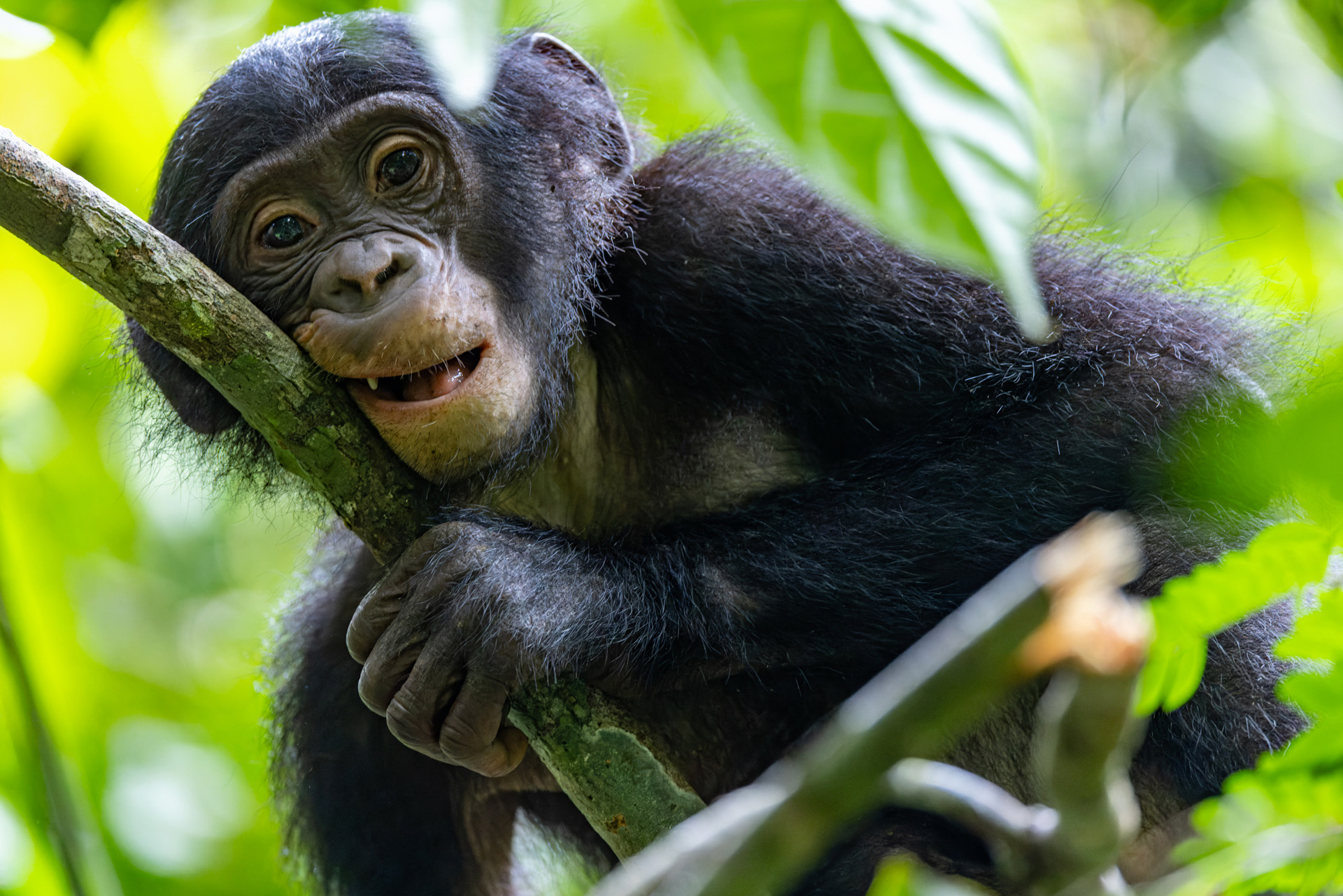
A twenty-year study in Congo’s largest protected park confirms that rangers play a crucial role in safeguarding endangered species.
Scientists have determined the population of bonobos in one of the largest pristine tropical forests, a region considered the world’s stronghold for this endangered species. Research spanning two decades, conducted by a team of 48 scientists, estimates that Salonga National Park in the Democratic Republic of Congo (DRC) is home to between 8,000 and 18,000 adult bonobos. While the population has remained stable since 2000, signs of potential decline have emerged. The study, led by researchers at the Max Planck Institute of Animal Behavior (MPI-AB), highlights specific factors that positively influence bonobo populations and provides actionable strategies for their conservation across their range.
“Estimating the population of bonobos in Congo’s largest protected park is a significant step in conservation efforts,” says Mattia Bessone, first author on the study. “We highlight the effectiveness of park rangers in preserving this endangered species, showing that Salonga’s success can serve as a model for other conservation projects.”
Africa’s largest pristine forest
Salonga National Park in the Democratic Republic of the Congo is Africa’s largest protected forest park, covering an area the size of Switzerland. It is pristine, primary forest renowned for being a sanctuary for the largest population of bonobos, a species of great ape found only in the Congo. In Salonga, bonobos are relatively safe from the deforestation and commercial hunting that threaten their existence elsewhere. But there’s a problem with Salonga’s title as the bonobo bastion of the world: the exact number residing in Salonga was never known due to the absence of any comprehensive study across the park’s vast range, which comprises 33,000 km² of protected forest and a 9,000 km² corridor of human settlements.
“There was an old number floating around of how many bonobos there were in Salonga,” says Barbara Fruth who led the IUCN red list assessment of the species in 2016, “but this was an assumption based on surveys covering less than twenty percent of the entire park.”
But Fruth and other scientists recognized that Salonga offered a key to unlock much-needed answers for bonobo conservation.
“The unique thing about Salonga is that it is the only place where surveys have been repeated in the same areas,” says Fruth, a group leader at MPI-AB. “In this vast country, only Salonga offers the opportunity to model trends and assess whether bonobos are declining in Congo.”
Compiling twenty years of data
Mattia Bessone, a postdoctoral researcher with Fruth, led the effort to combine all surveys conducted in Salonga between 2000 to 2018, amounting to 13 surveys by 48 scientists. Bessone faced challenges due to the varying methods used to count bonobos, ranging from traditional nest counting to modern motion-triggered cameras. He used statistical techniques to reconcile these differences and provide estimates for bonobo populations across the entire range of Salonga, including areas previously unstudied. This work represents the largest temporal comparison of a bonobo population to date, underscoring its significant geographical scope.
The results provide several key insights that can inform the conservation and management of bonobos.
What bonobos need to thrive
The study estimates that 8,000–18,000 adult bonobos live in Salonga, a result that “is not that surprising,” says Bessone, as it aligns with past extrapolations from smaller surveys. The population number also appears to have remained stable since 2000, but the scientists discovered a concerning downward trend in both density and distribution, though this is not statistically significant.
“What this tells us is that bonobos are not in immediate danger, but we need to stay vigilant and to keep investing in conservation efforts if we are to ensure their survival,” says Bessone.
The study draws attention to specific factors that could guide where future conservation efforts are focused.
Primary forest cover is the main predictor for bonobo occurrence, while proximity to villages negatively impacts their presence. But not all humans keep bonobos away. Bonobos occur more often near park ranger posts, highlighting the protective effect of law enforcement.
“We can’t say what the rangers do specifically that leads to this effect,” says Bessone. “It could be that rangers are a possible deterrent to poachers. Whatever the reason, it is clear that just the presence of law enforcement has a positive effect on bonobos.”
Another bright spot emerged in the park’s south side, where villages from a traditional minority have been living since before Salonga National Park was established in 1970. “In these villages, there is a cultural taboo that prevents hunting of bonobo,” says Bessone. “It could be this that creates the positive effect they have on bonobo abundance.”
Through long-term monitoring in one of the most pristine places in Africa, the study’s implications are significant.
“The biggest threats to bonobos are deforestation and commercial hunting, and our findings show that preserving forest and investing in law enforcement has concrete benefits for bonobo conservation,” says Fruth. “We hope this motivates national and international conservation authorities to invest more into Salonga and other protected areas to ensure that bonobos remain part of our world far into the future.”
Reference: “Bonobo (Pan paniscus) Density and Distribution in Central Africa’s Largest Rainforest Reserve: Long-term Survey Data Show Pitfalls in Methodological Approaches and Call for Vigilance” by Mattia Bessone, Hjalmar S. Kühl, Ilka Herbinger, Gottfried Hohmann, Kouamé Paul N’Goran, Papy Asanzi, Stephen Blake, Michel Basele, Martin Bofeko, Nono Bondjengo, Pitshou Wangongo Bondo, Rigobert Booto, Pedro Barros da Costa, Violette Dérozier, Maurice Emetshu, Ernest Dadis Bush Fotsing, Falk Grossmann, Patrick Guislain, John Hart, Bernard Beka Ikembelo, Mpongo Dieumerci Iyomi, Bila-Isia Inogwabini, Oke Intamba, Iyomi Bernard Iyatshi, Pierre Kafando, Mbangi Augustin Kambere, Jean-Léon Kambale Katembo, Janvier Katembo Kukumanga, Innocent Liengola, Fiona Maisels, Florence Maliva, Maurice Manala, Samy Matungila, Menard Mbende, Jean A. D. Mbenga, Dissondet Baudelaire Moundzoho, Pamus Paluku Musenzi, Steven Mwanduko, Pascal Naky, Mozart Ngomo, Pele M. Nkumu, Robert Ratsina, Gay Edwards Reinartz, Tenekwetche Sop, Samantha Strindberg, Ashley Vosper, Loving Kako Wanzalire Musubaho and Barbara Fruth, 2 December 2024, International Journal of Primatology.
DOI: 10.1007/s10764-024-00468-w
Never miss a breakthrough: Join the SciTechDaily newsletter.
Follow us on Google and Google News.