
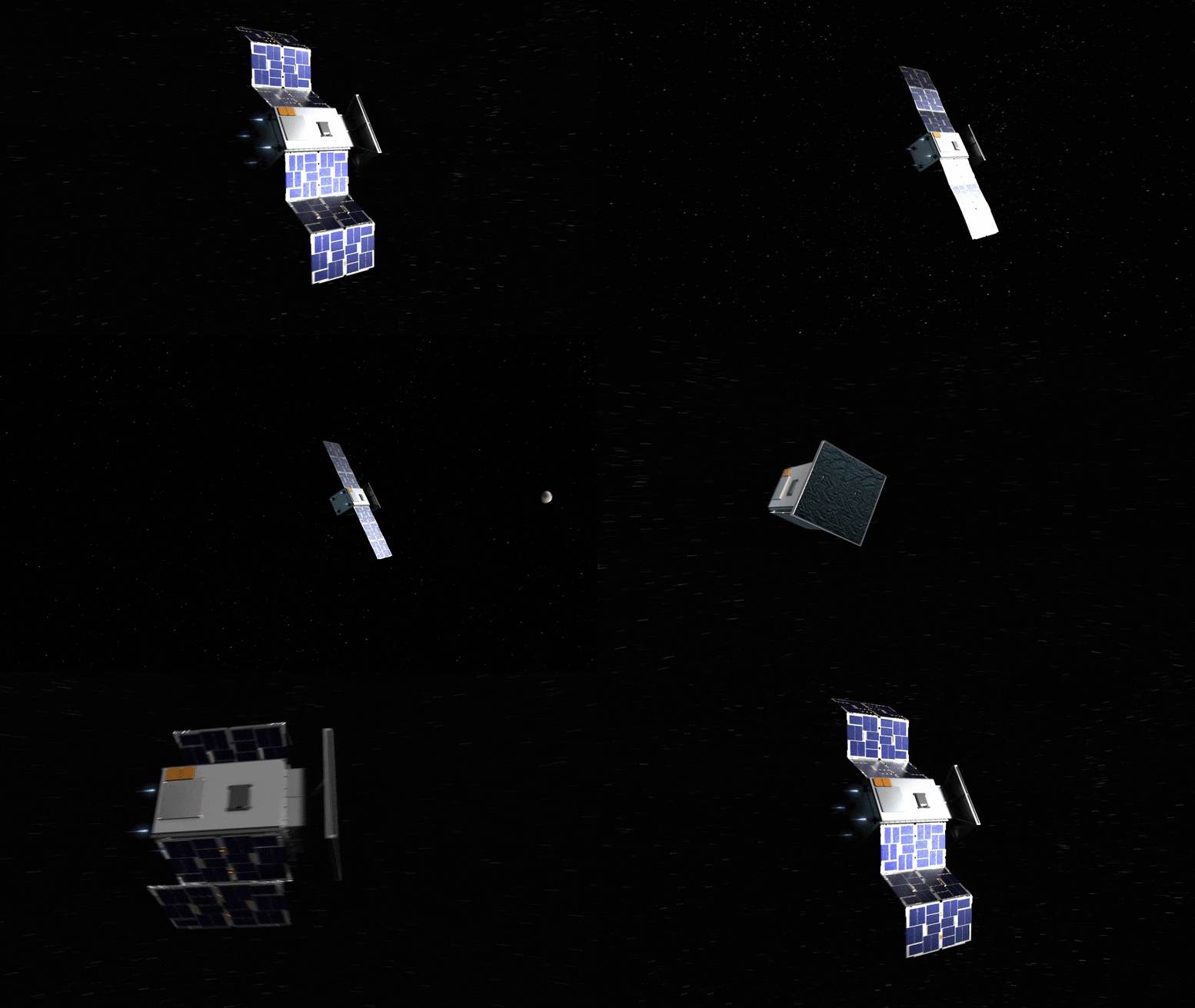
Following successful deployment and start of spacecraft commissioning on July 4, the Cislunar Autonomous Positioning System Technology Operations and Navigation Experiment (CAPSTONE) spacecraft experienced communications issues while in contact with the Deep Space Network (DSN). The spacecraft team currently is working to understand the cause and re-establish contact. The team has good trajectory data for the spacecraft based on the first full and second partial ground station pass with the Deep Space Network. If needed, the mission has enough fuel to delay the initial post-separation trajectory correction maneuver for several days.
According to Advanced Space, who is flying the spacecraft on behalf of NASA, the operations team is actively working on this issue with the Deep Space Network and determining the best next steps:
- As a result of this anomaly, the first trajectory correction maneuver – originally scheduled for the morning of July 5th – has been delayed. This maneuver is designed to more accurately target the transfer orbit to the Moon. This maneuver is the first in a series that are designed to make small corrections to increase the accuracy of the transfer orbit to the Moon. The spacecraft remains on the overall intended ballistic lunar transfer (BLT) while this targeting maneuver is delayed.
- One of the benefits of the BLT, the designed trajectory, is its robustness to delays such as this.
- The mission transfer approach and system margins provide time to resolve and understand this anomaly before proceeding with the first trajectory correction maneuver.
- At the time of publication, the CAPSTONE spacecraft is currently approximately 285,000 km (175,000 miles) from Earth (~8 times GEO) on its planned ballistic transfer orbit to the Moon.
CAPSTONE will fly in a unique, halo-shaped orbit around the Moon before the orbit is used by Gateway, NASA’s future lunar outpost for our Artemis program. The CAPSTONE mission, short for Cislunar Autonomous Positioning System Technology Operations and Navigation Experiment, will validate navigation technologies and orbital dynamics for Gateway, which will one day serve as a staging area for missions to the Moon and potentially as a jumping point for missions to Mars.
Following CAPSTONE’s initial deployment on July 4, the spacecraft was able to successfully deploy solar arrays, stabilize, and began charging its onboard battery. CAPSTONE’s propulsion system was also readied for the spacecraft’s first maneuver. CAPSTONE made initial contact with the DSN ground station in Madrid, Spain, followed by a partial contact with the Goldstone ground station in California. From these contacts, mission operators have been able to determine CAPSTONE’s approximate position and velocity in space.
According to Advanced Space, the spacecraft was commissioning nominally for the first 11 hours:
- Spacecraft was deployed successfully from the launch vehicle.
- Spacecraft successfully deployed solar arrays, achieved three-axis stabilization, and entered a battery charging mode.
- Spacecraft successfully executed Earth-pointing mode, communicated with DSN stations in Madrid Spain and the operations team began check-out and commissioning of the spacecraft.
- The operations team was able to determine spacecraft state (position and velocity) and design initial trajectory correction maneuver.
- Propulsion system was commissioned and prepared for the first trajectory correction maneuver.
As a result of the communications issues, CAPSTONE’s first trajectory correction maneuver – originally scheduled for the morning of July 5 – has been delayed. This maneuver is the first in a series that are designed to make small corrections to increase the accuracy of the transfer orbit to the Moon, and the spacecraft remains on the overall intended ballistic lunar transfer while awaiting this trajectory correction.
Teams are working to resolve CAPSTONE’s communications issues.
Never miss a breakthrough: Join the SciTechDaily newsletter.
Follow us on Google and Google News.