
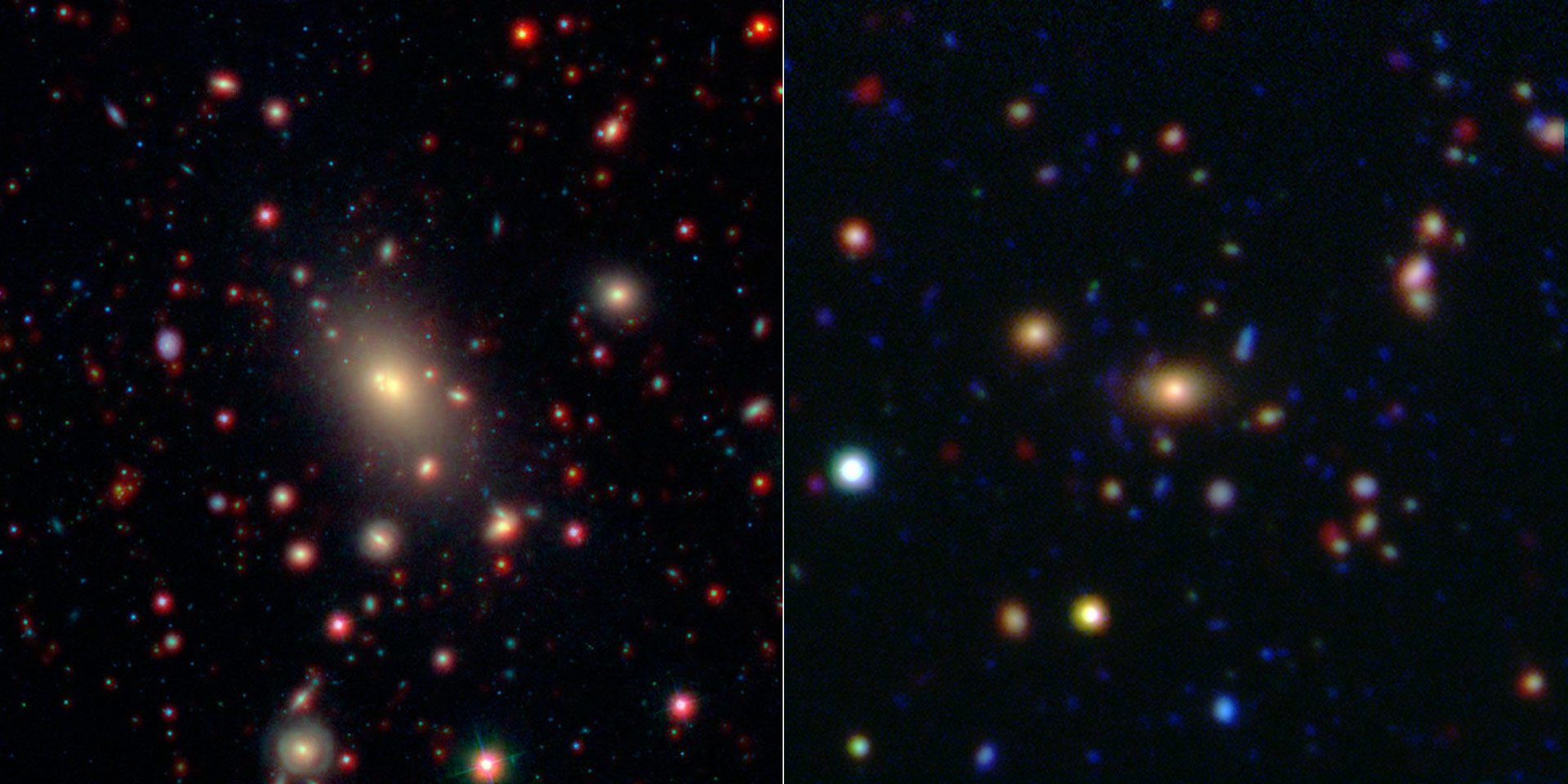
Using data from Spitzer and WISE, scientists reveal in a new study that massive galaxies appear to slow their growth over time, feeding less and less off neighboring galaxies.
Our universe is filled with gobs of galaxies, bound together by gravity into larger families called clusters. Lying at the heart of most clusters is a monster galaxy thought to grow in size by merging with neighboring galaxies, a process astronomers call galactic cannibalism.
New research from NASA’s Spitzer Space Telescope and Wide-field Infrared Survey Explorer (WISE) is showing that, contrary to previous theories, these gargantuan galaxies appear to slow their growth over time, feeding less and less off neighboring galaxies.
“We’ve found that these massive galaxies may have started a diet in the last 5 billion years, and therefore have not gained much weight lately,” said Yen-Ting Lin of the Academia Sinica in Taipei, Taiwan, lead author of a study published in the Astrophysical Journal.
Peter Eisenhardt, a co-author from NASA’s Jet Propulsion Laboratory in Pasadena, California, said, “WISE and Spitzer are letting us see that there is a lot we do understand — but also a lot we don’t understand — about the mass of the most massive galaxies.” Eisenhardt identified the sample of galaxy clusters studied by Spitzer, and is the project scientist for WISE.
The new findings will help researchers understand how galaxy clusters — among the most massive structures in our universe — form and evolve.
Galaxy clusters are made up of thousands of galaxies, gathered around their biggest member, what astronomers call the brightest cluster galaxy, or BCG. BCGs can be up to dozens of times the mass of galaxies like our own Milky Way. They plump up in size by cannibalizing other galaxies, as well as assimilating stars that are funneled into the middle of a growing cluster.
To monitor how this process works, the astronomers surveyed nearly 300 galaxy clusters spanning 9 billion years of cosmic time. The farthest cluster dates back to a time when the universe was 4.3 billion years old, and the closest, when the universe was much older, 13 billion years old (our universe is presently 13.8 billion years old).
“You can’t watch a galaxy grow, so we took a population census,” said Lin. “Our new approach allows us to connect the average properties of clusters we observe in the relatively recent past with ones we observe further back in the history of the universe.”
Spitzer and WISE are both infrared telescopes, but they have unique characteristics that complement each other in studies like these. For instance, Spitzer can see more detail than WISE, which enables it to capture the farthest clusters best. On the other hand, WISE, an infrared all-sky survey, is better at capturing images of nearby clusters, thanks to its larger field of view. Spitzer is still up and observing; WISE went into hibernation in 2011 after successfully scanning the sky twice.
The findings showed that BCG growth proceeded along rates predicted by theories until 5 billion years ago, or a time when the universe was about 8 billion years old. After that time, it appears the galaxies, for the most part, stopped munching on other galaxies around them.
The scientists are uncertain about the cause of BCGs’ diminished appetites, but the results suggest current models need tinkering.
“BCGs are a bit like blue whales — both are gigantic and very rare in number. Our census of the population of BCGs is in a way similar to measuring how the whales gain their weight as they age. In our case, the whales aren’t gaining as much weight as we thought. Our theories aren’t matching what we observed, leading us to new questions,” said Lin.
Another possible explanation is that the surveys are missing large numbers of stars in the more mature clusters. Clusters can be violent environments, where stars are stripped from colliding galaxies and flung into space. If the recent observations are not detecting those stars, it’s possible that the enormous galaxies are, in fact, continuing to bulk up.
Future studies from Lin and others should reveal more about the feeding habits of one of nature’s largest galactic species.
JPL manages the Spitzer Space Telescope mission for NASA’s Science Mission Directorate, Washington. Science operations are conducted at the Spitzer Science Center at the California Institute of Technology in Pasadena. Data are archived at the Infrared Science Archive housed at the Infrared Processing and Analysis Center at Caltech. Caltech manages JPL for NASA. For more information about Spitzer, visit http://spitzer.caltech.edu and http://www.nasa.gov/spitzer.
JPL managed and operated WISE for NASA’s Science Mission Directorate. Edward Wright is the principal investigator and is at UCLA. The mission was selected competitively under NASA’s Explorers Program managed by the agency’s Goddard Space Flight Center in Greenbelt, Maryland. The science instrument was built by the Space Dynamics Laboratory in Logan, Utah. The spacecraft was built by Ball Aerospace & Technologies Corp. in Boulder, Colorado. Science operations and data processing take place at the Infrared Processing and Analysis Center at the California Institute of Technology in Pasadena. Caltech manages JPL for NASA. More information is online at http://www.nasa.gov/wise and http://wise.astro.ucla.edu and http://jpl.nasa.gov/wise.
Reference: “The Stellar Mass Growth of Brightest Cluster Galaxies in the IRAC Shallow Cluster Survey” by Yen-Ting Lin, Mark Brodwin, Anthony H. Gonzalez, Paul Bode, Peter R. M. Eisenhardt, S. A. Stanford and Alexey Vikhlinin, 17 June 2013, The Astrophysical Journal.
DOI: 10.1088/0004-637X/771/1/61
arXiv:1305.5254
Never miss a breakthrough: Join the SciTechDaily newsletter.
Follow us on Google and Google News.
1 Comment
The good news is that, concomitant with the development of clusters, is the development of galactic VOIDS. Voids are empty regions of space that have experienced an outflow of galaxies. Think of a corporate parking lot–the lot is almost filled to capacity in the morning, but by 6 pm, it’s mostly empty, and as the evening wears on it’s completely empty. Why are voids exciting? It minimizes the chances of colliding with other galaxies, as we sail through Space. It’s like driving on an empty lane, the less traffic, the less chances of collisions occurring. If you look at a diagram of “The Universe within 1 Billion light years”, you’ll see that it looks somewhat like a soccer ball. That is, the voids are orthogonal.