
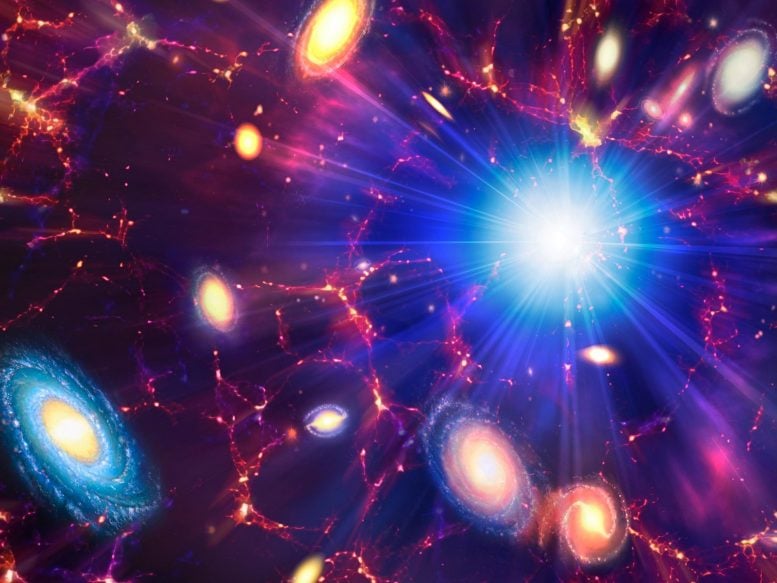
Analysis combines Dark Energy Survey and South Pole Telescope data to understand evolution of universe.
Sometimes to know what the matter is, you have to find it first.
When the universe began, matter was flung outward and gradually formed the planets, stars, and galaxies that we know and love today. By carefully assembling a map of that matter today, scientists can try to understand the forces that shaped the evolution of the universe.
A group of scientists, including several with the University of Chicago and Fermi National Accelerator Laboratory, have released one of the most precise measurements ever made of how matter is distributed across the universe today.
Combining data from two major telescope surveys of the universe, the Dark Energy Survey and the South Pole Telescope, the analysis involved more than 150 researchers and is published as a set of three articles on January 31 in the journal Physical Review D.
Among other findings, the analysis indicates that matter is not as “clumpy” as we would expect based on our current best model of the universe, which adds to a body of evidence that there may be something missing from our existing standard model of the universe.
Cooling and Clumps
After the Big Bang created all the matter in the universe in a very hot, intense few moments about 13 billion years ago, this matter has been spreading outward, cooling and clumping as it goes. Scientists are very interested in tracing the path of this matter; by seeing where all the matter ended up, they can try to recreate what happened and what forces would have had to have been in play.
The first step is collecting enormous amounts of data with telescopes.
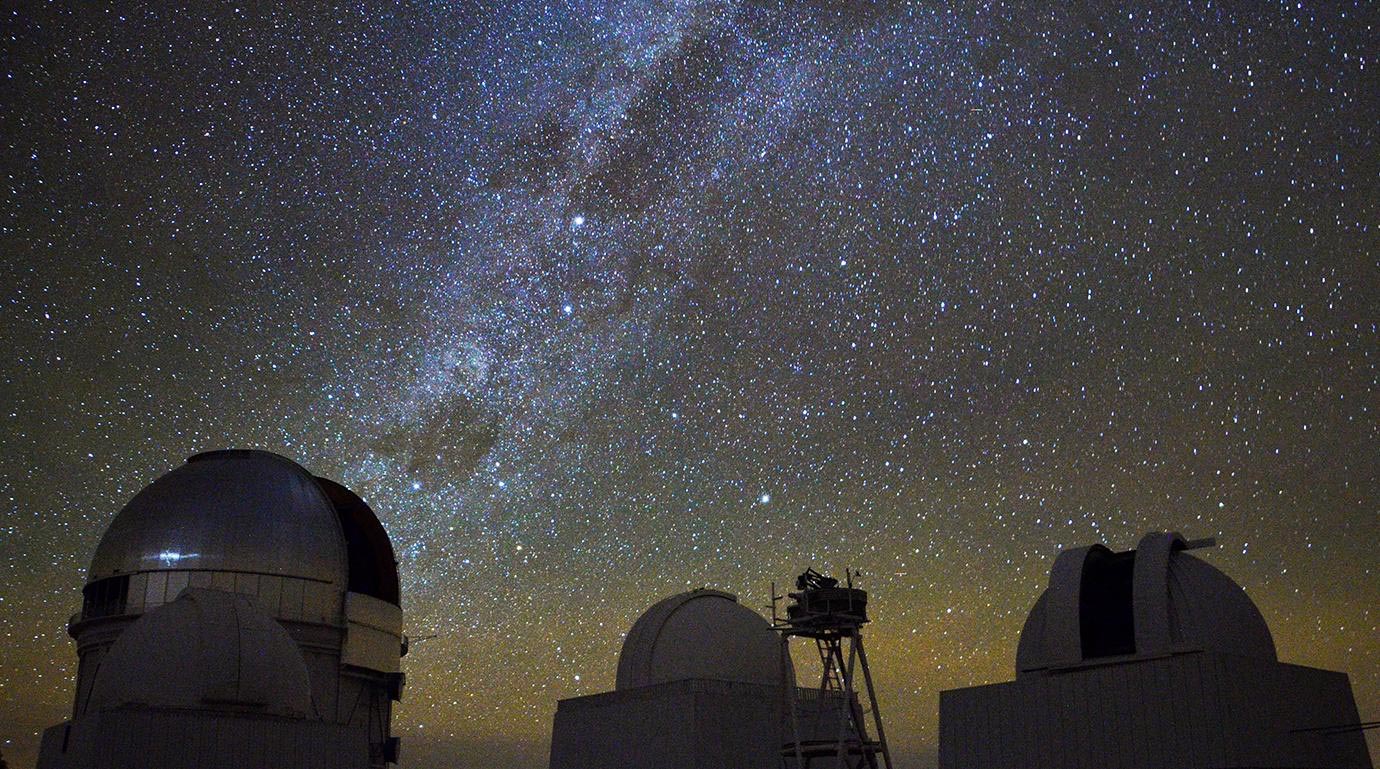
In this study, scientists combined data from two very different telescope surveys: The Dark Energy Survey, which surveyed the sky over six years from a mountaintop in Chile, and the South Pole Telescope, which looks for the faint traces of radiation that are still traveling across the sky from the first few moments of the universe.
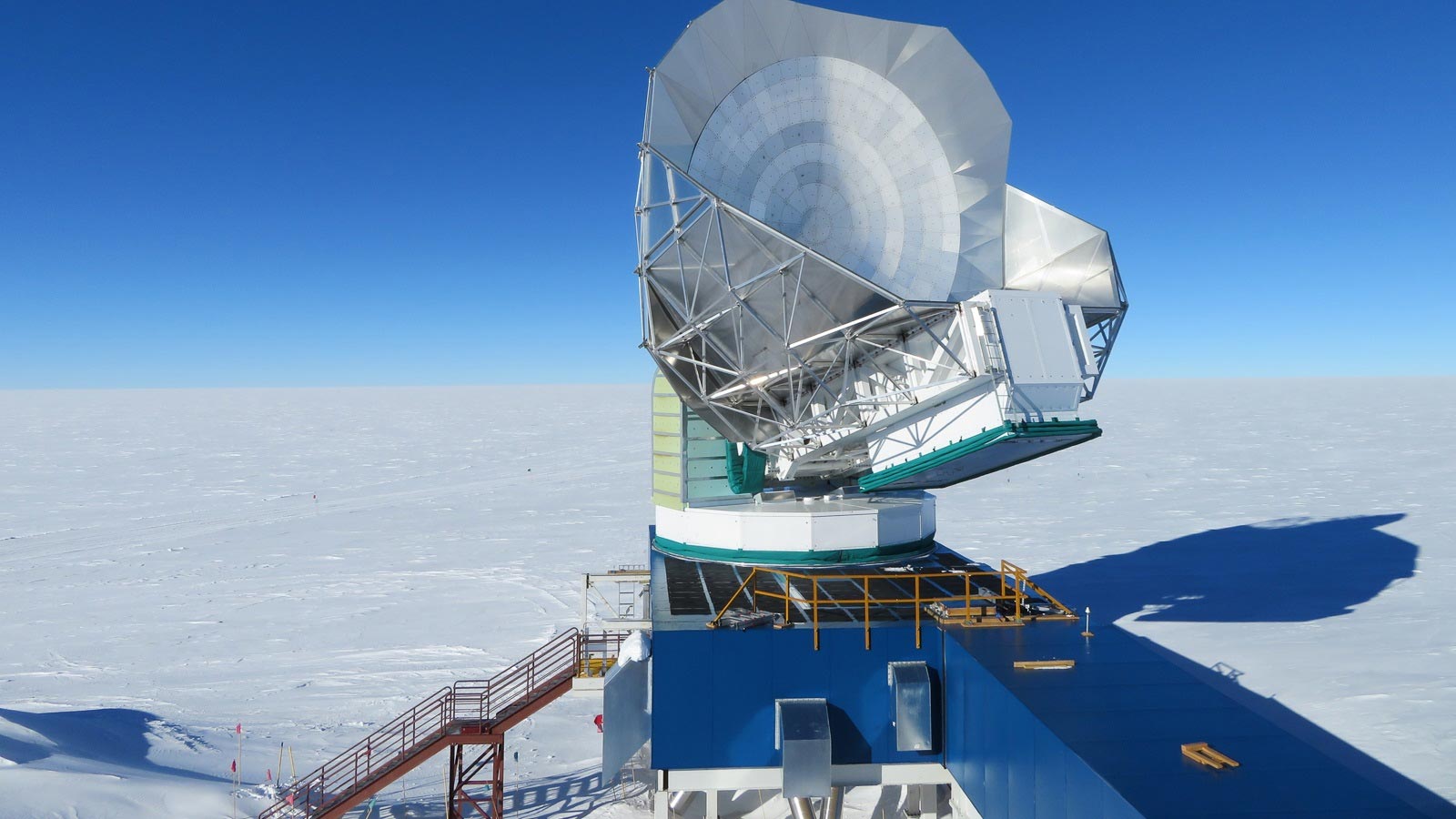
Combining two different methods of looking at the sky reduces the chance that the results are thrown off by an error in one of the forms of measurement. “It functions like a cross-check, so it becomes a much more robust measurement than if you just used one or the other,” said UChicago astrophysicist Chihway Chang, one of the lead authors of the studies.
In both cases, the analysis looked at a phenomenon called gravitational lensing. As light travels across the universe, it can be slightly bent as it passes objects with lots of gravity, like galaxies.
This method catches both regular matter and dark matter—the mysterious form of matter that we have only detected due to its effects on regular matter—because both regular and dark matter exert gravity.
By rigorously analyzing these two sets of data, the scientists could infer where all the matter ended up in the universe. It is more precise than previous measurements—that is, it narrows down the possibilities for where this matter wound up—compared to previous analyses, the authors said.

Signs of a Flaw in the Standard Model
The majority of the results fit perfectly with the currently accepted best theory of the universe.
But there are also signs of a crack—one that has been suggested in the past by other analyses, too.
“It seems like there are slightly less fluctuations in the current universe, than we would predict assuming our standard cosmological model anchored to the early universe,” said analysis coauthor and University of Hawaii astrophysicist Eric Baxter (UChicago PhD’14).
That is, if you make a model incorporating all the currently accepted physical laws, then take the readings from the beginning of the universe and extrapolate it forward through time, the results look slightly different from what we actually measure around us today.
“There’s a lot of new things you can do when you combine these different angles of looking at the universe.”
Chihway Chang, UChicago astrophysicist
Specifically, today’s readings find the universe is less “clumpy”—clustering in certain areas rather than evenly spread out—than the model would predict.
If other studies continue to find the same results, scientists say, it may mean there is something missing from our existing model of the universe, but the results are not yet to the statistical level that scientists consider to be ironclad. That will take further study.
However, the analysis is a landmark as it yielded useful information from two very different telescope surveys. This is a much-anticipated strategy for the future of astrophysics, as more large telescopes come online in the next decades, but few had actually been carried out yet.
“I think this exercise showed both the challenges and benefits of doing these kinds of analyses,” Chang said. “There’s a lot of new things you can do when you combine these different angles of looking at the universe.”
University of Chicago Kavli Associate Fellow Yuuki Omori was also a lead co-author for the papers. The full studies and authorships, “Joint analysis of Dark Energy Survey Year 3 data and CMB lensing from SPT and Planck,” can be found in three papers selected as the editor’s suggestion at Physical Review D.
References:
“Joint analysis of Dark Energy Survey Year 3 data and CMB lensing from SPT and Planck. I. Construction of CMB lensing maps and modeling choices” by Y. Omori et al. (DES and SPT Collaborations), 31 January 2023, Physical Review D.
DOI: 10.1103/PhysRevD.107.023529
“Joint analysis of Dark Energy Survey Year 3 data and CMB lensing from SPT and Planck. II. Cross-correlation measurements and cosmological constraints” by C. Chang et al. (DES & SPT Collaborations), 31 January 2023, Physical Review D.
DOI: 10.1103/PhysRevD.107.023530
“Joint analysis of Dark Energy Survey Year 3 data and CMB lensing from SPT and Planck. III. Combined cosmological constraints” by T. M. C. Abbott et al. (DES and SPT Collaborations), 31 January 2023, Physical Review D.
DOI: 10.1103/PhysRevD.107.023531
The South Pole Telescope is primarily funded by the National Science Foundation and the Department of Energy and is operated by a collaboration led by the University of Chicago. The Dark Energy Survey was an international collaboration coordinated through Fermi National Accelerator Laboratory and funded by the Department of Energy, the National Science Foundation, and many institutions around the world.
Never miss a breakthrough: Join the SciTechDaily newsletter.
Follow us on Google and Google News.
12 Comments
The BigBang is the perfect explosion with chaos within.Without dark matter or energy it could not sustain itself and would just collapse back in on itself.Perhaps dark energy and dark matter maybe gravitational pressure which keeps the Big Bang continuing creating more space which will never cease hence the infinite expanding universe.
The early universe was not an “explosion” since the universe is much too uniform for that.
More fantasy from the Cosmos people. Go back to your dark rooms and dream up some more bull for more grants.
Complain about progress and make up conspiracy theory all you want, nothing is stopping you from being irrelevant.
All matter in the universe? While we do not even know how big the universe is, only the portion we can see. We don’t even know there is dark matter. All we know is that there is gravity that seems to be clumping regular matter. The press is starving for headlines.
We know for sure there is dark matter, from many types of independent observations. That’s why it is a key part of modern cosmology!
“. . . one of the most accurate measurements to date of the universe’s matter distribution.” How can anyone measure matter distribution when most of the matter is hundreds, thousands, millions, or more light years from us? It makes no sense to say we can measure where the matter is now!
We are just dumb hairless apes trying to describe things. You cavemen are funny. Humans really don’t know a thing yet.
I love the cascade of objections to articles like this, it gives me hope that not all those who access the web are gullible fools.
Well done my skeptical friends!
“Accurate New Map of the Universe”?
How accurate can something be when most of it is sheer guesswork and make-believe? Not a bit of proof exists for either dark energy or dark matter.
Ignoring the effects of real, observable, measurable, galactic scale plasmas, magnetic and electric fields, and claiming the effects are from matter and energy that can’t be seen or detected, is so like invoking magic or other superstitions to explain the Universe.
Mixing a handful of actual data with a mountain of make-believe doesn’t prove anything beyond the fact that some “researchers” let their imaginations run away with them.
It is accurate because it is based on data. Check with the nearest encyclopedia.
And your unreferenced complaint, which isn’t very imaginative though all made up, says nothing on that fact.
The low clumpiness result is far from significant at some 1.4 sigma and has decreased from some 2 sigma of earlier results. In that sense the standard cosmology is even more solid now.