
Close Menu
    Facebook X (Twitter) Instagram
    SciTechDaily
    • Biology
    • Chemistry
    • Earth
    • Health
    • Physics
    • Science
    • Space
    • Technology
    Facebook X (Twitter) Pinterest YouTube RSS
    SciTechDaily
    Home»Space»Cosmic Fireworks: Celebrating Independence Day With Webb’s Star Formation Spectacle
    Space

    Cosmic Fireworks: Celebrating Independence Day With Webb’s Star Formation Spectacle

    By Space Telescope Science InstituteJuly 4, 2024No Comments6 Mins Read
    Facebook Twitter Pinterest Telegram LinkedIn WhatsApp Email Reddit
    Share
    Facebook Twitter LinkedIn Pinterest Telegram Email Reddit
    Celestial Fireworks Around Forming Star
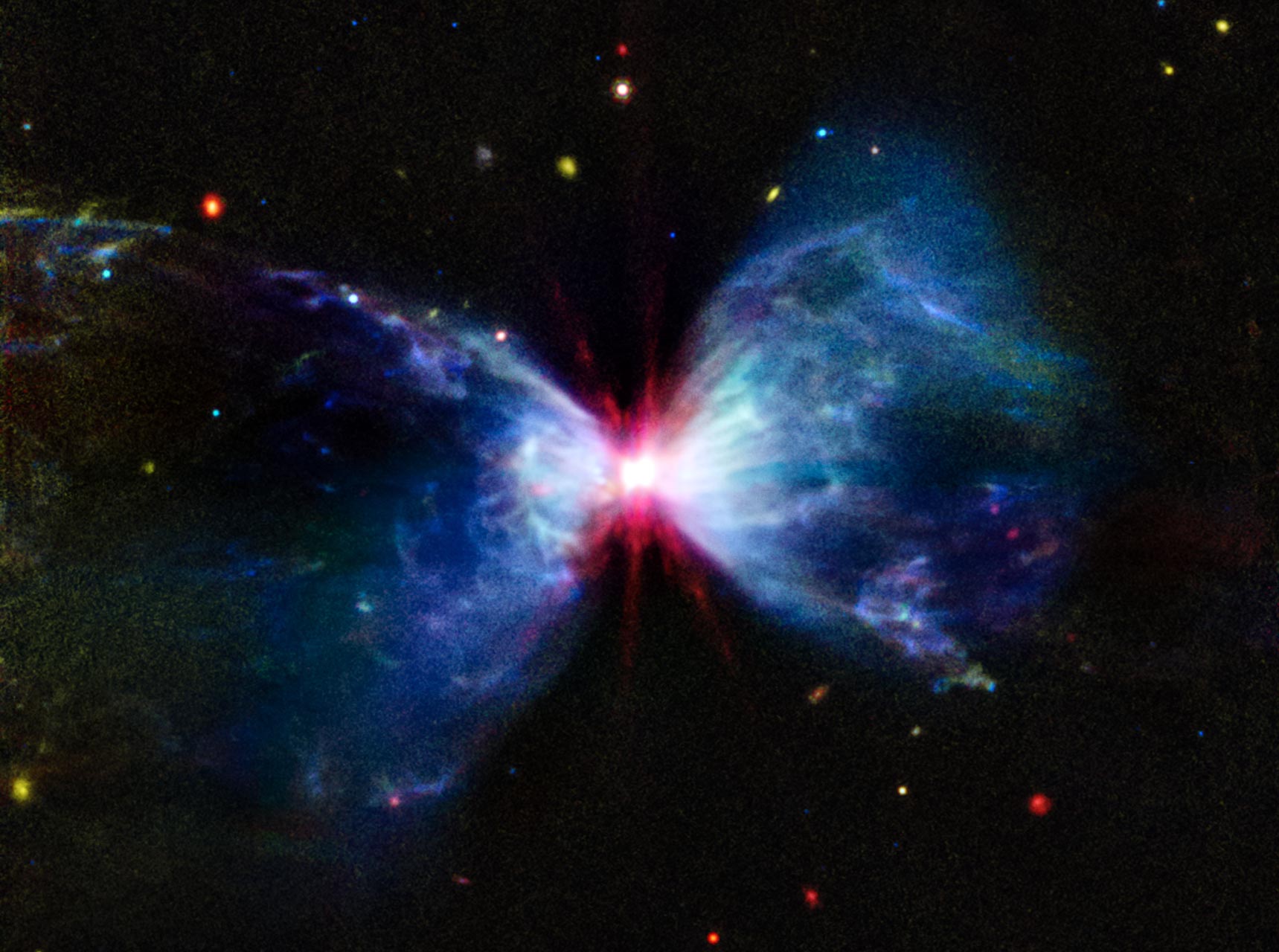
    This new image from NASA’s James Webb Space Telescope showcases a young protostar in the process of forming within a fiery hourglass-shaped molecular cloud. Captured using the MIRI instrument, this scene reveals dynamic outflows and bright regions caused by interactions with surrounding gases and dust. Credit: NASA, ESA, CSA, STScI

    Webb’s latest mid-infrared image reveals a protostar’s formation, highlighted by color variations that detail its dynamic interactions with the surrounding molecular cloud.

    NASA’s James Webb Space Telescope is celebrating U.S. Independence Day with an observation of the protostar, hidden inside the dark molecular cloud L1527 in mid-infrared light, as it evolves. This vibrant new view highlights the behavior of this young object and traces the different concentrations of gas and dust surrounding the protostar.

    L1527 and Protostar (Webb MIRI Image)
    L1527, shown in this image from NASA’s James Webb Space Telescope’s MIRI (Mid-Infrared Instrument), is a molecular cloud that harbors a protostar. It resides about 460 light-years from Earth in the constellation Taurus. The more diffuse blue light and the filamentary structures in the image come from organic compounds known as polycyclic aromatic hydrocarbons (PAHs), while the red at the center of this image is an energized, thick layer of gases and dust that surrounds the protostar. The region in between, which shows up in white, is a mixture of PAHs, ionized gas, and other molecules. Credit: NASA, ESA, CSA, STScI

    Webb Space Telescope Captures Celestial Fireworks Around Forming Star

    The cosmos seems to come alive with a crackling explosion of pyrotechnics in this new image from NASA’s James Webb Space Telescope. Taken with Webb’s MIRI (Mid-Infrared Instrument), this fiery hourglass marks the scene of a very young object in the process of becoming a star. A central protostar grows in the neck of the hourglass, accumulating material from a thin protoplanetary disk, seen edge-on as a dark line.

    Insights Into Protostellar Development

    The protostar, a relatively young object of about 100,000 years, is still surrounded by its parent molecular cloud, or large region of gas and dust. Webb’s previous observation of L1527, with NIRCam (Near-Infrared Camera), allowed us to peer into this region and revealed this molecular cloud and protostar in opaque, vibrant colors.

    Dynamic Outflows and Molecular Impact

    Both NIRCam and MIRI show the effects of outflows, which are emitted in opposite directions along the protostar’s rotation axis as the object consumes gas and dust from the surrounding cloud. These outflows take the form of bow shocks to the surrounding molecular cloud, which appear as filamentary structures throughout. They are also responsible for carving the bright hourglass structure within the molecular cloud as they energize, or excite, the surrounding matter and cause the regions above and below it to glow. This creates an effect reminiscent of fireworks brightening a cloudy night sky. Unlike NIRCam, however, which mostly shows the light that is reflected off dust, MIRI provides a look into how these outflows affect the region’s thickest dust and gases.

    The areas colored here in blue, which encompass most of the hourglass, show mostly carbonaceous molecules known as polycyclic aromatic hydrocarbons. The protostar itself and the dense blanket of dust and a mixture of gases that surround it are represented in red. The sparkler-like red extensions are an artifact of the telescope’s optics (see image below).

    Webb’s Diffraction Spikes Thumb
    This illustration demonstrates the science behind Webb’s diffraction spike patterns, showing how diffraction spikes happen, the influence of the primary mirror and struts, and the contributions of each to Webb’s diffraction spikes. Credit: NASA, ESA, CSA, Leah Hustak (STScI), Joseph DePasquale (STScI)

    In between, MIRI reveals a white region directly above and below the protostar, which doesn’t show as strongly in the NIRCam view. This region is a mixture of hydrocarbons, ionized neon, and thick dust, which shows that the protostar propels this matter quite far away from it as it messily consumes material from its disk.

    Evolving Protostar and Its Future

    As the protostar continues to age and release energetic jets, it’ll consume, destroy, and push away much of this molecular cloud, and many of the structures we see here will begin to fade. Eventually, once it finishes gathering mass, this impressive display will end, and the star itself will become more apparent, even to our visible-light telescopes.

    L1527 and Protostar (Webb Compass MIRI Image)
    This image of the nebula L1527, captured by Webb’s Mid-Infrared Instrument (MIRI), shows compass arrows, a scale bar, and a color key for reference.
    The north and east compass arrows show the orientation of the image on the sky. Note that the relationship between north and east on the sky (as seen from below) is flipped relative to direction arrows on a map of the ground (as seen from above).
    The scale bar is labeled in astronomical units (AU), which is the average distance between Earth and the Sun, or 93 million miles (150 million kilometers).
    This image shows invisible mid-infrared wavelengths of light that have been translated into visible-light colors. The color key shows which MIRI filters were used when collecting the light. The color of each filter name is the visible light color used to represent the infrared light that passes through that filter.
    Credit: NASA, ESA, CSA, STScI

    The combination of analyses from both the near-infrared and mid-infrared views reveals the overall behavior of this system, including how the central protostar is affecting the surrounding region. Other stars in Taurus, the star-forming region where L1527 resides, are forming just like this, which could lead to other molecular clouds being disrupted and either preventing new stars from forming or catalyzing their development.

    The James Webb Space Telescope (JWST), often hailed as the successor to the Hubble Space Telescope, is a large, space-based observatory optimized for infrared wavelengths. This enables it to look further back in time than any other telescope, observing the formation of the first galaxies and stars. Launched on December 25, 2021, JWST provides unprecedented resolution and sensitivity, allowing astronomers to study every phase of cosmic history across our universe. Its key capabilities include examining the atmospheres of exoplanets, observing distant galaxies, and exploring star formation in detail.

    Never miss a breakthrough: Join the SciTechDaily newsletter.
    Follow us on Google and Google News.

    Astronomy James Webb Space Telescope Popular Space Telescope Science Institute
    Share. Facebook Twitter Pinterest LinkedIn Email Reddit

    Related Articles

    NASA’s New $10 Billion Webb Space Telescope Will Reveal the Supermassive Black Hole at the Heart of the Milky Way

    Mapping the Universe’s Earliest Structures and Dark Matter Distribution With COSMOS-Webb

    NASA’s Webb Space Telescope to Explore a Neighboring, Dusty Planetary System

    NASA’s Webb Telescope Will Look Back in Time, Use Quasars to Unlock the Secrets of the Early Universe

    NASA’s Webb Space Telescope to Study How Massive Stars’ Blasts of Radiation Influence Their Environments

    Piercing Through a Galaxy’s Dusty Core to Uncover the Secrets of an Active Supermassive Black Hole

    NASA’s Webb Telescope Will Be the World’s Premier Space Science Observatory – Here’s What Those Powerful Capabilities Mean for Astronomy

    Back to the Spectacular Firestorm of Star Birth at the Beginning of the Universe: Probing the First Galaxies With Webb

    NASA’s James Webb Space Telescope to Examine Objects in the Solar System Graveyard

    Leave A Reply Cancel Reply

    • Facebook
    • Twitter
    • Pinterest
    • YouTube

    Don't Miss a Discovery

    Subscribe for the Latest in Science & Tech!

    Trending News

    Scientists Uncover Potential Brain Risks of Popular Fish Oil Supplements

    Scientists Discover a Surprising Way To Make Bread Healthier and More Nutritious

    After 60 Years, Scientists Uncover Unexpected Brain Effects of Popular Diabetes Drug Metformin

    New Research Uncovers Hidden Side Effects of Popular Weight-Loss Drugs

    Scientists Rethink Extreme Warming After Surprising Ocean Discovery

    Landmark Study Links Never Marrying to Significantly Higher Cancer Risk

    Researchers Discover Unknown Beetle Species Just Steps From Their Lab

    Largest-Ever Study Finds Medicinal Cannabis Ineffective for Anxiety, Depression, PTSD

    Follow SciTechDaily
    • Facebook
    • Twitter
    • YouTube
    • Pinterest
    • Newsletter
    • RSS
    SciTech News
    • Biology News
    • Chemistry News
    • Earth News
    • Health News
    • Physics News
    • Science News
    • Space News
    • Technology News
    Recent Posts
    • Early Warning Signals of Esophageal Cancer May Be Hiding in Plain Sight
    • Researchers Have Discovered a THC-Free Cannabis Compound That May Replace Opioids
    • Common Blood Pressure Drug Shows Surprising Power Against Deadly Antibiotic-Resistant Superbug
    • Students Build Dark Matter Detector and Set New Experimental Limits
    • Scientists Discover Caffeine Can Repair Key Memory Circuits After Sleep Loss
    Copyright © 1998 - 2026 SciTechDaily. All Rights Reserved.
    • Science News
    • About
    • Contact
    • Editorial Board
    • Privacy Policy
    • Terms of Use

    Type above and press Enter to search. Press Esc to cancel.