
Close Menu
    Facebook X (Twitter) Instagram
    SciTechDaily
    • Biology
    • Chemistry
    • Earth
    • Health
    • Physics
    • Science
    • Space
    • Technology
    Facebook X (Twitter) Pinterest YouTube RSS
    SciTechDaily
    Home»Space»Cosmic Parade: Planets, the Moon, and a Comet Dazzle Over Paranal
    Space

    Cosmic Parade: Planets, the Moon, and a Comet Dazzle Over Paranal

    By European Southern Observatory (ESO)April 25, 2025No Comments3 Mins Read
    Facebook Twitter Pinterest Telegram LinkedIn WhatsApp Email Reddit
    Share
    Facebook Twitter LinkedIn Pinterest Telegram Email Reddit
    Planetary Party Portrait Above Paranal
     Saturn, Venus, Mars, and more line up in a rare cosmic display, revealing the hidden order of planetary orbits. Credit: B.Haeussler/ESO

    A dazzling snapshot from ESO’s Paranal Observatory captures a rare sky parade — the Moon, a comet, and nearly every visible planet strung across the heavens.

    This celestial lineup is an optical illusion caused by their shared orbital plane, the ecliptic, which slices through the night sky at a striking angle to the Milky Way. It’s a stunning moment that reveals the hidden geometry of our Solar System.

    A Celestial Parade Over Paranal

    This stunning image, captured in early February at ESO’s Paranal Observatory in Chile, showcases a rare celestial lineup. Spread across the night sky are several of our Solar System’s planets, appearing almost as if they’re marching in a parade. Alongside the Moon, the glow of the Milky Way, and the newly discovered comet C/2024 G3, you can spot Saturn, Venus, Jupiter, and Mars — and with closer inspection, even the distant ice giants Neptune and Uranus make an appearance.
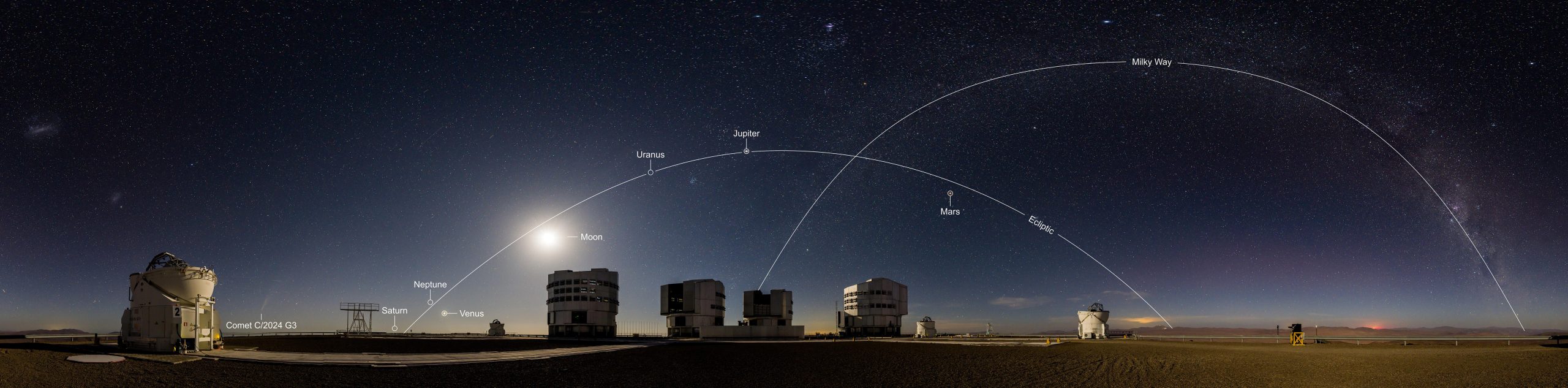
    Planetary Party Portrait Above Paranal Equirectangular Projection
    In this portrait of ESO’s Paranal Observatory, taken in early February, our planets appear to parade one after the other across the night sky. In addition to the Moon, our own Milky Way, and the comet C/2024 G3, we can see Saturn, Venus, Jupiter, and Mars — even Neptune and Uranus are hiding here too! Credit: B.Haeussler/ESO

    Why Planets Align in the Sky

    When multiple planets are visible at once, they often seem to trace a straight line across the sky. This isn’t just a coincidence — it’s because all the planets orbit the Sun on roughly the same flat plane, known as the ecliptic. While they’re actually spread out at different distances in space, their shared orbital path makes them appear aligned from our viewpoint on Earth. This kind of multi-planet visibility only happens every few years, making it a special event for skywatchers.

    This animation shows how, from the perspective of an observer on Earth, the Sun appears to move across the background of stars in the night sky, tracing out a path as we orbit around the Sun. This path is known as the ecliptic, and the constellations on that path are known as the Zodiac constellations.

    A Cosmic Tilt Revealed

    In the image, you’ll notice that this line of planets cuts across the Milky Way at a noticeable angle. That’s because the ecliptic — the plane of our Solar System — is tilted about 60 degrees relative to the galactic plane, the vast disk of stars that forms our Milky Way. If you could flatten the Milky Way like a tabletop, the Solar System would stick out at a steep angle, like a tilted pin. This dramatic tilt is what creates the striking intersection of planetary paths and galactic light in the night sky.

    Never miss a breakthrough: Join the SciTechDaily newsletter.
    Follow us on Google and Google News.

    Astronomy European Southern Observatory
    Share. Facebook Twitter Pinterest LinkedIn Email Reddit

    Related Articles

    Supermassive Black Holes on a Collision Course: Closest Pair of Supermassive Black Holes to Earth Ever Discovered

    Black Hole Discovered Lurking in Star Cluster Outside Our Galaxy

    Discovery in a Galaxy Over 12 Billion Light-Years Away – Reveals How Element Found in Our Bones Is Forged in the Universe

    Strange 160 Mile-Long “Dog-Bone” Asteroid Kleopatra Captured in Detailed Images

    Astronomers Find Small Rocky Planet – Just Half the Mass of Venus

    First Clear Detection of a Moon-Forming Disc Around a Planet Outside Our Solar System

    Mystery Solved: Astronomers Unravel the Puzzle of Betelgeuse’s “Great Dimming”

    Stunning Galactic Fireworks: New ESO Images Reveal Spectacular Features of Nearby Galaxies

    Astronomers Were Puzzled by “Great Dimming” of Betelgeuse – Now the Mystery Is Solved

    Leave A Reply Cancel Reply

    • Facebook
    • Twitter
    • Pinterest
    • YouTube

    Don't Miss a Discovery

    Subscribe for the Latest in Science & Tech!

    Trending News

    Tea or Coffee? Your Daily Choice Could Affect Osteoporosis Risk

    Vitamin C May Fight Cancer in a Surprising Way

    Hidden Earthquake Threat: Oregon’s Fault May Be Closer to the Surface Than Scientists Thought

    Scientists Discover Hidden Sleep Switch That Boosts Brainpower, Builds Muscle, and Burns Fat

    Ancient Mega-Floods Once Ripped Across Mars and Left This Giant Scar

    Scientists Discover Cheap, Natural Remedy for High Blood Pressure

    Earth’s Upper Atmosphere Is Cooling Fast and Scientists Finally Know Why

    32,000 Olympic Pools of Magma Nearly Erupted Beneath Atlantic Island

    Follow SciTechDaily
    • Facebook
    • Twitter
    • YouTube
    • Pinterest
    • Newsletter
    • RSS
    SciTech News
    • Biology News
    • Chemistry News
    • Earth News
    • Health News
    • Physics News
    • Science News
    • Space News
    • Technology News
    Recent Posts
    • Ancient DNA Reveals How Farming Spread and Nearly Broke a Civilization
    • 146,000-Year-Old Discovery Rewrites the Story of Human Creativity
    • The Type of Alcohol You Drink Could Affect How Long You Live
    • 19-Year Study Reveals the Surprising Truth About Sitting and Dementia
    • This Common Vitamin May Help Stop Prediabetes From Turning Into Diabetes
    Copyright © 1998 - 2026 SciTechDaily. All Rights Reserved.
    • Science News
    • About
    • Contact
    • Editorial Board
    • Privacy Policy
    • Terms of Use

    Type above and press Enter to search. Press Esc to cancel.