

Scientists have introduced a new technique for uncovering the ancient history of Earth’s landscapes. The method can shed light on how environments respond to geological activity and climate change, while also helping identify areas that may contain valuable mineral deposits.
Curtin University scientists have developed a new method for exploring the deep history of Australia’s landscapes. The technique offers important clues about how Earth’s surface responds to long-term geological forces and climate change, while also helping identify where valuable mineral deposits may be concentrated.
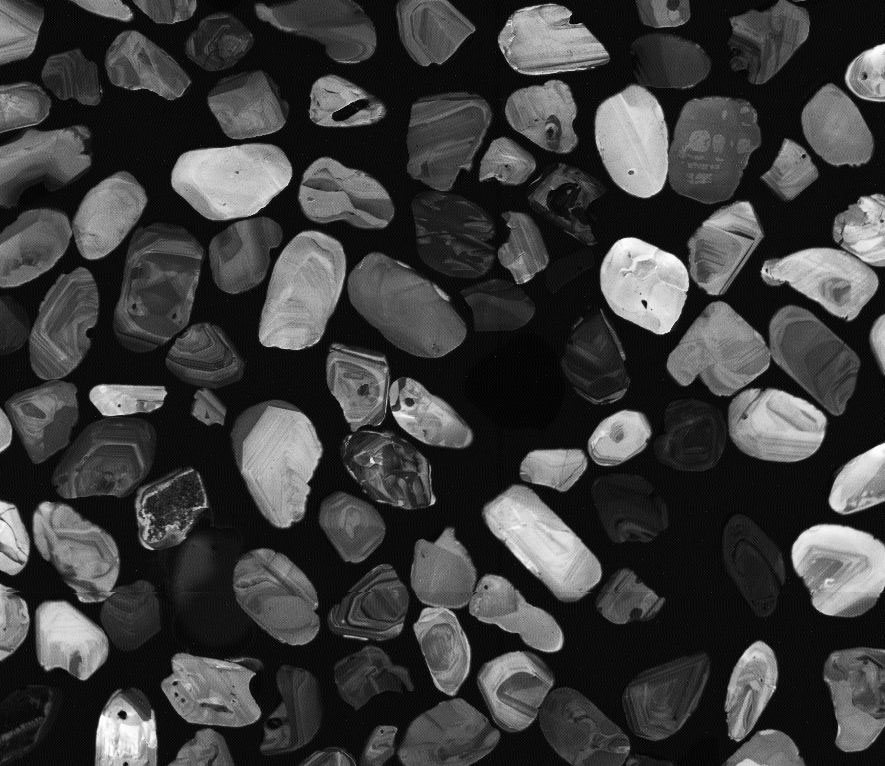
The research was carried out by an international collaboration led by Curtin’s Timescales of Mineral Systems Group within the School of Earth and Planetary Sciences, alongside researchers from the University of Göttingen and the University of Cologne. The team focused on microscopic zircon crystals preserved in ancient coastal sands.
Zircon is among the most resilient minerals found on Earth. Its durability allows it to withstand weathering, erosion, and transport through river systems and along coastlines over millions of years, making it an ideal record keeper of geological processes.
Within each zircon crystal is a trace amount of krypton, a rare gas that forms when minerals are exposed at Earth’s surface and struck by cosmic rays (high-energy, charged subatomic particles from space). This gas accumulates slowly over time, capturing a history of surface exposure.
Measuring Erosion Through a “Cosmic Clock”
By analyzing the krypton trapped inside the zircon grains, researchers were able to determine how long the crystals remained near the Earth’s surface before being buried. This process acts as a natural “cosmic clock,” allowing scientists to reconstruct how rapidly ancient landscapes eroded and changed across vast geological timescales.
Lead author and Adjunct Curtin Research Fellow Dr Maximilian Dröllner, who is also based at the University of Göttingen, said the method opens the door to studying landscapes that are far older than those accessible with previous techniques. These insights could improve understanding of how Earth’s surface might react to future climate shifts and tectonic activity.
“Our planet’s history shows climate and tectonic forces can control how landscapes behave over very long timescales,” Dr Dröllner said.
“This research helps us understand what happens when sea levels change and how deep-seated Earth movements influence the evolution of landscapes.”
When Landscapes Pause and Persist
The findings show that when landscapes are tectonically stable and sea levels remain high, erosion slows dramatically and sediments can remain stored and reworked near the surface for millions of years.
Co-author and Timescales of Mineral Systems Group lead Professor Chris Kirkland, said this has relevance for understanding the evolution of the surface of the planet over billions of years, but also future societal planning and land management.
“As we modify natural systems, we can expect changes in how sediment is stored in river basins and along coastlines and continental shelves,” Professor Kirkland said.
“Our results show that these processes can fundamentally reshape landscapes, not just coastlines, over time.”
Implications for Mineral Resources
Co-author, Associate Professor Milo Barham, also from the Timescales of Mineral Systems Group, said the study also had important implications for Australia’s mineral resources.
“Climate doesn’t just influence ecosystems and weather patterns, it also controls where mineral resources end up and how accessible they become,” Associate Professor Barham said.
“Extended periods of sediment storage allow durable minerals to gradually concentrate while less stable materials break down, explaining why Australia hosts some of the world’s most significant mineral sand deposits.
“Understanding these links is critical as demand for these minerals continues to grow, as it provides a long-term perspective that can improve models used to predict future environmental and resource outcomes arising from changes to these sediment systems.”
Reference: “Ancient landscape evolution tracked through cosmogenic krypton in detrital zircon” by Maximilian Dröllner, Milo Barham, Christopher L. Kirkland, Taryn Scharf, Sabrina Niemeyer and Tibor J. Dunai, 13 January 2026, Proceedings of the National Academy of Sciences.
DOI: 10.1073/pnas.2516058122
Never miss a breakthrough: Join the SciTechDaily newsletter.
Follow us on Google and Google News.
1 Comment
How deeply buried or submerged in water do zircon crystals have to be before energetic cosmic rays no longer ‘wind the clock?’