
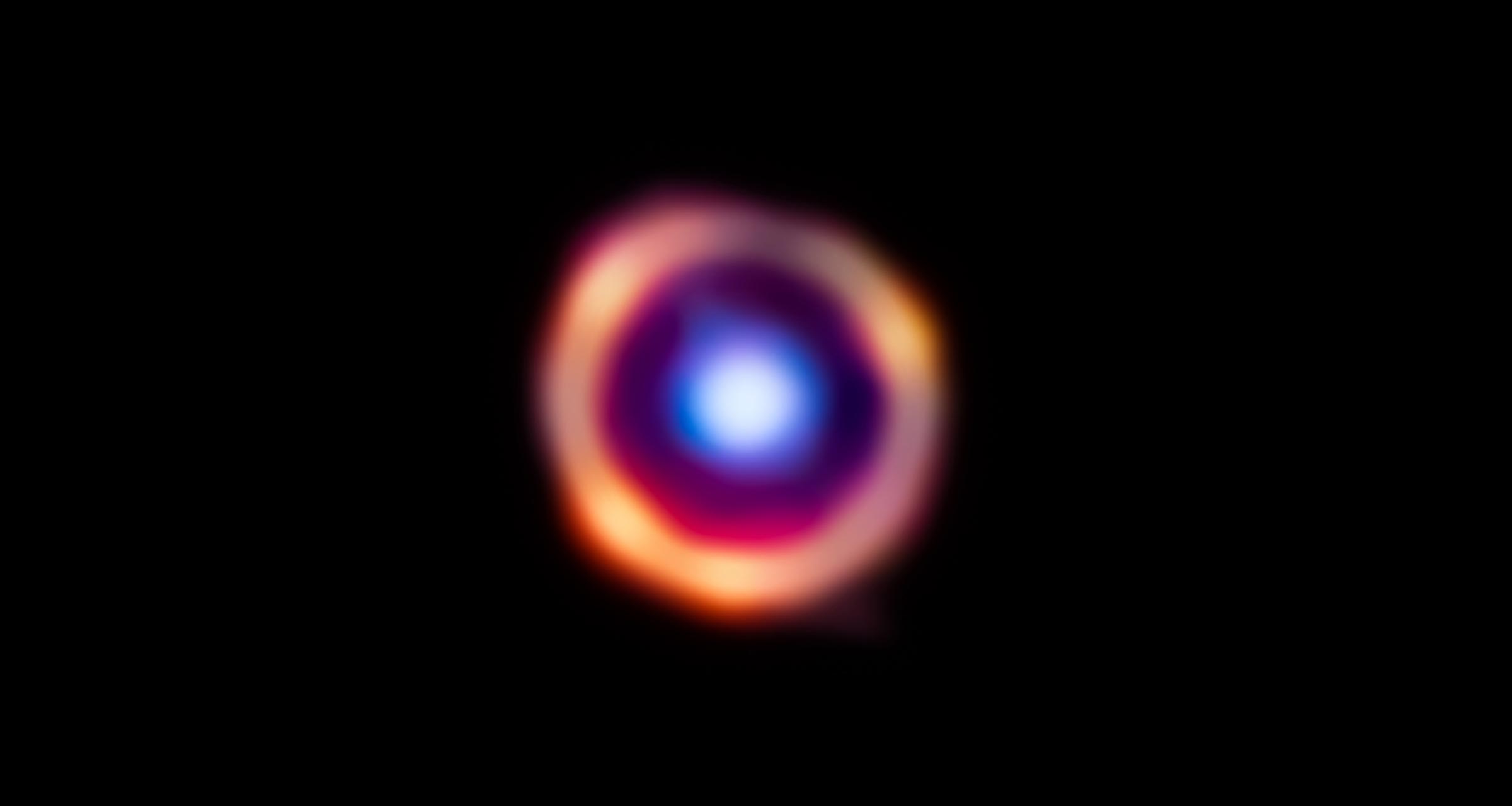
Astronomers have found complex organic molecules in a galaxy more than 12 billion light-years away from Earth.
Using NASA’s James Webb Space Telescope, an international team of astronomers detected complex organic molecules, akin to Earth’s smoke, soot, and smog, in a galaxy 12 billion light-years away. The discovery challenges previous understanding about the link between these molecules and star formation, as some regions showed the presence of these molecules without star formation, and vice versa. The detection was made possible by the combined power of Webb and gravitational lensing, a phenomenon that occurs when two galaxies align perfectly from an observer’s perspective on Earth. This is Webb’s first detection of complex molecules in the early universe and opens up possibilities to further understand the nature of galaxies and the universe’s history.
An international team of astronomers has detected complex organic molecules in the most distant galaxy to date using NASA’s James Webb Space Telescope.
The discovery of the molecules, which are familiar on Earth in smoke, soot and smog, demonstrates the power of Webb to help understand the complex chemistry that goes hand-in-hand with the birth of new stars even in the earliest periods of the universe’s history. At least for galaxies, the new findings cast doubt on the old adage that where there’s smoke, there’s fire.
Using the Webb telescope, Texas A&M University astronomer Justin Spilker and collaborators found the organic molecules in a galaxy more than 12 billion light-years away. Because of its extreme distance, the light detected by the astronomers began its journey when the universe was less than 1.5 billion years old — about 10% of its current age. The galaxy was first discovered by the National Science Foundation’s South Pole Telescope in 2013 and has since been studied by many observatories, including the radio telescope ALMA and the Hubble Space Telescope.
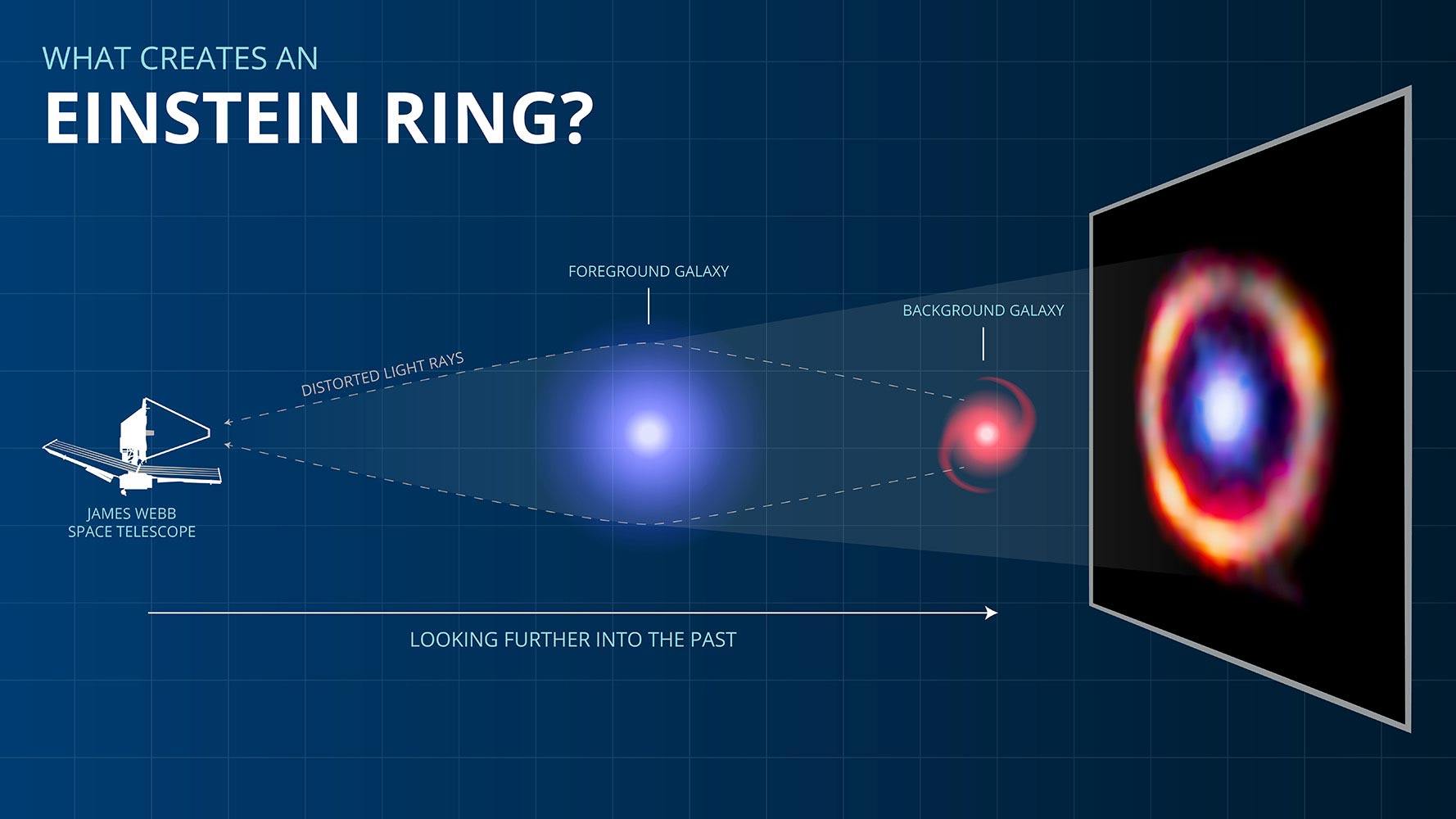
Spilker notes the discovery, reported on June 5 in the journal Nature, was made possible through the combined powers of Webb and fate, with a little help from a phenomenon called gravitational lensing. Lensing, originally predicted by Albert Einstein’s theory of relativity, happens when two galaxies are almost perfectly aligned from our point of view on Earth. The light from the background galaxy is stretched and magnified by the foreground galaxy into a ring-like shape, known as an Einstein ring.
“By combining Webb’s amazing capabilities with a natural ‘cosmic magnifying glass,’ we were able to see even more detail than we otherwise could,” said Spilker, an assistant professor in the Texas A&M Department of Physics and Astronomy and a member of the George P. and Cynthia Woods Mitchell Institute for Fundamental Physics and Astronomy. “That level of magnification is actually what made us interested in looking at this galaxy with Webb in the first place, because it really lets us see all the rich details of what makes up a galaxy in the early universe that we could never do otherwise.”
Cosmic Smoke Signals and Star Formation
The data from Webb found the telltale signature of large organic molecules akin to smog and smoke —building blocks of the same cancer-causing hydrocarbon emissions on Earth that are key contributors to atmospheric pollution. However, Spilker says the implications of galactic smoke signals are much less disastrous for their cosmic ecosystems.
“These big molecules are actually pretty common in space,” Spilker explained. “Astronomers used to think they were a good sign that new stars were forming. Anywhere you saw these molecules, baby stars were also right there blazing away.”
The new results from Webb show that this idea might not exactly ring true in the early universe, according to Spilker.
“Thanks to the high-definition images from Webb, we found a lot of regions with smoke but no star formation, and others with new stars forming but no smoke,” Spilker added.
University of Illinois Urbana-Champaign graduate student Kedar Phadke, who led the technical development of the team’s Webb observations, noted that astronomers are using Webb to make connections across the vastness of space with unprecedented potential.
“Discoveries like this are precisely what Webb was built to do: understand the earliest stages of the universe in new and exciting ways,” Phadke said. “It’s amazing that we can identify molecules billions of light-years away that we’re familiar with here on Earth, even if they show up in ways we don’t like, like smog and smoke. It’s also a powerful statement about the amazing capabilities of Webb that we’ve never had before.”
The team’s leadership also includes NASA’s Goddard Space Flight Center astronomer Jane Rigby, University of Illinois professor Joaquin Vieira and dozens of astronomers around the world.
The discovery is Webb’s first detection of complex molecules in the early universe — a milestone moment that Spilker sees as a beginning rather than an end.
“These are early days for the Webb Telescope, so astronomers are excited to see all the new things it can do for us,” Spilker said. “Detecting smoke in a galaxy early in the history of the universe? Webb makes this look easy. Now that we’ve shown this is possible for the first time, we’re looking forward to trying to understand whether it’s really true that where there’s smoke, there’s fire. Maybe we’ll even be able to find galaxies that are so young that complex molecules like these haven’t had time to form in the vacuum of space yet, so galaxies are all fire and no smoke. The only way to know for sure is to look at more galaxies, hopefully even further away than this one.”
The team’s paper, “Spatial variations in aromatic hydrocarbon emission in a dust-rich galaxy,” can be viewed online along with related figures and acknowledgments.
Reference: “Spatial variations in aromatic hydrocarbon emission in a dust-rich galaxy” by Justin S. Spilker, Kedar A. Phadke, Manuel Aravena, Melanie Archipley, Matthew B. Bayliss, Jack E. Birkin, Matthieu Béthermin, James Burgoyne, Jared Cathey, Scott C. Chapman, Håkon Dahle, Anthony H. Gonzalez, Gayathri Gururajan, Christopher C. Hayward, Yashar D. Hezaveh, Ryley Hill, Taylor A. Hutchison, Keunho J. Kim, Seonwoo Kim, David Law, Ronan Legin, Matthew A. Malkan, Daniel P. Marrone, Eric J. Murphy, Desika Narayanan, Alex Navarre, Grace M. Olivier, Jeffrey A. Rich, Jane R. Rigby, Cassie Reuter, James E. Rhoads, Keren Sharon, J. D. T. Smith, Manuel Solimano, Nikolaus Sulzenauer, Joaquin D. Vieira, David Vizgan, Axel Weiß and Katherine E. Whitaker, 5 June 2023, Nature.
DOI: 10.1038/s41586-023-05998-6
JWST is operated by the Space Telescope Science Institute under the management of the Association of Universities for Research in Astronomy under NASA contract NAS 5-03127. The South Pole Telescope is supported by the National Science Foundation, the Department of Energy, and the United States Antarctic Program.
Never miss a breakthrough: Join the SciTechDaily newsletter.
Follow us on Google and Google News.