
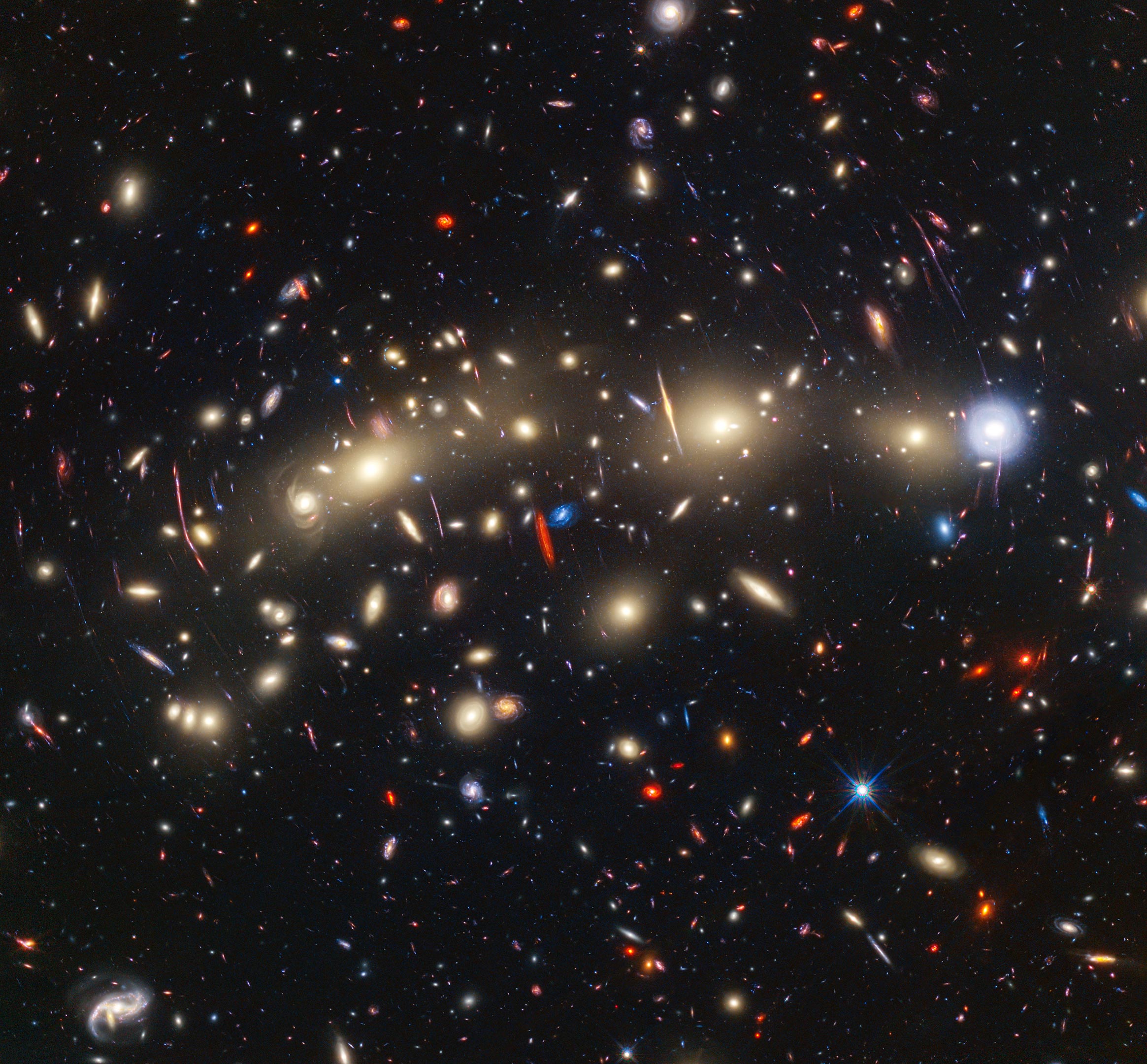
The striking image represents one of the most comprehensive views of the universe ever taken and reveals a vivid landscape of galaxies along with more than a dozen newfound, time-varying objects.
Astronomers once again have combined the observational powers of NASA’s James Webb Space Telescope and Hubble Space Telescope to create one of the most detailed and colorful portraits of the cosmos, just in time for the holiday season.
The new image, dubbed the Christmas Tree Galaxy Cluster by the research team that includes Texas A&M University astronomer, Dr. Lifan Wang, combines visible light from Hubble with infrared light detected by Webb to showcase MACS0416, a galaxy cluster about 4.3 billion light-years from Earth. Because the cluster is able to magnify the light from more distant background galaxies through a phenomenon known as gravitational lensing, it has enabled researchers to identify magnified supernovae and even very highly magnified individual stars.
Scientific Insights From the Cluster
“We’re calling MACS0416 the Christmas Tree Galaxy Cluster, both because it’s so colorful and because of these flickering lights we find within it,” said University of Missouri astronomer Dr. Haojing Yan, lead author of one of two papers describing the scientific results. The paper, co-authored by Wang, has been accepted for publication in The Astrophysical Journal.
Wang, a member of the Texas A&M Department of Physics and Astronomy and the George P. and Cynthia Woods Mitchell Institute for Fundamental Physics and Astronomy since 2006, is part of a time-domain astronomy team that is using JWST to discover the universe’s very first supernovae, the oldest of which on record dates back to a time when the universe was more than 3 billion years old. The international collaboration, known as the Prime Extragalactic Areas for Reionization and Lensing Science (PEARLS), is led by Arizona State University astronomer Dr. Rogier Windhorst and credited with acquiring the data resulting in the discoveries.
Innovative Techniques and Predictions
One of the team’s tactics is to use the unparalleled observing power of Webb to search for objects varying in observed brightness over time, known as transients. In a 2017 white paper published prior to the launch of JWST, Wang and his co-authors predicted that the telescope would find a few such transients in a single shot using its powerful main imager, called the Near Infrared Camera (NIRCam). Wang cites the MACS0416 image and the 14 transients it contains as proof positive, noting that the discoveries are exceeding the team’s predictions.
“The JWST is discovering a large number of transient objects, mostly supernovae, in the universe,” Wang said. “Not only it is finding supernovae, it has also found stars in faraway galaxies that are magnified by the gravitational field of nearby foreground galaxies.”
The discoveries are made through repeated observations of a sky area toward the galaxy cluster MACS0416. The Northern Ecliptic Pole (NEP), a region where JWST can continuously point to and take data throughout the year, is ideal for acquiring time-domain observations in the future. Wang says the unprecedented sensitivity allows some supernovae, such as those from the explosions of white dwarf stars, to be detected throughout the universe, even as far back to the epoch when the universe was just beginning to form its first stars.
Answering Key Astronomical Questions
“There are two fundamental questions in astronomy: How did the first stars form, and what is the nature of the forces that drive the expansion of the universe?” Wang said. “The transients that JWST is able to discover will provide the data needed to address these questions.
“These discoveries show that JWST is the most powerful tool for studying the faint transients at the cosmic dawn, when the universe emerges from the dark age with no stars to the present-day epoch. The supernovae it observes can probe the process of the first stars as well as the expansion of the universe out to a time when the universe was less than 1 billion years old.”
Exploring Supernovae and Distant Stars
Wang says some of these supernovae are likely from the death of low-mass stars, which evolve into white dwarfs and explode through thermonuclear explosions. The lensed stars allow individual stars in the distant universe to be studied. These early stars are also likely to be very massive stars that produce extremely bright transients through the so-called pair production instability process.
“We anticipate that these ‘routinely discoverable’ transients will hold great potential in addressing the questions concerning the end of the cosmic dark age and the physics of the expansion of the dark universe,” Wang said.
For more on this research:
“JWST’s PEARLS: Transients in the MACS J0416.1-2403 Field” by Haojing Yan, Zhiyuan Ma, Bangzheng Sun, Lifan Wang, Patrick Kelly, Jose M. Diego, Seth H. Cohen, Rogier A. Windhorst, Rolf A. Jansen, Norman A. Grogin, John F. Beacom, Christopher J. Conselice, Simon P. Driver, Brenda Frye, Dan Coe, Madeline A. Marshall, Anton Koekemoer, Christopher N. A. Willmer, Aaron Robotham, Jordan C. J. D’Silva, Jake Summers, Mario Nonino, Nor Pirzkal, Russell E. Ryan Jr., Rafael Ortiz III, Scott Tompkins, Rachana A. Bhatawdekar, Cheng Cheng, Adi Zitrin and S. P. Willner, Accepted, The Astrophysical Journal.
arXiv:2307.07579
Never miss a breakthrough: Join the SciTechDaily newsletter.
Follow us on Google and Google News.