
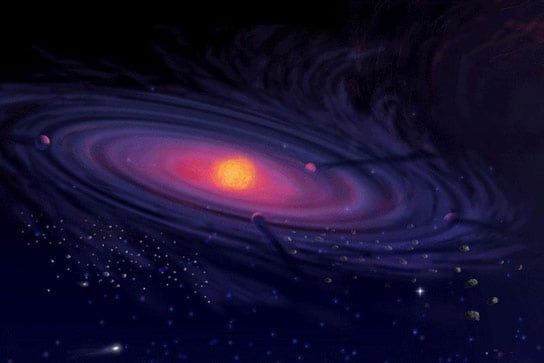
New research from physicists at Helmholtz-Zentrum Dresden-Rossendorf looks at how magnetic fields can cause turbulences within “dead zones,” resulting in the formation of black holes and other objects in the cosmos.
Just how stars and black holes in the Universe are able to form from rotating matter is one of the big questions of astrophysics. What we do know is that magnetic fields figure prominently in the picture. However, our current understanding is that they only work if matter is electrically well conductive – but in rotating discs, this isn’t always the case. Now, a new publication by Helmholtz-Zentrum Dresden-Rossendorf physicists in the scientific journal Physical Review Letters shows how magnetic fields can also cause turbulences within “dead zones,” thus making an important contribution to our current understanding of just how compact objects form in the cosmos.
When Johannes Kepler first proposed his laws of planetary motion in the early days of the 17th century, he could not have foreseen the central role cosmic magnetic fields would play in planetary system formation. Today, we know that in the absence of magnetic fields, mass would not be able to concentrate in compact bodies like stars and black holes. One prominent example is our solar system, which formed 4.6 billion years ago through the collapse of a gigantic cloud of gas, whose gravitational pull concentrated particles in its center, culminating in the formation of a large disc. “These accretion discs are extremely stable from a hydrodynamic perspective as according to Kepler’s laws of planetary motion angular momentum increases from the center towards the periphery,” explains HZDR’s own Dr. Frank Stefani. “In order to explain the growth rates of stars and black holes, there has to exist a mechanism, which acts to destabilize the rotating disc and which at the same time ensures mass is transported towards the center and angular momentum towards the periphery.”
As early as 1959, Evgenij Velikhov conjectured that magnetic fields are capable of prompting turbulences within stable rotating flows. However, it wasn’t until 1991 that astrophysicists Steven Balbus and John Hawley fully grasped the fundamental significance of this magneto rotational instability (MRI) in cosmic structure formation. Balbus and Hawley will be this year’s recipients of the one million Dollar Shaw Prize for astronomy, which will be given in September 2013. However, in order to ensure the MRI actually works, the discs have to exhibit a minimum degree of electrical conductivity. In areas of low conductivity like the “dead zones” of protoplanetary discs or the far-off regions of accretion discs that surround supermassive black holes, the MRI’s effect is numerically difficult to comprehend and is thus a matter of dispute. HZDR scientists, who to date have been mostly concerned with an experimental study of the MRI, have now offered a new theoretical explanation for this phenomenon.
Rivalry between physicists and astrophysicists
If you try and simulate the MRI in a liquid metal experiment with an exclusively vertically oriented magnetic field this field has to be rather strong. At the same time, since the rotational speed has to be very high, these types of experiments are extremely involved, and thus far success has eluded them. Back in 2005, for the first time ever, Dr. Stefani and his colleagues at the HZDR and the Leibniz Institute for Astrophysics Potsdam managed to successfully simulate the cosmic process in the lab. By adding a circular magnetic field to a vertical one, they were able to observe the MRI at substantially smaller magnetic fields and rotational speeds. According to Steven Balbus and Hantao Ji per the current August edition of the magazine Physics Today, one of the blemishes of this “helical MRI” is the fact that it only acts to destabilize rotational profiles that are relatively precipitous towards the periphery, which for now does not include rotation profiles obeying Kepler’s law.
Magnetic fields and rotating flows reinforce each other
The HZDR scientists are now countering this weighty astrophysics argument with their latest insights. The calculations by Dr. Oleg Kirillov and Dr. Frank Stefani have shown that the helical MRI very much applies to the Keplerian rotation profile if only the circular magnetic field is produced not entirely from the outside but at least partly from within the accretion disc. “This is in fact a much more realistic scenario. In the extreme case that there does not exist a vertical field, we’re looking at a problem of what came first – the chicken or the egg. A circular magnetic field acts to destabilize the disc and the resulting turbulence generates components of vertical magnetic fields. They in turn reproduce the circular magnetic field because of the special form of the disc’s rotational movement.” Regardless of whether with or without a vertical magnetic field, current calculations show that the MRI is possible even in areas of low conductivity like the “dead zones” – something astrophysicists had not previously thought possible.
The HZDR scientists were driven by their long-standing experience with cosmic magnetic field experiments in the lab, from a model of Earth’s dynamo to magneto-rotational instability all the way to Tayler instability. The latter is being debated by astrophysicists with reference to cosmic jets and the formation of neutron stars, among others, but also has to be considered in the construction of large liquid metal batteries, for example. At this time, the scientists are planning a large-scale experiment using liquid sodium, which they are hoping to realize over the next few years as part of the DRESDYN Project. “Once we get this experiment, which for the first time ever will combine the MRI with Tayler instability, up and running, we will much improve our understanding of the interaction between various magnetic cosmic phenomena,” says a happy Stefani. Regardless of who is the one to push the envelope in this amicable competition – the experimental physicists or the theoretical astrophysicists – the angular momentum transport in astrophysics and in the lab will continue to be a hotly contested topic.
References:
“Extending the Range of the Inductionless Magnetorotational Instability” by Oleg N. Kirillov and Frank Stefani, 7 August 2013, Physical Review Letters.
DOI: 10.1103/PhysRevLett.111.061103
arXiv:1303.4642
“Angular momentum transport in astrophysics and in the lab” by Hantao Ji and Steven Balbus, 1 August 2013, Physics Today.
doi:10.1063/PT.3.2081
Never miss a breakthrough: Join the SciTechDaily newsletter.
Follow us on Google and Google News.