
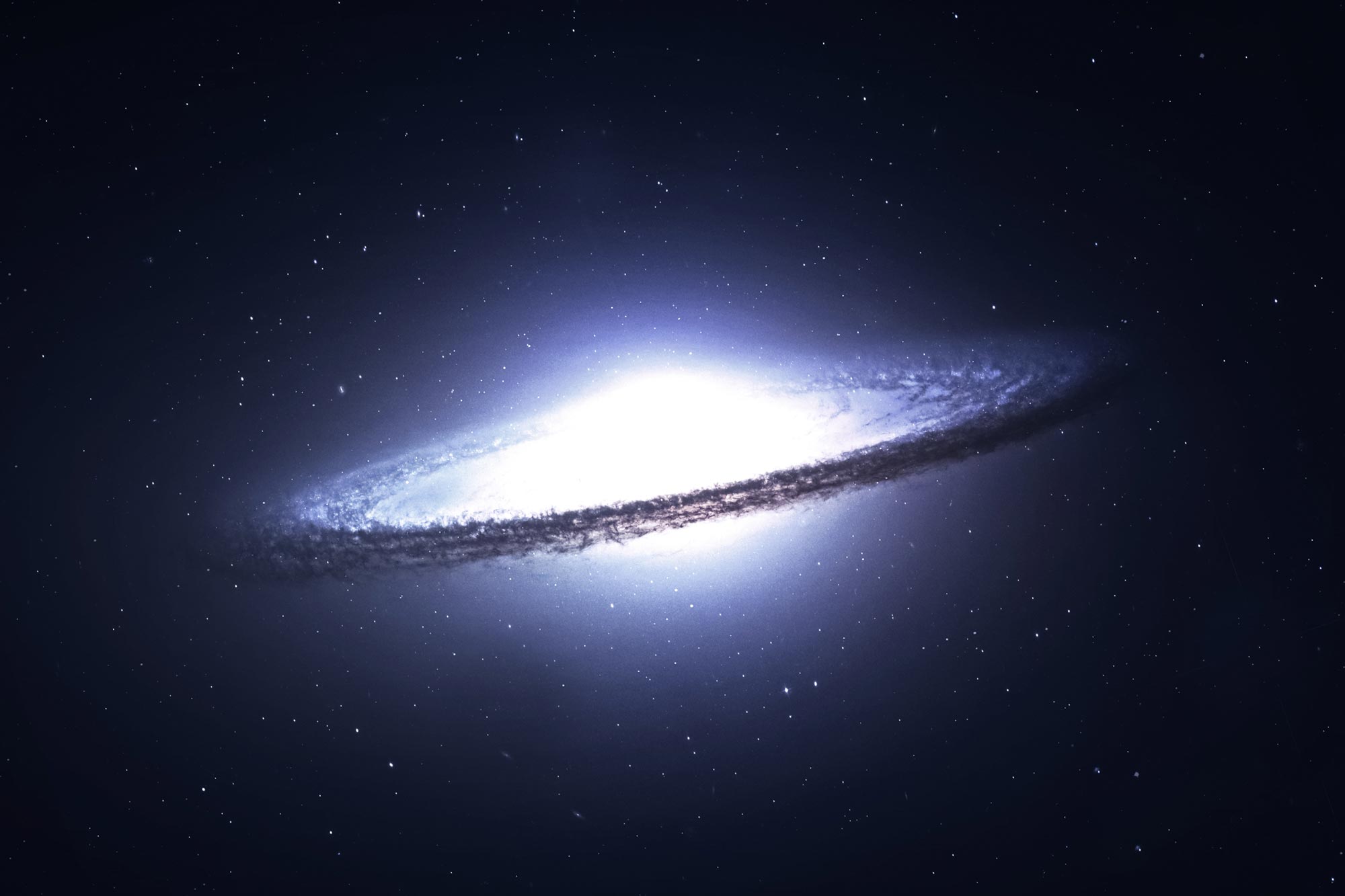
Cosmic voids are not truly empty but are filled with vacuum energy that powers the universe’s expansion.
If you could somehow strip away everything inside the vast cosmic voids, removing all normal matter, neutrinos, dark matter, cosmic rays, and even radiation, what would remain?
At first glance, it might seem like the answer is nothing at all. But that conclusion would be wrong. Even in the most remote and seemingly barren regions of the universe, empty space is still there. And that “emptiness” is not truly empty.
Empty space is not nothing
That’s because the vacuum of space-time is not truly empty. It contains something. Not in the usual sense of matter or radiation, but something more fundamental. It exists within the underlying fabric of reality itself. It can be difficult to describe precisely in everyday language, but what I’m referring to are quantum fields.
In quantum field theory, the particles that make up our universe, such as electrons, top quarks, neutrinos, and even dark matter, are not fundamental objects on their own. What we call a particle is actually a manifestation of something deeper. The truly fundamental entities are the fields. Each type of particle has a corresponding field, and these fields extend through every region of space and time. They have been present since the Big Bang and fill every corner of the universe.
When we point to something and say, “Look at that electron zooming by,” what we are really observing is an excitation, a vibration, or a wave in the underlying field. That localized disturbance is what we interpret as a particle. Even if all particles were removed, even if all the matter and radiation were gone, the field itself would still remain.
Vacuum energy drives expansion
That underlying field carries energy. Because of the Heisenberg uncertainty principle, even what we think of as empty space cannot have zero energy. The details of that principle are a topic in their own right. When physicists try to calculate how much energy exists in the vacuum, the results vary wildly, ranging from staggeringly large values to formally infinite ones… which is also a discussion for another time.
What matters here is that this energy produces a measurable effect. We call that effect “dark energy,” the name given to the phenomenon responsible for the universe’s accelerating expansion.
Observations of cosmic acceleration tell us that the actual amount of vacuum energy is small compared with many theoretical predictions. However, it is not zero. Dark energy, or vacuum energy if you prefer, has almost no impact in regions packed with matter. In dense environments, its influence is negligible. On Earth, for example, matter is so concentrated that it completely overwhelms any effect dark energy might have.
If dark energy suddenly vanished, life on Earth would look exactly the same. A baseball would follow the same path when thrown. A burrito would take just as long to heat in the microwave. Nothing in our daily experience would change.
The same holds true for galaxies, galaxy clusters, filaments, walls, and every other dense structure in the cosmic web. In those regions, gravity and matter dominate the dynamics.
Cosmic voids are different. These vast expanses contain very little matter. In such places, the vacuum of space-time itself becomes the dominant component. If you were positioned at the center of a cosmic void, dark energy would be the primary influence surrounding you.
Voids are where dark energy wins
In fact, voids are the places where dark energy is doing its job of accelerating the expansion of the universe. It’s not happening in any dense places like galaxies or clusters. It’s only happening in the voids. The voids don’t just empty out to build the cosmic web.
The voids themselves are expanding. They are literally tearing the cosmic web apart. What we see as these very large, beautiful, and intricate structures in the universe are temporary. Over the course of the next 5-10-20 billion years, the exact number doesn’t matter, the cosmic web is going to evaporate. And it will do that through the action of the voids pressing against everything else.
So the voids are full. They are vibrating with fundamental quantum energies. They are doing work on the rest of the universe to accelerate its expansion. And they are the only places in the universe that can do this, and the only reason they can do this is that they are devoid of everything else.
So yes, voids are empty of matter. This is how we discover them. This is how we measure them. This is how we define them. But the emptiness of matter means that they are full of dark energy. And so no matter where you go in the universe, whether it’s to a nearby Galaxy or the deepest interior of the emptiest void, you will never ever quite be alone.
Adapted from an article originally published in UniverseToday.
Never miss a breakthrough: Join the SciTechDaily newsletter.
Follow us on Google and Google News.
16 Comments
Can you prove that the voids as a whole are getting larger?
Define void.
The expansion of the universe has been verified using multiple methods. Most of that expansion occurs in the voids, due to them having less gravity to resist the expansion.
This whole article has one major Achilles heel. Dark matter and dark energy do not exist. All made up to make our flawed gravitational model work.
Amen brother, the entirety of the Big Bang model consists of invisible (undetectable) entities and events. It’s nothing but a mathematical fairytale.
Do you have a better idea, Dave?
Humans are getting closer to uncovering the reality of what is. Well done!
Uncovering the reality of what is, is likely to be a gradual process, that is likely to take forever, at least as long as there are people in existence.
So, we’re going back to the ether theory?
You can comprehend it – but not with math. Math prevents comprehension because it forced your mind to comprehend math – which isn’t reality.
You have a full on super-computer that thinks in images. Use it. Not for fantasy and silly stuff.
Read ‘Abdu’l-Bahá’s “Tablet of the Universe”. He talks about there being two types of matter other than the ones we see, and are both gravitationally interactive. This, plus a universal medium that is infinitely pliable and which is capable of transmitting vibrations.
Heidelberg’s uncertainty principle is an analytical technique not a source of physics or energy.
The universe may not be expanding at all. It might be a combination of measurement errors and a disbelief that there are types of matter subtracting energy from passing photons as they travel long distances.
Revealed knowledge is always better than the idle speculations of materialist philosophers.
Another letter worth reading on this topic is the Tablet to Dr August Forel, the Swiss scientist. There letters are easily found on line.
‘Abdu’l-Bahá was not a physicist. He was a theologian, the second leader of the Bahá’í Faith, which was founded by his father, Bahá’u’lláh. This faith is a monotheistic religion, which is thought to have over ten million members around the world. So what he wrote was not the result of a scientific study, but a result of theology, as you call it revealed knowledge. It is an interesting religion, but it is not science. Anyway, this man died in 1921, and he was succeeded as leader of the religion by his grandson, Shoghi Effendi.
This article is stating a hypothesis as though it’s a well established theory. Quantum fluctuations are thought to play a role in the expansion of the universe. But there is a discrepancy between the energy released from quantum fluctuations, and the strength of dark energy – of 120 orders of magnitude. That’s a huge discrepancy, and one that is not easily rectified.
This is exactly my paper “A Dual-Energy Symmetry Framework” the key difference being that I am not so vague and have mathmatically proven all this and even named it, I also hold the A priori on this so I hope he cited my work!
No kidding. Tesla and many others (many of which ended up dead) tapped into vacuum energy a long time ago.
So true!! I’m currently obsessed with an electrical engineer named Floyd Sweet. He figured out how to create something he called a vacuum triode amplifier. It was about the size of a deck of cards, but it could easily power a house. It worked using the same field as the one described in this article, so it showed some very interesting anti-gravity properties on top of the ‘free’ energy stuff.