
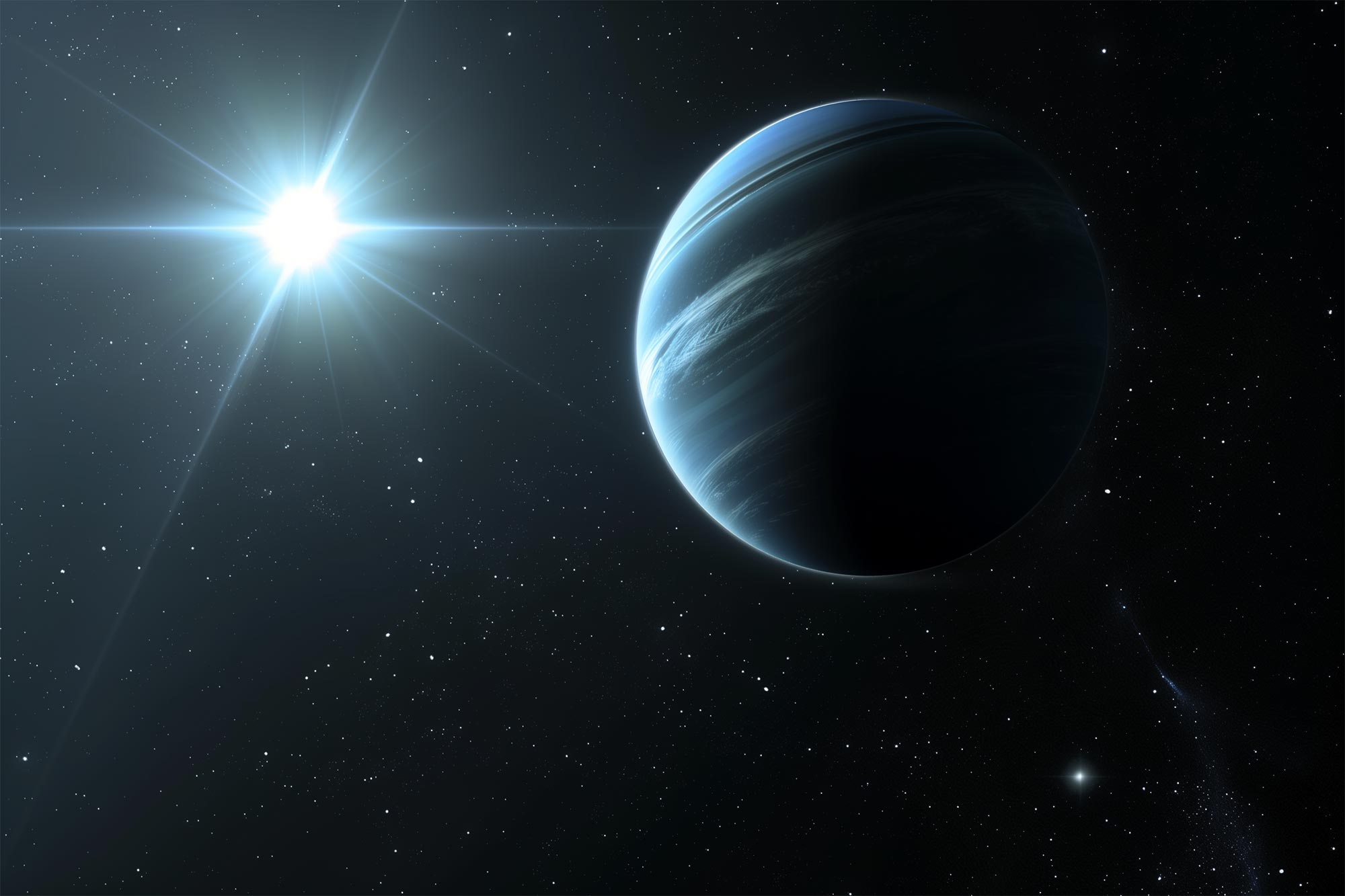
Scientists have long overlooked white dwarfs as hosts for habitable exoplanets, assuming their lack of fusion would make life impossible. But new climate models challenge that idea, showing that planets around these fading stars might actually be warmer than those orbiting Sun-like stars.
A combination of rapid rotation and atmospheric conditions creates surprisingly favorable environments, suggesting that astrobiologists should take a second look at these overlooked celestial remnants.
White Dwarfs: A Surprising Haven for Life?
A new study from astronomers at the University of California, Irvine, suggests that more white dwarf stars in the Milky Way may be capable of supporting habitable exoplanets than previously believed. With an estimated 10 billion white dwarfs in our galaxy, these findings could significantly expand the search for life beyond Earth.
Published in The Astrophysical Journal, the research, led by UC Irvine associate professor Aomawa Shields, compares the climates of exoplanets orbiting two different types of stars. One is a hypothetical white dwarf nearing the end of its life cycle, while the other is Kepler-62, a main sequence star similar in age and characteristics to our Sun.

Climate Models Reveal Unexpected Warmth
Using a 3D global climate model typically used to study Earth’s atmosphere, the team discovered that an exoplanet orbiting a white dwarf could be significantly warmer than a comparable planet around Kepler-62, despite receiving similar energy levels from its star.
“While white dwarf stars may still give off some heat from residual nuclear activity in their outer layers, they no longer exhibit nuclear fusion at their cores. For this reason, not much consideration has been given to these stars’ ability to host habitable exoplanets,” Shields explained. “Our computer simulations suggest that if rocky planets exist in their orbits, these planets could have more habitable real estate on their surfaces than previously thought.”
How Rotational Speed Shapes Habitability
She said a key difference in the star/planet systems her team studied – a variation responsible for a planetary climate being habitable or not – was the rotational characteristics of the planets.
The white dwarf star’s habitable zone – the region in which an exoplanet could host life-supporting liquid water, among other traits – is much closer to the star compared to that of other stars such as Kepler-62. Shields stressed that this results in a much faster rotation period – 10 hours – for the white dwarf exoplanet, while Kepler-62’s exoplanet has a 155-day rotation period.
The Role of Synchronous Orbits in Climate
While both planets would likely be locked into a synchronous orbit – with a permanent dayside and a perpetual nightside – the ultrafast white dwarf planet’s rotation stretches out the cloud circulation around the planet. The much slower, 155-day orbital period of the Kepler-62 planet contributes to a large, dayside, liquid water cloud mass.
“We expect synchronous rotation of an exoplanet in the habitable zone of a normal star like Kepler-62 to create more cloud cover on the planet’s dayside, reflecting incoming radiation away from the planet’s surface,” Shields said. “That’s usually a good thing for planets orbiting close to the inner edge of their stars’ habitable zones, where they could stand to cool off a bit rather than lose their oceans to space in a runaway greenhouse. But for a planet orbiting squarely in the middle of the habitable zone, it’s not such a good idea.”
She continued: “The planet orbiting Kepler-62 has so much cloud cover that it cools off too much, sacrificing precious habitable surface area in the process. On the other hand, the planet orbiting the white dwarf is rotating so fast that it never has time to build up nearly as much cloud cover on its dayside, so it retains more heat, and that works in its favor.”
Fewer dayside liquid clouds and a stronger greenhouse effect on the nightside create warmer conditions on the white dwarf planet relative to the Kepler-62 planet.
A New Perspective on White Dwarf Habitability
“These results suggest that the white dwarf stellar environment, once thought of as inhospitable to life, may present new avenues for exoplanet and astrobiology researchers to pursue,” Shields said. “As powerful observational capabilities to assess exoplanet atmospheres and astrobiology have come on line, such as those associated with the James Webb Space Telescope, we could be entering a new phase in which we’re studying an entirely new class of worlds around previously unconsidered stars.”
Reference: “Increased Surface Temperatures of Habitable White Dwarf Worlds Relative to Main-sequence Exoplanets” by Aomawa L. Shields, Eric T. Wolf, Eric Agol and Pier-Emmanuel Tremblay, 16 January 2025, The Astrophysical Journal.
DOI: 10.3847/1538-4357/ad9827
Shields collaborators on this project, which received funding from the National Science Foundation and the National Center for Atmospheric Research, were Eric Wolf of the University of Colorado Boulder; Eric Agol of the University of Washington; and Pier-Emmanuel Tremblay of the University of Warwick in the United Kingdom.
Never miss a breakthrough: Join the SciTechDaily newsletter.
Follow us on Google and Google News.
2 Comments
A combination of rapid rotation and atmospheric conditions creates surprisingly favorable environments, suggesting that astrobiologists should take a second look at these overlooked celestial remnants.
VERY GOOD!
Scientific research guided by correct theories can enable researchers to think more. According to the Topological Vortex Theory (TVT), climate change on Earth may be more affected by the deviation between the Earth’s spin axis and the Sun’s spin axis, and the distance between the Earth and the Sun may not be the main reason for the Sun’s influence on climate change on Earth. Because when the spin axis of the Sun is close to parallel to that of the Earth, it is more favorable for the topological vortices of the two systems to superimpose or form Möbius bands. This may be one of the reasons why the climate near the equator of the Earth is not easily affected by seasonal changes (https://scitechdaily.com/microscope-spacecrafts-most-precise-test-of-key-component-of-the-theory-of-general-relativity/#comment-862645).
Topological Vortex Theory (TVT) is based on topology and fluid dynamics, which have solid mathematical and physical foundations. Under the topological vortex architecture, science and pseudoscience are clear at a glance. Topological Vortex Theory (TVT) can play a crucial role in elucidating the foundations of physics, establishing its principles, and combating pseudoscience.
However, some individuals, some AI, and some so-called peer review publications (including PRL, PNAS, Nature, Science, etc.) stubbornly believe that two sets of cobalt-60 can form the mirror image of each other by rotating in opposite directions (https://scitechdaily.com/microscope-spacecrafts-most-precise-test-of-key-component-of-the-theory-of-general-relativity/#comment-854286), and stubbornly believe that the Topological Vortex Theory (TVT) currently lacks validation. This is because they have been misled by pseudoscientific information.
Vortex phenomena are ubiquitous in cosmic space, from vortices of quantum particles and living cells to tornados and black holes. The inviscid and incompressible spaces have been widely used in engineering simulation (https://scitechdaily.com/microscope-spacecrafts-most-precise-test-of-key-component-of-the-theory-of-general-relativity/#comment-870077). These all are the most powerful verification and validation.
Ask some so-called peer review publications (including PRL, PNAS, Nature, Science, etc.):
1. Does space not exist?
2. Does time not exist?
3. Does the ideal fluid not exist?
4. Do scientific experiments require time and space?
5. Do certain engineering simulations require ideal fluids?
6. If non-existent things are applied to scientific experiments and engineering simulations, and good results can be achieved. So, what is the difference between the non-existent thing and God?
Some individuals and some so-called peer review publications (including PRL, PNAS, Nature, Science, etc.) have been misleading the public with confusing concepts (https://pic2.zhimg.com/v2-4127b0b58fe8b88feb27c189fb705029_1440w.jpg?source=172ae18b), unscientific logic and reasoning, and self righteous Impact Factor (IF), hindering the progress of science and technology.
Fighting against rampant pseudoscience, physics still has a long way to go.
Life in the Milky Way galaxy is only in the solar system, of course, there may be microbial life on a planet in one or more stars in the galaxy, but if there is life like Earth in the Milky Way, if there is intelligent life like Earth, it does not exist in the Milky Way Galaxy, but in the infinite space there is 100% infinite life like Earth and more advanced than Earth. There is a hundred percent number