

Stellar migration may greatly increase the number of habitable planets in the Milky Way. Future ESA missions will test these predictions with detailed exoplanet observations.
What can the Galactic Habitable Zone (GHZ)—the region of a galaxy where complex life is thought most likely to arise—reveal about identifying stars that might host habitable planets?
A recent study, accepted for publication in Astronomy & Astrophysics, set out to answer this by examining how the movement of stars, known as stellar migration, could affect the search for life-supporting worlds in the Milky Way. The work, carried out by an international research team, offers new insights into the astrophysical conditions that may determine where habitable planets form and how life might develop beyond Earth.
Modeling stellar migration and its effects
To explore this, the researchers created computer simulations that modeled the impact of stellar migration on the position and boundaries of the GHZ. Their approach tested both scenarios—with and without migration—to determine the statistical chances of rocky, Earth-like planets forming around stars across different regions of the galaxy. They also incorporated a chemical evolution model to track how the Milky Way developed over time, with particular attention to its vertical structure and thickness.
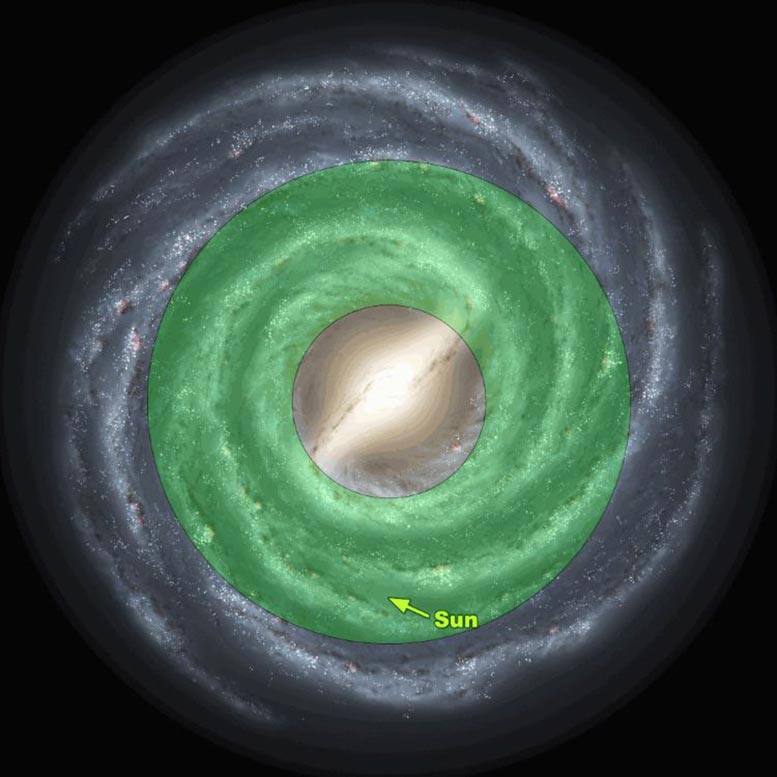
The results showed that stellar migration strongly affects the likelihood of habitable planets forming in the galaxy’s outer zones. Because stars drift and redistribute, the models predicted that the presence of stellar migration makes stars about five times more likely to host habitable planets compared with no migration at all. The study also suggested that gas giants may play a significant role in shaping the chances for rocky planet formation closer to the galactic center.
The paper notes in its conclusions, “In this study, we have significantly expanded the exploration of the parameter space defining the Galactic Habitable Zone, compared to previous analyses present in literature. Our findings are particularly relevant in the context of upcoming space missions, such as the ESA [European Space Agency] PLAnetary Transits and Oscillations of Stars (PLATO), the ESA Ariel space mission, and Large Interferometer For Exoplanets (LIFE). These missions will deliver unprecedented data on planetary properties, orbital architectures, and atmospheric compositions.”
Revisiting the concept of habitable zones
The notion of the GHZ builds off the longstanding idea of the stellar habitable zone (HZ), which is the specific distance a planet must orbit its star for liquid water to exist on its surface, which was first introduced in the 1950s. Like all scientific notions, the idea of a GHZ has evolved over time since it was first introduced in the 1980s, but the overarching idea is this region is comprised of heavier elements (i.e., iron, silicon, and oxygen) that are used to form terrestrial planets like Earth. As this study notes, the exact size of the GHZ is still being debated, but the consensus in the scientific community is that the GHZ does not exist in the center of the galaxy, as this region hosts countless supernovae and other celestial events that would limit habitable planets from forming.
As the study notes, there are several ESA missions in the pipeline whose goals will be to expand our knowledge of both how and where to find life beyond Earth. For example, the PLATO mission, which is slated to launch in December 2026, will have the goal of scanning one million stars to observe and identify exoplanets that cross in front of them, known as a transit, and is one of the most common methods for discovering exoplanets to date.
The Ariel mission, which is slated to launch in 2029, will have the goal of observing at least 1,000 confirmed exoplanets to learn more about their chemical and heat compositions. Finally, the LIFE mission was started in 2017 with the goal of studying the atmospheres of terrestrial exoplanets to identify potential signs of life known as biomarkers.
What new discoveries about the GHZ and stellar migration will researchers make in the coming years and decades? Only time will tell, and this is why we science!
As always, keep doing science & keep looking up!
Reference: “Shaping Galactic habitability: Impact of stellar migration and gas giants” by E. Spitoni, M. Palla, L. Magrini, F. Matteucci, C. Danielski, M. Tsantaki, A. Sozzetti, M. Molero, F. Fontani, D. Romano, G. Cescutti and L. Silva, 4 August 2025, Astronomy & Astrophysics.
DOI: 10.1051/0004-6361/202555050
Adapted from an article originally published on Universe Today.
Never miss a breakthrough: Join the SciTechDaily newsletter.
Follow us on Google and Google News.
1 Comment
An article reporting on the results of a nothing study. Any such study performing simulations on modern computers undoubtedly lacks all the significant variables from which reliable results could exist.
Specifically, we know very little about our galaxy, heck!, we don’t even know very much about our closest stellar neighbour. How could anyone produce reliable results in a study or computer simulation which is guaranteed to be missing crucial details, data, variables, factors, etc.?
Again, this is a nothing article from a nothing study. A complete waste of internet ink.