
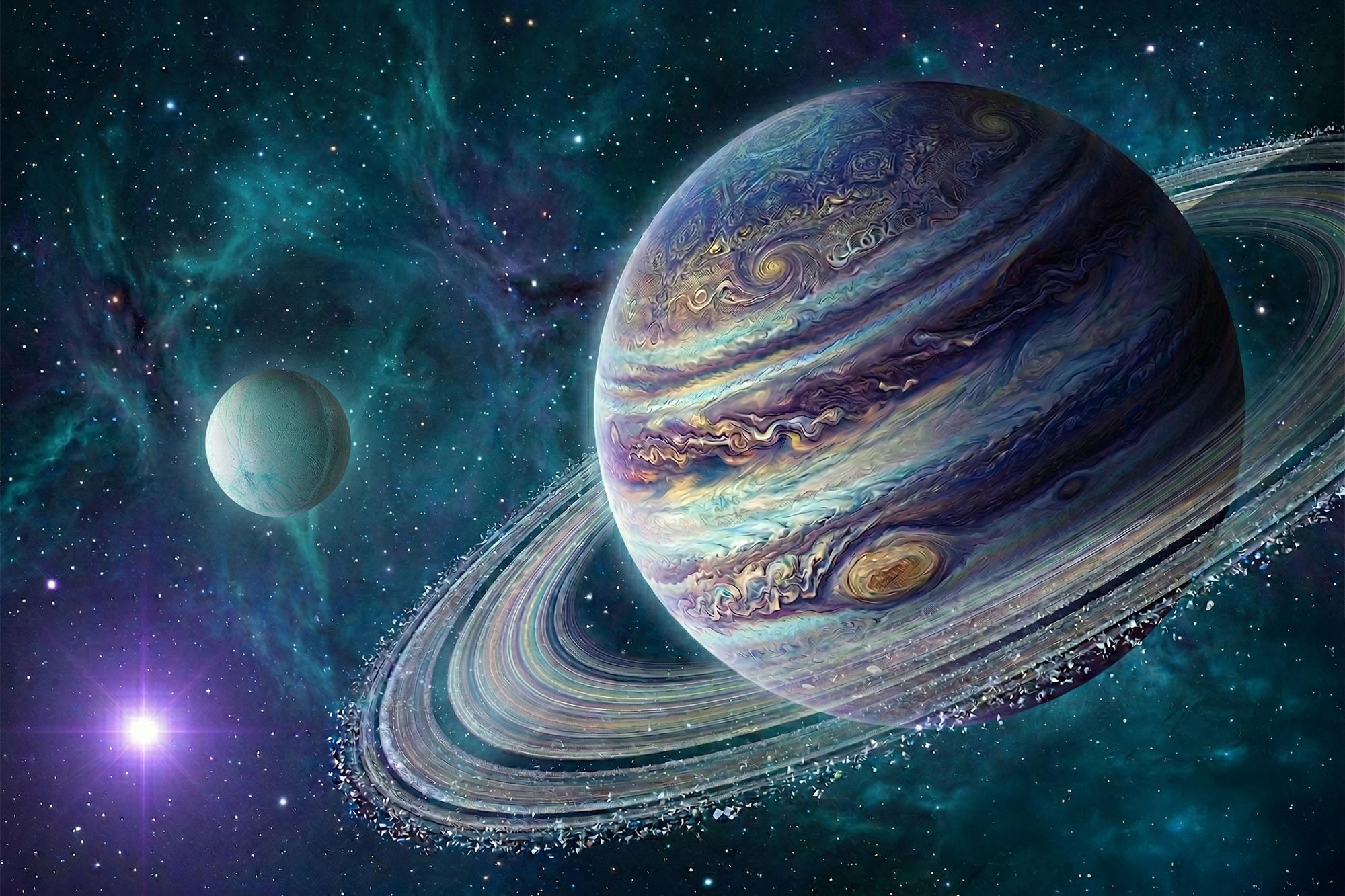
Scientists propose that life-sustaining environments may exist on moons orbiting free-floating planets drifting through interstellar space.
Liquid water is widely seen as a key ingredient for life. New research suggests that stable, life-supporting environments may also exist far from any star. A team from the Excellence Cluster ORIGINS at LMU and the Max Planck Institute for Extraterrestrial Physics (MPE) found that moons orbiting free-floating planets can keep their oceans liquid for up to 4.3 billion years. Dense hydrogen atmospheres combined with tidal heating could sustain these conditions for nearly as long as Earth has existed, long enough for complex life to emerge.
Planetary systems often develop in chaotic ways. When young planets pass too close to each other, gravitational interactions can eject them from their systems. These objects become free-floating planets (FFPs), drifting through the galaxy without a host star. Earlier work by LMU physicist Dr. Giulia Roccetti showed that gas giants expelled in this way can still retain some of their moons.
Tidal heating keeps oceans liquid
After ejection, the orbits of these moons change significantly. They tend to become highly elongated, causing their distance from the planet to vary constantly.
This leads to strong tidal forces that repeatedly flex the moon, compressing its interior and generating heat through friction. This internal heating can be enough to maintain liquid water oceans, even in the extreme cold of interstellar space and without any starlight.
Hydrogen as stable heat trap
Whether that heat remains at the surface depends on the atmosphere. On Earth, carbon dioxide acts as a greenhouse gas. Previous studies suggested it could support habitable conditions on exomoons for up to 1.6 billion years. However, in the frigid environments around free-floating planets, carbon dioxide would freeze and lose its ability to trap heat.
To address this, researchers from astrophysics, biophysics, and astrochemistry explored hydrogen-rich atmospheres. Although molecular hydrogen does not usually absorb infrared radiation well, it behaves differently under high pressure.
A process called collision-induced absorption allows colliding hydrogen molecules to temporarily form structures that can absorb and retain heat. Unlike carbon dioxide, hydrogen remains stable at very low temperatures, making it an effective insulating layer in these conditions.
Parallels to early Earth
The study also offers insight into how life might begin.
“Our collaboration with the team of Professor Dieter Braun helped us recognize that the cradle of life does not necessarily require a sun,” says David Dahlbüdding, doctoral researcher at LMU and lead author of the study. “We discovered a clear connection between these distant moons and the early Earth, where high concentrations of hydrogen through asteroid impacts could have created the conditions for life.”
Tidal forces may do more than provide heat. The repeated stretching and squeezing of a moon can create wet-dry cycles, where water evaporates and then condenses again. These cycles are thought to play a key role in forming complex molecules and may support critical steps toward the origin of life.
Moons hospitable to life in interstellar space
Free-floating planets could be widespread across the Milky Way. Some estimates suggest they may be as numerous as stars. Their moons, if present, could offer stable environments for billions of years. These findings expand the range of places where life might exist and suggest that living systems could arise and persist even in the darkest parts of the galaxy.
Reference: “Habitability of Tidally Heated H2-Dominated Exomoons around Free-Floating Planets” by David Dahlbüdding, Tommaso Grassi, Karan Molaverdikhani, Giulia Roccetti, Barbara Ercolano, Dieter Braun and Paola Caselli, 24 February 2026, Monthly Notices of the Royal Astronomical Society.
DOI: 10.1093/mnras/stag243
Never miss a breakthrough: Join the SciTechDaily newsletter.
Follow us on Google and Google News.
1 Comment
Scientific reports are very wonderful