
Neurons that die early in Alzheimer’s help drive brain waste removal. Treating this process sooner could change outcomes.
Researchers at the University of Queensland have uncovered a critical connection between the brain’s waste removal system and the loss of neurons tied to Alzheimer’s disease.
According to Professor Elizabeth Coulson of UQ’s School of Biomedical Sciences and the Queensland Brain Institute, the study shows that early neuronal decline is closely linked to failures in the brain’s ability to clear waste. This discovery may offer insight into how Alzheimer’s first takes root.
“The research focused on specific brain neurons which are the first to die in Alzheimer’s disease,” Professor Coulson said.
“Our previous studies found the degeneration of these brain neurons and build-up of toxic proteins go hand-in-hand in Alzheimer’s disease. The brain has inbuilt cleaning systems to rid it of waste and toxins, which is essential to cognitive health and preventing neurodegenerative diseases. However, how the brain knows to empty the waste is still unclear.”
Neurons control fluid movement
Associate Professor Kai-Hsiang Chuang, the lead author from UQ’s School of Biomedical Sciences, explained that the findings could help shape new tools and therapies aimed at addressing early-stage neurodegeneration.
“The 5-year study involved 25 participants between the ages of 60 and 90, including 10 individuals showing signs of early mild cognitive impairment, as well as animal models,” said Dr. Chuang.
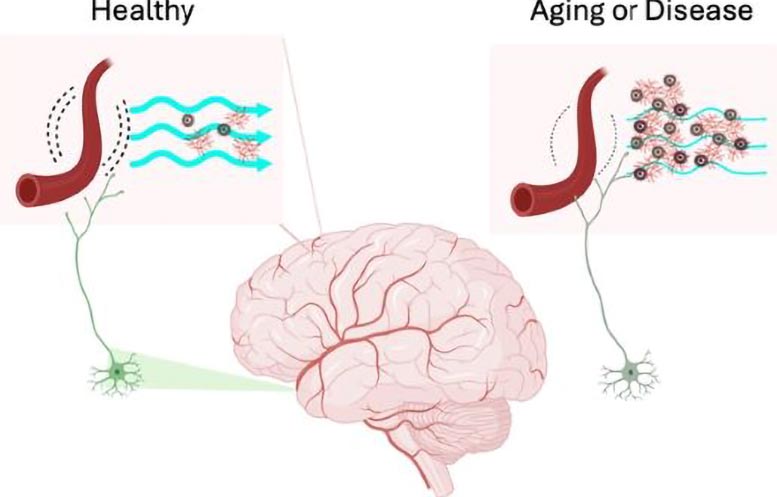
The study revealed that neurons previously associated mainly with cognition also regulate blood and fluid flow responsible for waste removal in the brain. When these neurons become weakened, the brain’s ability to clear waste is reduced.
The team also observed that standard Alzheimer’s medications helped restore some of the fluid movement needed for waste clearance.
Professor Coulson noted that these results question current assumptions about when the brain’s cleaning system is most active.
“Although there has been a lot written about the brain clearing toxins during sleep, this has been debated within the science community,” Professor Coulson said.
“Our studies show the neurons that first die in Alzheimer’s disease are active when we are awake and the brain is active. But more research is needed to examine the association between toxin clearance and sleep-wake states.”
Long-term work on Alzheimer’s mechanisms
These results build on Professor Coulson’s two decades of research, which includes demonstrating that obstructive sleep apnea can lead to neurodegeneration resembling Alzheimer’s, as well as uncovering the role of the brain receptor p75NTR in initiating neuronal death in various diseases.
“We are trying to develop a drug to target this p75 cell death receptor to stop the neurons from dying, not just treat the symptoms of dementia,” Professor Coulson said.
“If that worked, it would be a breakthrough and could improve thousands of lives.”
In a new study, led by Dr. Ying Xia of UQ’s School of Biomedical Sciences and CSIRO eHEALTH group and who collaborated on the current study, researchers are evaluating the effectiveness of current Alzheimer’s drugs.
“We need to determine if they are less effective once neurons are lost, and whether they could change how the disease progresses if we start the treatment earlier,” Dr. Xia said.
“This will help us understand how to identify the patients who are most likely to benefit from existing treatments.”
Reference: “Cholinergic basal forebrain neurons regulate vascular dynamics and cerebrospinal fluid flux” by Kai-Hsiang Chuang, Xiaoqing Alice Zhou, Ying Xia, Zengmin Li, Lei Qian, Eamonn Eeles, Grace Ngiam, Jurgen Fripp and Elizabeth J. Coulson, 23 June 2025, Nature Communications.
DOI: 10.1038/s41467-025-60812-3
Never miss a breakthrough: Join the SciTechDaily newsletter.
Follow us on Google and Google News.