
COVID-19 patients commonly report having headaches, confusion, and other neurological symptoms, but doctors don’t fully understand how the disease targets the brain during infection.
Now, researchers at Tulane University have shown in detail how COVID-19 affects the central nervous system, according to a new study published in Nature Communications.
The findings are the first comprehensive assessment of neuropathology associated with SARS-CoV-2 infection in a nonhuman primate model.
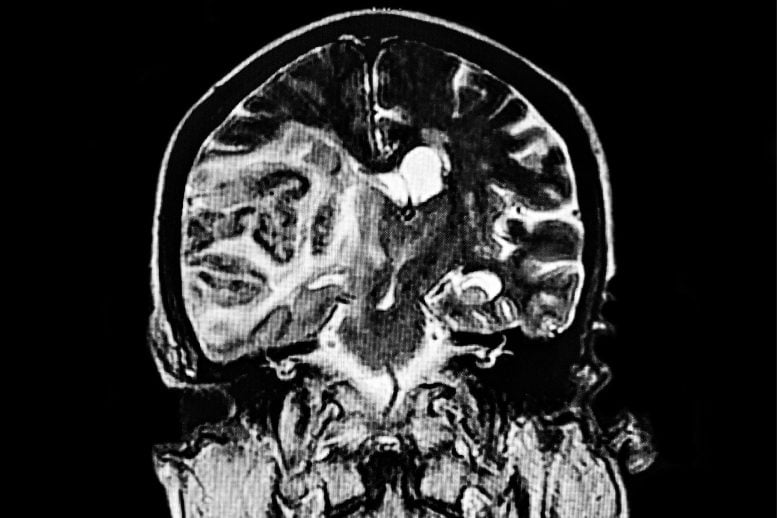
The team of researchers found severe brain inflammation and injury consistent with reduced blood flow or oxygen to the brain, including neuron damage and death. They also found small bleeds in the brain.
Surprisingly, these findings were present in subjects that did not experience severe respiratory disease from the virus.
Long-Term Study on SARS-CoV-2 Brain Damage
Tracy Fischer, PhD, lead investigator and associate professor of microbiology and immunology at the Tulane National Primate Research Center, has been studying brains for decades. Soon after the primate center launched its COVID-19 pilot program in the spring of 2020, she began studying the brain tissue of several subjects that had been infected.
Fischer’s initial findings documenting the extent of damage seen in the brain due to SARS-CoV-2 infection were so striking that she spent the next year further refining the study controls to ensure that the results were clearly attributable to the infection.
“Because the subjects didn’t experience significant respiratory symptoms, no one expected them to have the severity of disease that we found in the brain,” Fischer said. “But the findings were distinct and profound, and undeniably a result of the infection.”
The findings are also consistent with autopsy studies of people who have died of COVID-19, suggesting that nonhuman primates may serve as an appropriate model, or proxy, for how humans experience the disease.
Neurological Complications and Long COVID Implications
Neurological complications are often among the first symptoms of SARS-CoV-2 infection and can be the most severe and persistent. They also affect people indiscriminately —all ages, with and without comorbidities, and with varying degrees of disease severity.
Fischer hopes that this and future studies that investigate how SARS-CoV-2 affects the brain will contribute to the understanding and treatment of patients suffering from the neurological consequences of COVID-19 and long COVID.
Reference: “Neuropathology and virus in brain of SARS-CoV-2 infected non-human primate” by Ibolya Rutkai, Meredith G. Mayer, Linh M. Hellmers, Bo Ning, Zhen Huang, Christopher J. Monjure, Carol Coyne, Rachel Silvestri, Nadia Golden, Krystle Hensley, Kristin Chandler, Gabrielle Lehmicke, Gregory J. Bix, Nicholas J. Maness, Kasi Russell-Lodrigue, Tony Y. Hu, Chad J. Roy, Robert V. Blair, Rudolf Bohm, Lara A. Doyle-Meyers, Jay Rappaport and Tracy Fischer, 1 April 2022, Nature Communications.
DOI: 10.1038/s41467-022-29440-z
The COVID-19 pilot research program at the Tulane National Primate Research Center was supported by funds made possible by the National Institutes of Health Office of Research Infrastructure Program, Tulane University and Fast Grants.
Never miss a breakthrough: Join the SciTechDaily newsletter.
Follow us on Google and Google News.
10 Comments
I suspect that many diseases(especially during childhood and puberty), have long term effects that we did not understand at the time, but are finding out now.
In time the full picture of long term damage to covid infected patients will be alot clearer. This is a new virus and it’s long term will take time to uncover…
My first sign of CoVid was it felt like my entire brain was on fire. I suffered delirium and excrutiating migraines after. I now have tinnitus made worse when working on regaining memory. Suffering long term symptoms.
Having Covid that attack my brain was absolutely horrible my brain was on fire I couldn’t get out of bed for months. I lost my hearing the ringing is constant and the dizziness still trying to manage it thanks to my neurologist. It’s been a year and half and I don’t think it’s ever going to go away.
A suffering long hauler
Yet the public is becoming happily resigned to Covid being a normal rite of passage, “just like getting a cold.” How are we still so willingly ignorant of the risks of this novel, ever-changing disease and so blithely arrogant about its long-term impact? The impact of long-term Covid is going to be an ongoing and very costly tragedy for all of us.
Very Interesting.
1. Covid-19 Virus is a stealth bomber. Not just respiratory infection.
2. Early in the start of the infection it was clear that it had breeched the blood-brain barrier and affected the Controller of the human ecosystem. The Brain.
3. The damage to the Brain and neurological sub-system and the Neuron Damage is not unique in the history of Viral infection or bacterial infections affecting humans. For example, Brain Fever in African Sub-Continent due to insect bite, and also deadly brain influenza caused by a mosquito bite (bacterial?) are known diseases, both leading to rapid death. In addition a pathogen like Guinea Worms in the Humn Ecosystem cn cause great pain and havoc. Dogs re more suceptible to Guinea Worms.
4. I suspect that the Covid-19 variant and its countless mutatnts identified as variants of concern, use different mechanisms for fusing with cells, in various sub-systems of the Human Ecosystem. The assumption that only the spike protien is responsible single handedly, in all cases of fusion with human cells , may be incorrect, though it appears to be the dominant method for the majority of the infection and infalmmation in the said sub-system, as the immune system defenders come to fight the invaders. If the C19 Virus wins and ovwrwhelms the Immune system defenders, the organ under atack fails, leading to death. Many Covid 19 patients died as a result of multipe organ failures.
5. It is going to be a long haul battle/ War aganst the impact of the Covid-19 on the organs left behind , even after the Covid-19 infection has been removed from the Human Ecosystem. This includes the Organ we call Brain. We will will need to develop Brain Repair technologies using Stem Cell progenitors, to replace Brain Cells damaged wth fresh ones?
Views expressed are personal and not binding on anyone.
… more easy to rule them now days. more easy for the queens and kings of a tribe… no change there, but kmekkkeekee..
Nice PLANTED comments here
I want to know how many that are experiencing the brain problems, have been vaccinated… ? 👀
I am curious as to how much research is being done on the damage to taste and smell long term. I had it almost a year ago and my taste and smell came back and then about 3 months later it went away again and my taste makes everything taste horrible. My smell comes and goes. I have read online that there are a lot of other people like me struggling with this damage from Covid. It’s horrible. Hopefully they will find something to help people like me and several others soon.