
Close Menu
    Facebook X (Twitter) Instagram
    SciTechDaily
    • Biology
    • Chemistry
    • Earth
    • Health
    • Physics
    • Science
    • Space
    • Technology
    Facebook X (Twitter) Pinterest YouTube RSS
    SciTechDaily
    Home»Biology»Crunchy or Mushy? Maggots Have a Secret Way to Taste Texture
    Biology

    Crunchy or Mushy? Maggots Have a Secret Way to Taste Texture

    By PLOSFebruary 4, 2025No Comments4 Mins Read
    Facebook Twitter Pinterest Telegram LinkedIn WhatsApp Email Reddit
    Share
    Facebook Twitter LinkedIn Pinterest Telegram Email Reddit
    Maggot Apple
    New research shows that maggots rely on specific neurons to assess food texture, not just flavor. When these neurons were switched off, the larvae could no longer distinguish between too-hard and too-soft food.

    Scientists have discovered that fruit fly larvae can actually “taste” food texture, thanks to specialized neurons in their mouthparts.

    By disabling these neurons, researchers found that the larvae lost their ability to judge food hardness, attempting to eat things they normally wouldn’t. Surprisingly, the same neurons that detect sugar can also sense mechanical properties like food texture. This discovery suggests that our understanding of taste is more complex than previously thought, opening the door to further research in humans.

    Neurons That Taste Food Texture

    Scientists at the University of Fribourg in Switzerland, led by Nikita Komarov and Simon Sprecher, have discovered that fruit fly larvae can detect food texture using specialized neurons in their mouths. Their study, published in PLOS Biology on January 30th, reveals that these neurons, located in the larvae’s peripheral taste organs, contain mechanoreceptors that sense texture. This ability is linked to the painless gene, which plays a key role in their function.

    While most research on taste focuses on flavors like sweetness or saltiness, food texture also shapes eating preferences. For example, someone may enjoy the taste of mushrooms but dislike their rubbery consistency. While flavor perception relies on chemical signals, texture detection requires mechanical sensation, and it remains unclear whether taste organs like the tongue have this ability. To explore this, researchers studied fruit fly larvae—commonly known as maggots—because of their simple nervous system and the availability of powerful genetic tools.
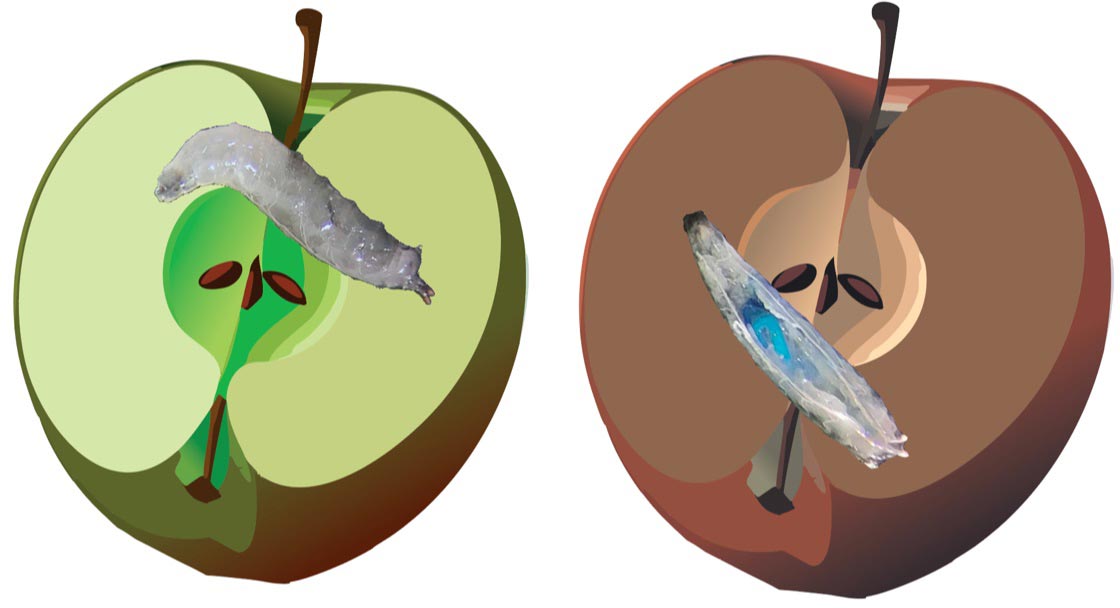
    Larvae Prefer Rotting Fruit
    Larvae navigate and prefer older, rotting fruit compared to fresh fruit. Credit: Nikita Komarov, modified using Adobe Illustrator 2024 from Komarov N, et al., 2025, PLOS Biology, CC-BY 4.0

    Maggots and Their Texture Preferences

    The researchers established that maggots will not eat food that is too hard or too soft, but if it is just right—corresponding to days old decaying fruit—they dig in.

    Hypothesizing that this ability to sense food texture takes place in the peripheral taste organs, the researchers selectively disabled taste neurons in the larva mouth. As a result, the maggots lost their sense of taste texture and tried eating food that was softer or harder than their usual preference. Further experiments revealed that the painless mechanoreceptor gene is required for this sense.

    Lastly, they found that the C6 neuron in the maggot taste organ can sense both sugar and mechanical stimulation, meaning that the same neuron can taste food texture and food substance. Taste sensation and signal integration is thus quite different from other systems, and investigations beyond fruit flies are needed to fully understand taste perception in mammals, including humans.

    Reevaluating Food Texture in Taste Science

    The authors add, “Food texture remains a neglected attribute of overall food fitness. We find – with the power of Drosophila genetics – that at least the hardness of food is a crucial aspect of the overall gustatory profile. Excitingly the same neurons that sense chemicals in the taste system can in some cases sense texture.”

    Reference: “Food hardness preference reveals multisensory contributions of fly larval gustatory organs in behaviour and physiology” by Nikita Komarov, Cornelia Fritsch, G. Larisa Maier, Johannes Bues, Marjan Biočanin, Clarisse Brunet Avalos, Andrea Dodero, Jae Young Kwon, Bart Deplancke and Simon G. Sprecher, 30 January 2025, PLOS Biology.
    DOI: 10.1371/journal.pbio.3002730

    This work was supported by the Swiss National Science Foundation grant 310030_219348 and IZKSZ3_218514 to SGS. The funder had no role in the study design, data collection and analysis, decision to publish, or preparation.

    Never miss a breakthrough: Join the SciTechDaily newsletter.
    Follow us on Google and Google News.

    Chemical Biology Food Science Neuroscience PLOS Taste
    Share. Facebook Twitter Pinterest LinkedIn Email Reddit

    Related Articles

    Magnetic Brain Stimulation Can Improve Memory

    Protein Made in the Liver May Cause Alzheimer’s Disease in the Brain

    Taste Cells Can Control a Whole Animal’s Foraging Strategy

    Tasting Light: Mapping the Cellular Circuits Behind Spitting

    Neurotransmitter Levels in the Brain Predict Math Ability

    Evidence of Sleep-Dependent Brain Activity in Clearing Toxic Proteins and Preventing Alzheimer’s Disease

    New Insights Into How Whisker Bending Translates to Sensory Touch Signals

    Human Screams Communicate at Least Six Emotions – Surprisingly Acoustically Diverse

    Key Factor Identified That Makes Worms Feel Full – Similar Factor May Control Feelings of Fullness in Humans

    Leave A Reply Cancel Reply

    • Facebook
    • Twitter
    • Pinterest
    • YouTube

    Don't Miss a Discovery

    Subscribe for the Latest in Science & Tech!

    Trending News

    Scientists Uncover Potential Brain Risks of Popular Fish Oil Supplements

    Scientists Discover a Surprising Way To Make Bread Healthier and More Nutritious

    After 60 Years, Scientists Uncover Unexpected Brain Effects of Popular Diabetes Drug Metformin

    New Research Uncovers Hidden Side Effects of Popular Weight-Loss Drugs

    Scientists Rethink Extreme Warming After Surprising Ocean Discovery

    Landmark Study Links Never Marrying to Significantly Higher Cancer Risk

    Researchers Discover Unknown Beetle Species Just Steps From Their Lab

    Largest-Ever Study Finds Medicinal Cannabis Ineffective for Anxiety, Depression, PTSD

    Follow SciTechDaily
    • Facebook
    • Twitter
    • YouTube
    • Pinterest
    • Newsletter
    • RSS
    SciTech News
    • Biology News
    • Chemistry News
    • Earth News
    • Health News
    • Physics News
    • Science News
    • Space News
    • Technology News
    Recent Posts
    • Scientists Discover Caffeine Can Repair Key Memory Circuits After Sleep Loss
    • Strange 65-Foot Dinosaur Discovered in Argentina
    • Researchers Uncover Source of Strange Deformation in Earth’s Largest Continental Rift
    • Scientists Solve Mystery of Where the Colorado River Vanished Millions of Years Ago
    • Not Just Alzheimer’s: Scientists Uncover Clues to a Second, Overlooked Disorder
    Copyright © 1998 - 2026 SciTechDaily. All Rights Reserved.
    • Science News
    • About
    • Contact
    • Editorial Board
    • Privacy Policy
    • Terms of Use

    Type above and press Enter to search. Press Esc to cancel.