
Close Menu
    Facebook X (Twitter) Instagram
    SciTechDaily
    • Biology
    • Chemistry
    • Earth
    • Health
    • Physics
    • Science
    • Space
    • Technology
    Facebook X (Twitter) Pinterest YouTube RSS
    SciTechDaily
    Home»Space»Cygnus Spacecraft Installed to Space Station for Cargo Transfers
    Space

    Cygnus Spacecraft Installed to Space Station for Cargo Transfers

    By NASAFebruary 22, 2022No Comments3 Mins Read
    Facebook Twitter Pinterest Telegram LinkedIn WhatsApp Email Reddit
    Share
    Facebook Twitter LinkedIn Pinterest Telegram Email Reddit
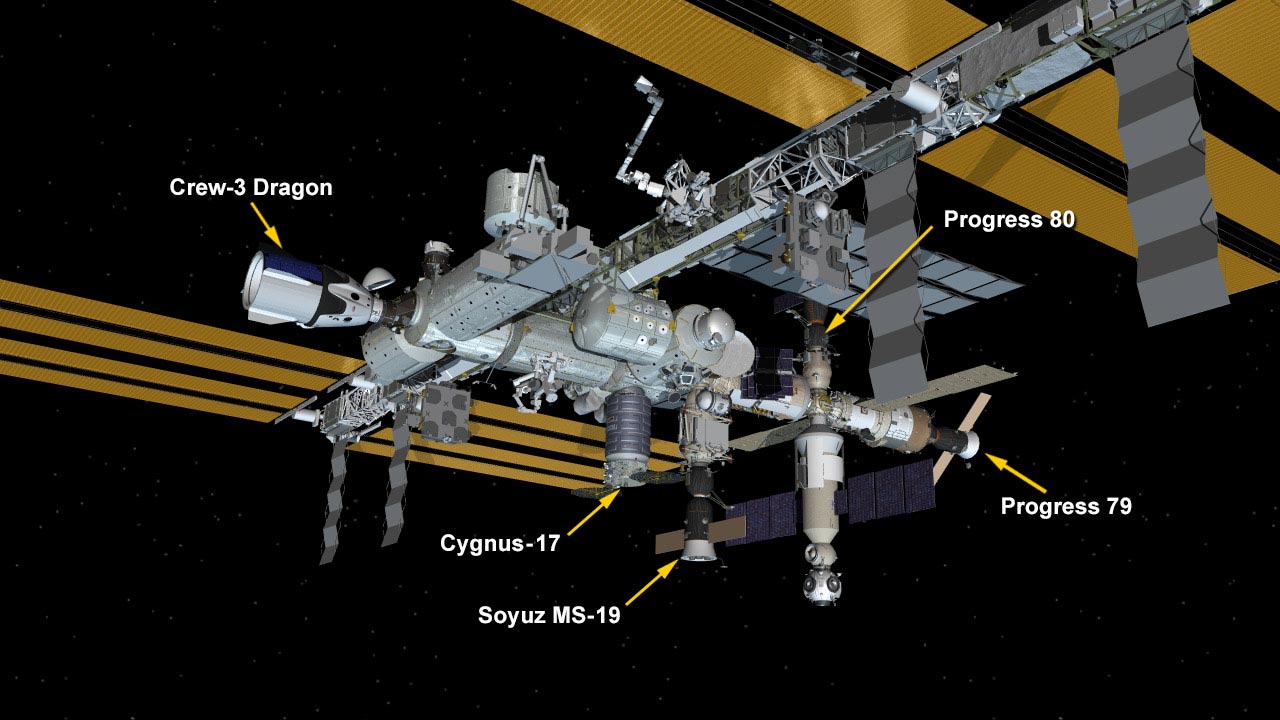
    ISS Configuration February 2022
    February 21, 2022: International Space Station Configuration. Five spaceships are parked at the space station including the SpaceX Crew Dragon; Northrop Grumman’s Cygnus space freighter; and Russia’s Soyuz MS-19 crew ship and the Progress 79 and 80 resupply ships. Credit: NASA

    Northrop Grumman’s Cygnus spacecraft installation on the International Space Station is now complete. Cygnus launched atop an Antares rocket at 12:40 p.m. EST Saturday, February 19 from NASA’s Wallops Flight Facility in Virginia. At about 4:44 a.m. on February 21, NASA astronaut Raja Chari, along with NASA astronaut Kayla Barron as backup, captured Cygnus, carrying 8,300 pounds (3,800 kilometers) of research, hardware, and science experiments to the International Space Station.

    Highlights of space station research facilitated by this mission include:

    • a study that examines the effects of a drug on breast and prostate cancer cells
    • a new combustion facility
    • an investigation from Colgate-Palmolive that will leverage the acceleration of skin aging in microgravity to help create and validate an engineered tissue model to serve as a platform for testing potential products to protect aging skin
    • a demonstration of a lithium-ion secondary battery capable of safe, stable operation under extreme temperatures and in a vacuum environment
    • new hydrogen sensors that will be tested for the space station’s oxygen generation system
    • a system that will test hydroponic and aeroponic techniques for plant growth and will allow scientists to observe root growth through video and still images

    Findings from these and other investigations aboard the space station will contribute to keeping astronauts healthy during long-duration space travel and demonstrate technologies for future human and robotic exploration missions as part of NASA’s Moon and Mars efforts, including lunar missions through the agency’s Artemis program.

    Cygnus will also deliver critical hardware to be installed during the upcoming ISS Roll-Out Solar Array (IROSA) spacewalks, as well as other components for the successful functioning of astronaut life on the space station, such as a trash deployer and acoustic covers for the waste management system.

    This Cygnus mission is the first to feature enhanced capabilities that will allow the spacecraft to perform a reboost, using its engines to adjust the space station’s orbit as a standard service for NASA. The agency has one reboost is planned while Cygnus is connected to the orbiting laboratory. A test of the maneuver was performed in 2018 during Cygnus’ ninth resupply mission.

    Cygnus will remain at the space station until May before it deploys CubeSats, then disposes of several thousand pounds of trash during its re-entry into Earth’s atmosphere, which will result in its destruction.

    Never miss a breakthrough: Join the SciTechDaily newsletter.
    Follow us on Google and Google News.

    International Space Station NASA Northrop Grumman
    Share. Facebook Twitter Pinterest LinkedIn Email Reddit

    Related Articles

    Cygnus’ Fiery Farewell: Space Freighter To Burn Up in Earth’s Atmosphere

    Cygnus Space Freighter Arrives at ISS With Only One Working Solar Array

    Cygnus Spacecraft Prepares for Rendezvous With International Space Station

    NASA Orders Additional Cargo Flights to Space Station From Northrop Grumman and SpaceX

    Northrop Grumman Cygnus Spacecraft Launches NASA Science, Cargo to International Space Station

    Intriguing NASA Science Experiments on Next Northrop Grumman Space Station Mission

    Cygnus Space Freighter Departs International Space Station – On Its Way to Destructive Re-Entry

    NASA Science and Cargo Launches on Northrop Grumman Resupply Mission to Space Station

    Cygnus Space Freighter Departs International Space Station

    Leave A Reply Cancel Reply

    • Facebook
    • Twitter
    • Pinterest
    • YouTube

    Don't Miss a Discovery

    Subscribe for the Latest in Science & Tech!

    Trending News

    New Research Shows Vitamin B12 May Hold the Key to Healthy Aging

    These Simple Daily Habits Can Quickly Improve Blood Pressure and Heart Risk Factors

    A Common Nutrient May Play a Surprising Role in Anxiety

    Doing This After 9 p.m. Could Double Your Risk of Gut Issues

    Scientists Discover How Coffee Impacts Memory, Mood, and Gut Health

    Why Did the Neanderthals Disappear? Scientists Reveal Humans Had a Hidden Advantage

    Physicists Propose Strange Experiment Where Time Goes Quantum

    Magnesium Magic: New Drug Melts Fat Even on a High-Fat, High-Sugar Diet

    Follow SciTechDaily
    • Facebook
    • Twitter
    • YouTube
    • Pinterest
    • Newsletter
    • RSS
    SciTech News
    • Biology News
    • Chemistry News
    • Earth News
    • Health News
    • Physics News
    • Science News
    • Space News
    • Technology News
    Recent Posts
    • This New Memory Technology Could Make Devices Last Months on One Charge
    • Scientists Turn Cancer’s Own Bacteria Against It in Breakthrough Therapy
    • Cannabis Can Make You Remember Things That Never Happened
    • Doctors Are Surprised by What This Vaccine Is Doing to the Heart
    • Quantum Breakthrough Turns Simple Forces Into Powerful New Interactions
    Copyright © 1998 - 2026 SciTechDaily. All Rights Reserved.
    • Science News
    • About
    • Contact
    • Editorial Board
    • Privacy Policy
    • Terms of Use

    Type above and press Enter to search. Press Esc to cancel.