
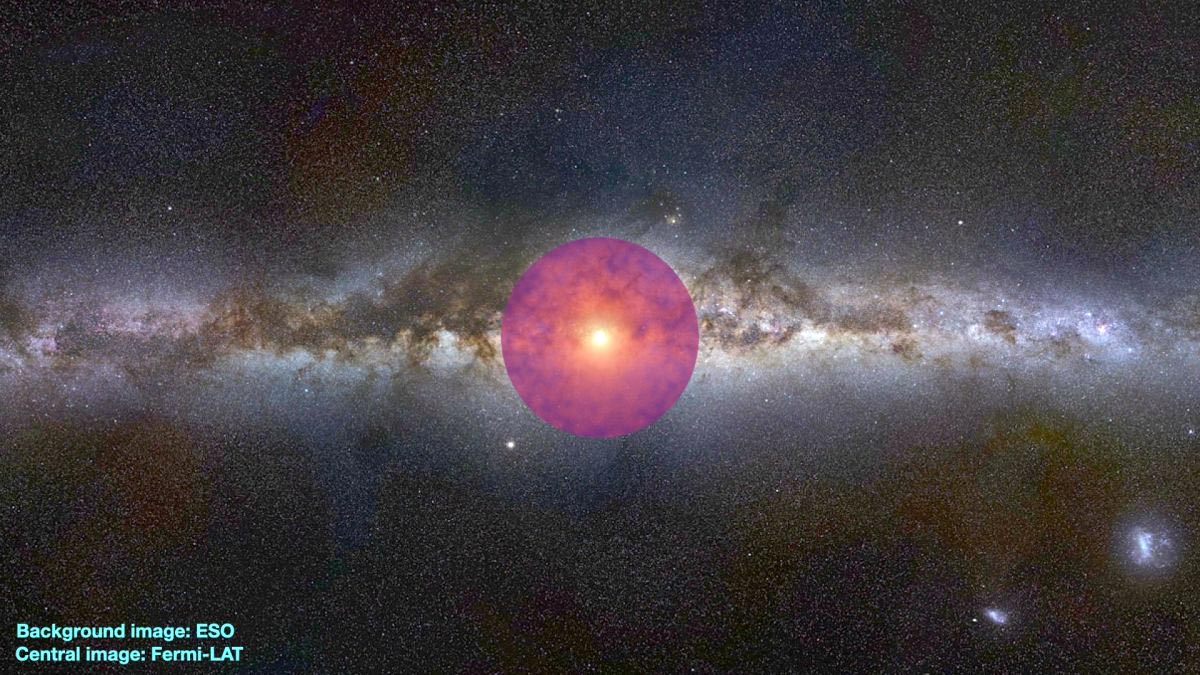
New research confirms that excess gamma rays from the Galactic center may originate from dark matter, supported by data from Fermi LAT, Pamela, and AMS-02. Spatial and energetic properties of the signal align with predictions of dark matter models, including those accounting for positron anomalies.
In the recent past, space missions dedicated to the study of astrophysical signals in the high-energy spectrum revealed a series of enigmatic excesses not predicted by the theoretical models. In order to find an explanation for these anomalies, many solutions have been proposed. The most exciting hypothesis invokes the contribution of the elusive dark matter, the mysterious form of matter 4 times more abundant than ordinary one and of which we have so far detected only its gravitational effects. Two recent theoretical studies carried out by Mattia di Mauro, researcher of the Turin division of INFN, one of which was published in Physical Review D, confirm that this explanation is compatible with measured excesses, further demonstrating that it is not disproven by potential discrepancies between theoretical and observational data.
The results obtained are based on an innovative and refined analysis comparing data acquired in the last 11 years by the main instrument aboard NASA’s Fermi, the Fermi Large Area Telescope (LAT), with measurements of other astronomical anomalies recorded by the orbiting Pamela detector and by the Alpha Magnetic Spectrometer experiment (AMS-02) aboard the International Space Station. Pamela and AMS are managed by international collaborations in which INFN plays a decisive role.
Starting from 2009, the year in which Fermi measurements showed a surplus of photons with energies equal to or greater than 1 GeV (2000 times the mass of an electron) coming from the center of our galaxy, the astrophysics community has tried to explain the observations in several ways, including the possible presence of thousands of weak pulsars near the galactic center and the potential gamma-ray contribution provided by dark matter. These analyses were subject to great uncertainty since they referred to models of the so-called astrophysical gamma-ray background, produced by cosmic rays or by known sources, which, although capable of including a certain variability, are subject to great error.
In order to describe the gamma-ray excess properties more precisely and to evaluate whether it is really compatible with dark matter, the new study relied on the broadest set of data collected in the last year by the LAT, and used an analysis technique that minimizes the uncertainties of the astrophysical background by adopting multiple models.
Energy-Invariant Spatial Distribution Points to Dark Matter
“The analysis methodology used,” explains Mattia di Mauro, “has provided very relevant information about the spatial distribution of excess gamma radiation, which can explain what generates the excess of high-energy photons in the Galactic center. If the excess was, for example, caused by the interaction between cosmic rays and atoms, we would expect to observe its greater spatial distribution at lower energies and its lower diffusion at higher energies due to the propagations of cosmic particles. My study, on the other hand, underlines how spatial distribution of the excess does not change as a function of energy. This aspect had never been observed before and could be explained by dark matter presence dark matter interpretation. This is because we think the particles composing the dark matter halo should have similar energies. The analysis clearly shows that the excess of gamma rays is concentrated in the Galactic center, exactly what we would expect to find in the heart of the Milky Way if dark matter is in fact a new kind of particle.”
A second study, which will be published in the same journal, examines the validity of the dark matter hypothesis using the predictions from a larger model that describes possible particle interactions of this elusive component of the universe. A theoretical model demonstrated how the existence of dark matter particles is not disproven by other anomalies recorded in the astrophysical background. These include the excess of positrons measured by Pamela and AMS-02, if attributed to a surplus of dark matter, and the non-detection of high-energy photons from dwarf galaxies close to ours, whose stellar motions imply the presence of high concentrations of dark matter.
“Starting from the physical model developed in this second study,” Di Mauro continues, “after considering different results for the interaction and annihilation of dark matter particles, alternatives that would precede the production of high-energy photons, we verified which of these possibilities best accorded with the galactic center’s excess gamma rays, while also considering the surplus of positrons and the non-detection of gamma rays from dwarf galaxies. This comparison has made able to derive accurate properties of the dark matter, properties compatible with the galactic center excess and the upper limits found with other particles data.”
Reference: “Characteristics of the Galactic Center excess measured with 11 years of Fermi-LAT data” by Mattia Di Mauro, 22 March 2021, Physical Review D.
DOI: 10.1103/PhysRevD.103.063029
Never miss a breakthrough: Join the SciTechDaily newsletter.
Follow us on Google and Google News.
9 Comments
Everything is as simple as a musical tuning fork.
The collision of electrons with electrons will give the frequency of x-rays. You see x-rays – there are high voltages (giant lightning)
collide electrons.
Collisions of protons with protons and neutrons will give a gamma frequency of 10 ^ 20 Hz. This is where the synthesis of nucleons in the centers of galaxies takes place.
Collisions of quarks with quarks will give a frequency of a hard beam of 10 ^ 32 Hz. Here synthesis of quarks takes place. It can be the Center of Our Universe.
Another call me maybe report. You guys are clueless , but won’t admit it because you would all go broke. telling fibs for a living is not living. Go do something useful like build some wells and houses for poor folk.
… it is dark to you, …
Încercați să găsiți modul de propagare a “gândului” şi poate vom ajunge la o soluție.Darun lucru este sigur.Cu cât vomşti mai mult,cu atât vom fi mai nefericiți.
No it isn’t.
The visible universe is ìnert.That is speaķ every things,the ĺaws are whìch control all visibĺe matter(energy)are fìxed havìng no alteration,the ingradients foming matter/energy are fixed.The speed of light is fixed radical point òf physics.Amount òf total mass and energy is fixed.So hòw a fĺuctuation can be determined to term this or by dark energy/matter and pròcess of formulation to account such phenomena if present.
Galactic Center Gamma-ray excess most likely has an an astrophysical source. A population of millions of Millisecond Pulsars (rapidly rotating neutron stars) in the Galactic bulge is a much more plausible explanation. Many recent studies have shown the same.
I’m sticking to my “it’s in the deep oceans earth crust/tectonic plates.Core was the result of the big bang theory in true supernova fashion. As ordinary Matter formed so did the dark matter deep down while it became cool & heated again with H20 forming..it was decaying now & emitting gamma rays that are still bouncing around in space feeding off particles & other decaying supernovas with h20 that was expelled from earth when that brown planet hit us & we fused with it basically creating another supernova effect more temperature changes. More gamma rays..More decaying & more dark matter & this is an uneven earth crust..tectonic plates moving bc the dark matter is turning into dark energy with it having interactions with hydrogen & gamma rays creating a plasma & this is all in the deep unexplored biosphere. With big a** Bio-luminous creatures that thrive in the dark deep ocean. All types of algae & polyps creating ongoing supply of oxgen. And storms are really brought on by the moons gravitational pull & the dark matters gravitational homeostasis the hot core spinning on an axis still causing under the surface little supernovas that cool decay & emit more excited gamma rays that shoot out the oxygen rich deep ocean & the barometric pressure is low so now these gamma rays just thriving off the electrical charge in the air as waves reach for the moons pull but the dark energy is keeping pulling that tide back so hard now bam gamma rays are so light with less oxygen getting all positively charged up with the electrons in the air hydrogen & oxygen chilling in electric static boom thundarrr plasma aka lightening strikes & there we humans are depressed & sad bc it’s a rainy day or our frequencies are off bc we have low barometric pressure & we eat too much or too less of the metals & sodium so we just got all this off balance s*** going on now. Yeah thats my story & I’m sticking to it. Drink alkaline water & stop eating processed foods.
I’m sticking to my “it’s in the deep oceans earth crust/tectonic plates.Core was the result of the big bang theory in true supernova fashion. As ordinary Matter formed so did the dark matter deep down while it became cool & heated again with H20 forming..it was decaying now & emitting gamma rays that are still bouncing around in space feeding off particles & other decaying supernovas with h20 that was expelled from earth when that brown planet hit us & we fused with it basically creating another supernova effect more temperature changes. More gamma rays..More decaying & more dark matter & this is an uneven earth crust..tectonic plates moving bc the dark matter is turning into dark energy with it having interactions with hydrogen & gamma rays creating a plasma & this is all in the deep unexplored biosphere. With big ass Bio-luminous creatures that thrive in the dark deep ocean. All types of algae & polyps creating ongoing supply of oxgen. And storms are really brought on by the moons gravitational pull & the dark matters gravitational homeostasis the hot core spinning on an axis still causing under the surface little supernovas that cool decay & emit more excited gamma rays that shoot out the oxygen rich deep ocean & the barometric pressure is low so now these gamma rays just thriving off the electrical charge in the air as waves reach for the moons pull but the dark energies pull got the tide coming in hard & bam HOT ELECTRIFIED PLASMA AKA lightening now u all off balance. Don’t have enough or too much metal & sodium..frequency all off. See..drink alkaline water & less processed food.