
Close Menu
    Facebook X (Twitter) Instagram
    SciTechDaily
    • Biology
    • Chemistry
    • Earth
    • Health
    • Physics
    • Science
    • Space
    • Technology
    Facebook X (Twitter) Pinterest YouTube RSS
    SciTechDaily
    Home»Technology»DARPA Grants Phase 2-4 Contract for Unmanned Sub-Hunting Vessel
    Technology

    DARPA Grants Phase 2-4 Contract for Unmanned Sub-Hunting Vessel

    By DARPAAugust 16, 2012No Comments2 Mins Read
    Facebook Twitter Pinterest Telegram LinkedIn WhatsApp Email Reddit
    Share
    Facebook Twitter LinkedIn Pinterest Telegram Email Reddit
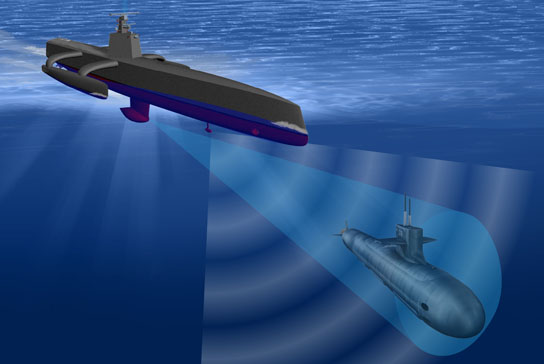
     Anti-Submarine Warfare Continuous Trail Unmanned Vessel (ACTUV) program
    Artist’s impression of DARPA’s autonomous surface vessel tracking and following enemy subs. Credit: DARPA

    DARPA granted a contract for Phases 2-4 of its Anti-Submarine Warfare Continuous Trail Unmanned Vessel program and expects operational prototype at-sea testing to begin in mid-2015.

    The growing number of adversaries able to build and operate quiet diesel-electric submarines is a national security threat that affects U.S. and friendly naval operations around the world. To address this emerging threat, DARPA recently awarded a contract for Phases 2-4 of its Anti-Submarine Warfare (ASW) Continuous Trail Unmanned Vessel (ACTUV) program to Science Applications International Corporation, McLean, Va.

    During Phases 2-4 the ACTUV program will attempt to design, construct and demonstrate an unmanned vessel that tracks quiet diesel-electric submarines for months at a time spanning thousands of kilometers of ocean with minimal human input.

    “Key features and technology for the vessel include advanced software, robust autonomy for safe operations in accordance with maritime laws, and innovative sensors to continuously track the quietest of submarine targets,” said Scott Littlefield, DARPA program manager.

    If successful, ACTUV would create a technological strategic advantage against the burgeoning quiet submarine threat and reduce manpower and other costs associated with current ASW trail operations.

    “Our goal is to transition an operational game-changer to the Navy,” said Littlefield. “This should create an asymmetry to our advantage, negating a challenging submarine threat at one-tenth their cost of building subs. The program also establishes foundational technologies for future unmanned naval systems.”

    During Phase 1 the program refined and validated the system concept, completing risk reduction testing associated with submarine tracking sensors and maritime autonomy. Operational prototype at-sea testing is expected in mid-2015.

    Never miss a breakthrough: Join the SciTechDaily newsletter.
    Follow us on Google and Google News.

    DARPA Defense Military Oceanography
    Share. Facebook Twitter Pinterest LinkedIn Email Reddit

    Related Articles

    One Giant Leap for MIT’s Robotic Mini Cheetah

    New Technology “Listens” for Right Whales – One of the World’s Most Endangered Whale Species

    Researchers Develop Speedier Network Analysis to Boost Recommendation Algorithms and Internet Search

    Photoacoustic Airborne Sonar System Combines Light and Sound to See Underwater

    MIT Rapid Agent Aerosol Detector: Highly Sensitive Trigger Enables Fast Detection of Biological Agents

    Battery-Free Ocean Exploration: MIT Underwater Navigation System Powered by Sound

    DARPA Invisible Man: Human Cells Engineered With Squid-Like Transparency

    Second Skin Protects Against Chemical Weapons, Biological Warfare Agents

    DARPA Program Takes Advantage of Floating Icebergs

    Leave A Reply Cancel Reply

    • Facebook
    • Twitter
    • Pinterest
    • YouTube

    Don't Miss a Discovery

    Subscribe for the Latest in Science & Tech!

    Trending News

    Just 10 Minutes a Day: Scientists Say This Ancient Chinese Practice Shows Powerful Blood Pressure Benefits

    Scientists Say This Popular Food Could Help Your Body Get Rid of Microplastics

    For the First Time, ChatGPT Has Solved an Unproven Math Problem in Geometry

    This Popular Supplement May Actually Slow Biological Aging, Scientists Reveal

    Can a Common Vitamin Fight the Most Aggressive Brain Cancer?

    Scientists Discover How to Stop Vision Loss Before It Starts

    The Mediterranean Isn’t Safe: Scientists Warn of Inevitable Tsunami

    Scientists Say Washing Dishes With a Sponge Has a Concerning Side Effect

    Follow SciTechDaily
    • Facebook
    • Twitter
    • YouTube
    • Pinterest
    • Newsletter
    • RSS
    SciTech News
    • Biology News
    • Chemistry News
    • Earth News
    • Health News
    • Physics News
    • Science News
    • Space News
    • Technology News
    Recent Posts
    • A 30-Year-Old Flu Shot Still Works Today With One Big Problem
    • Widely Available Drug Found To Ease One of Long COVID’s Most Stubborn Symptoms
    • New Study Finds Internalized Stress May Accelerate Cognitive Decline
    • Stopping Weight-Loss Drugs Like Ozempic Can Quickly Erase Heart Benefits
    • A 500-Million-Year-Old Surprise Is Forcing Scientists to Rethink Spider Evolution
    Copyright © 1998 - 2026 SciTechDaily. All Rights Reserved.
    • Science News
    • About
    • Contact
    • Editorial Board
    • Privacy Policy
    • Terms of Use

    Type above and press Enter to search. Press Esc to cancel.