
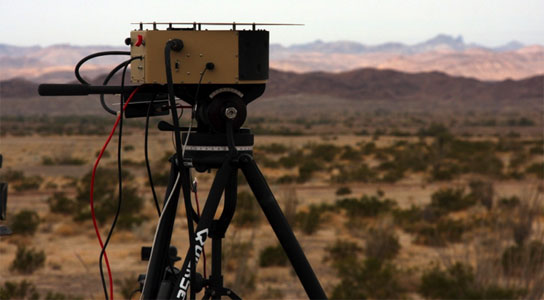
Launched in 2008 to improve the ability to detect threats from standoff distances, DARPA’s CT2WS program uses human brainwaves, improved sensors, and cognitive algorithms to improve visual threat detection, identifying up to 91 percent of targets during testing with extremely low false-alarm rates and widening a warfighter’s field of view to 120 degrees.
For warfighters operating in the field, the ability to detect threats from standoff distances can be life-saving. When advanced radar and drone coverage are not available, warfighters typically rely on their own vision to scan their surroundings. Scanning over a wide area, though, is challenging because of the amount of territory that must be reviewed, the limited field of view of the human eye, and the effects of fatigue. Current technologies like binoculars, cameras, and portable radars can help to improve visibility and increase the threat detection rate. Unfortunately, current miss rates of 47 percent or greater using these technologies leave warfighters unprepared and vulnerable.
DARPA launched the Cognitive Technology Threat Warning System (CT2WS) program in 2008 with the goal of maximizing warfighters’ awareness of their surroundings by developing man-portable visual threat detection devices. CT2WS succeeded in creating a technology kit capable not only of identifying up to 91 percent of targets during testing with extremely low false-alarm rates, but also widening a warfighter’s field of view to 120 degrees when all components of the kit are used in tandem. By incorporating a commercial radar (the Cerberus Scout surveillance system), target detection reached 100 percent.
“DARPA set out to solve a common challenge for forward troops: how can you reliably detect potential threats and targets of interest without making it a resource drain?” said Gill Pratt, DARPA program manager. “The prototype system has demonstrated an extremely low false alarm rate, a detection rate in the low nineties, all while reducing the load on the operator.”
The CT2WS system includes three component technologies: a 120-megapixel, tripod-mounted, electro-optical video camera with a 120-degree field of view; cognitive visual processing algorithms that can be run on laptops or more powerful computers to identify potential targets and cue images for operator review; and an electroencephalogram (EEG) cap that monitors the operator’s brain signals and records when the operator detects a threat. The components can be configured as necessary to work with existing systems and meet specific mission requirements.
CT2WS built on the concept that humans are inherently adept at detecting the unusual. Even though a person may not be consciously aware of movement or of unexpected appearance, the brain detects it and triggers the P-300 brainwave, a brain signal that is thought to be involved in stimulus evaluation or categorization. By improving the sensors that capture imagery and filtering results, a human user who is wearing an EEG cap can then rapidly view the filtered image set and let the brain’s natural threat-detection ability work. Users are shown approximately ten images per second, on average. Despite that quick sequence, brain signals indicate to the computer which images were significant.
The use of EEG-based human filtering significantly reduces the amount of false alarms. The cognitive algorithms can also highlight many events that would otherwise be considered irrelevant but are actually indications of threats or targets, such as a bird flying by or a branch’s swaying. In testing of the full CT2WS kit, absent radar, the sensor and cognitive algorithms returned 810 false alarms per hour. When a human wearing the EEG cap was introduced, the number of false alarms dropped to only five per hour, out of a total of 2,304 target events per hour, and a 91 percent successful target recognition rate.
Field tests of the CT2WS system were conducted in desert terrain at Yuma Proving Ground in Arizona, in tropical terrain in Hawaii, and in open terrain at California’s Camp Roberts. DARPA provided a final demonstration of the CT2WS system to Army officials at Fort Belvoir, Virginia.
The CT2WS technology is being transitioned to the Army’s Night Vision Lab.
Never miss a breakthrough: Join the SciTechDaily newsletter.
Follow us on Google and Google News.
1 Comment
Cyborgia advances, resistance is futile . . . says the man due for new lenses in his eyes and probably titanium hips in a decade. Hell, why resist?