
Close Menu
    Facebook X (Twitter) Instagram
    SciTechDaily
    • Biology
    • Chemistry
    • Earth
    • Health
    • Physics
    • Science
    • Space
    • Technology
    Facebook X (Twitter) Pinterest YouTube RSS
    SciTechDaily
    Home»Space»DARPA’s Galileo Program to Image Objects in GEO Faster
    Space

    DARPA’s Galileo Program to Image Objects in GEO Faster

    By DARPAJanuary 17, 2012No Comments3 Mins Read
    Facebook Twitter Pinterest Telegram LinkedIn WhatsApp Email Reddit
    Share
    Facebook Twitter LinkedIn Pinterest Telegram Email Reddit
    DARPA’s galileo program to image objects faster
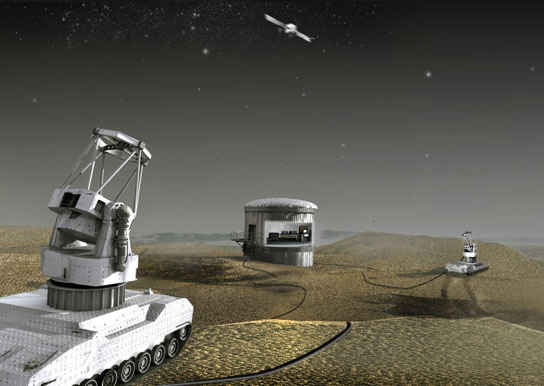
    DARPA aims to speed up the data capture of objects in GEO by connecting more mobile telescopes with flexible fiber optic cables for faster image creation. Credit: DARPA

    Current technology is limited for imaging objects in space since researchers use astronomical long-baseline interferometers and can only view objects from limited angles. DARPA is seeking to change all this by using flexible fiber optic cables to interconnect a larger number of mobile telescopes in the hope that they will be able to capture data of objects in GEO more quickly, which would result in faster image creation.

    Military satellites are critical sources of communications and data for today’s operations environments. Through DARPA’s Phoenix program, useable antennas or solar arrays from retired satellites in geosynchronous orbit (GEO – 36,000 kilometers above the earth) could be removed and potentially repurposed as components for new satellites to provide vital mission support. However, identifying cooperating satellites from which to harvest an array is a difficult and lengthy task using current ground-based satellite imaging techniques. By introducing precise fiber optic controls to ground-based telescopes, this challenge may be overcome. DARPA’s Galileo program seeks to bridge the precision fiber optic controls and long-baseline astronomical interferometry technical communities to enable imaging of objects in GEO faster than is possible today.

    “We know the fiber optic control community is engaged in precision control of light,” explained Air Force Lt. Col. Travis Blake, DARPA program manager. “If those solutions could be meshed with the unique demands of astronomic imaging, we could develop a new means of better, faster imaging of objects in GEO. We encourage experts from both technical communities to participate in Galileo’s upcoming Proposers’ Day.”

    Technology for imaging objects in space uses astronomical long-baseline interferometers, which rely on several interconnected telescopes grouped together to measure light reflections off an astronomical object as it moves across the sky. Current systems, however, can only view space objects from limited angles due to a complicated combination of evacuated light pipes—which can be several hundred feet long—turning mirrors and the active metrology required between telescopes to establish an extremely high-precision optical path.

    Imaging objects in GEO is a slow process because they don’t move much in the sky relative to the Earth’s rotation. Galileo seeks to harness the power of precision fiber optic controls to connect astronomical interferometry telescopes via flexible fiber optics cable, removing the need for rigid light pipes. Fiber optics technology may enable a larger number of interconnected mobile telescopes, which could more quickly capture the data required of an object in GEO from multiple angles, resulting in faster image creation.

    Never miss a breakthrough: Join the SciTechDaily newsletter.
    Follow us on Google and Google News.

    DARPA Fiber Optics GEO Telescope
    Share. Facebook Twitter Pinterest LinkedIn Email Reddit

    Related Articles

    Giant Magellan Telescope Gets Seven 28-Foot Mirrors and Adaptive Optics

    VISTA Telescope Uses IR to Show Helix Nebula In New Light

    Adaptive Optics Will Put Gemini Twin Telescopes at the Forefront of Astronomy Again

    SN Primo Is Farthest Type Ia Supernova Discovered

    Largest Galaxy Cluster in Distant Universe Found by NASA’s Chandra X-ray Observatory

    Comet Lovejoy Streaks Past Desert Telescope

    SOFIA Looking Deep Into the Orion Nebula

    Hubble Reaches New Milestone: 10,000th Scientific Paper Published

    Youngest Supernova Photographed

    Leave A Reply Cancel Reply

    • Facebook
    • Twitter
    • Pinterest
    • YouTube

    Don't Miss a Discovery

    Subscribe for the Latest in Science & Tech!

    Trending News

    Millions Take These IBS Drugs, But a New Study Finds Serious Risks

    Scientists Unlock Hidden Secrets of 2,300-Year-Old Mummies Using Cutting-Edge CT Scanner

    Bread Might Be Making You Gain Weight Even Without Eating More Calories

    Scientists Discover Massive Magma Reservoir Beneath Tuscany

    Europe’s Most Active Volcano Just Got Stranger – Here’s Why Scientists Are Rethinking It

    Alzheimer’s Symptoms May Start Outside the Brain, Study Finds

    Millions Take This Popular Supplement – Scientists Discover a Concerning Link to Heart Failure

    The Universe Is Expanding Too Fast and Scientists Can’t Explain Why

    Follow SciTechDaily
    • Facebook
    • Twitter
    • YouTube
    • Pinterest
    • Newsletter
    • RSS
    SciTech News
    • Biology News
    • Chemistry News
    • Earth News
    • Health News
    • Physics News
    • Science News
    • Space News
    • Technology News
    Recent Posts
    • Scientists Say a Hidden Structure May Exist Inside Earth’s Core
    • Doctors Surprised by the Power of a Simple Drug Against Colon Cancer
    • Why Popular Diabetes Drugs Like Ozempic Don’t Work for Everyone: The “Genetic Glitch”
    • Scientists Create Improved Insulin Cells That Reverse Diabetes in Mice
    • Scientists Stunned After Finding Plant Thought Extinct for 60 Years
    Copyright © 1998 - 2026 SciTechDaily. All Rights Reserved.
    • Science News
    • About
    • Contact
    • Editorial Board
    • Privacy Policy
    • Terms of Use

    Type above and press Enter to search. Press Esc to cancel.