
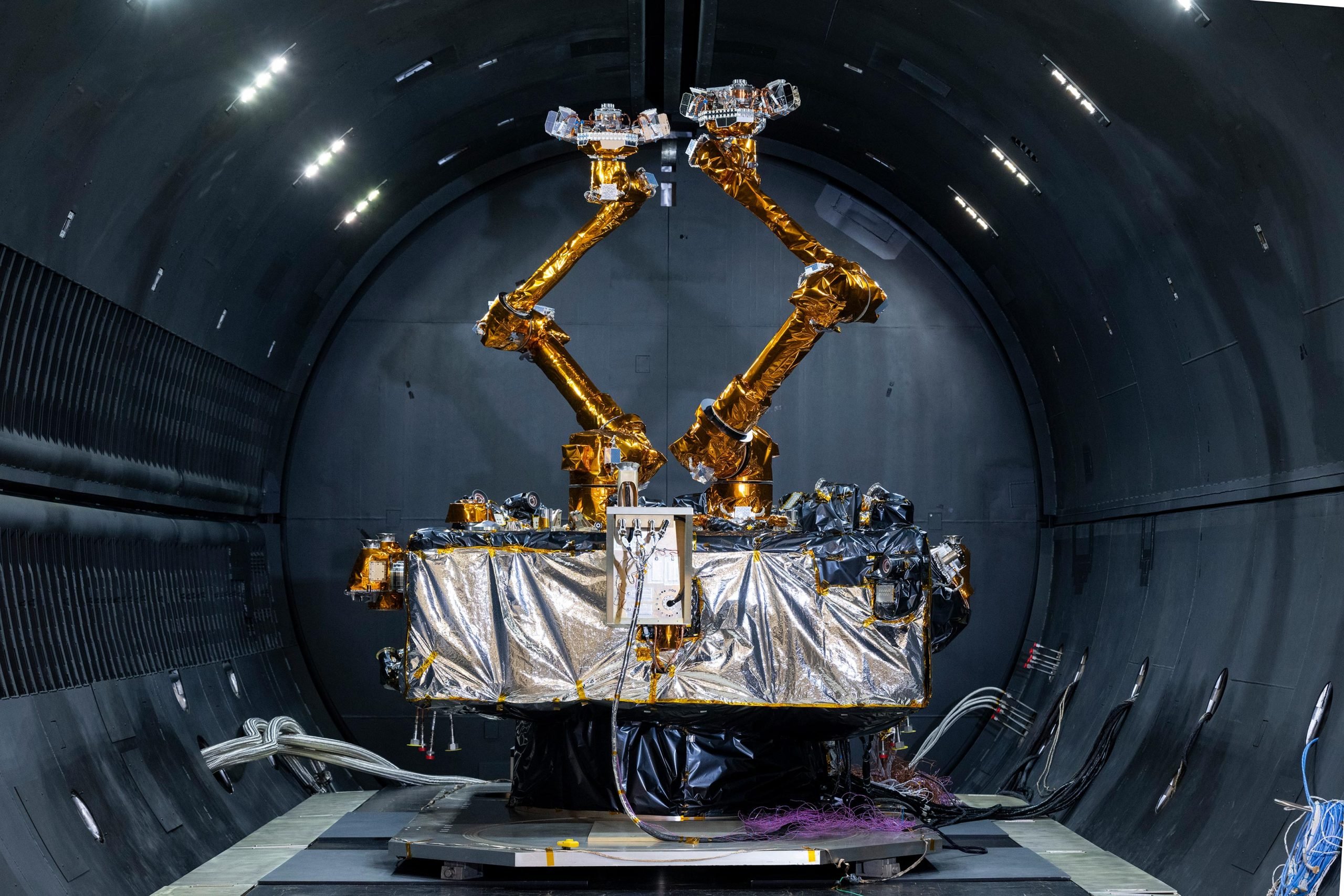
The U.S. Naval Research Laboratory and DARPA have developed a robotic payload capable of servicing satellites in orbit.
This payload, designed to perform repairs and upgrades, promises to revolutionize satellite operations by enhancing longevity and reducing costs associated with satellite servicing. With successful thermal vacuum testing and a partnership with Northrop Grumman, the project is poised for a 2026 launch, setting the stage for a new era of resilient and adaptable space infrastructure.
Transforming Space Operations: NRL and DARPA’s Robotic Revolution
The U.S. Naval Research Laboratory’s (NRL) Naval Center for Space Technology (NCST), in collaboration with the Defense Advanced Research Projects Agency (DARPA), has successfully completed the development of a spaceflight-qualified robotics suite designed to service satellites in orbit. The milestone was achieved on October 8.
Funded by DARPA, NRL developed the Robotic Servicing of Geosynchronous Satellites (RSGS) Integrated Robotic Payload (IRP). This groundbreaking technology has been handed over to DARPA’s commercial partner, Northrop Grumman’s SpaceLogistics, for integration with the Mission Robotics Vehicle (MRV), a spacecraft bus.

Milestones and Future Vision in Space Robotics
“The recent completion of thermal vacuum testing marks a major milestone toward achieving the program’s goal of demonstrating robotic servicing capabilities on orbit in the near future,” said Dr. Bruce Danly, NRL’s Director of Research. “NRL’s contributions to the robotic payload are an essential part of realizing this vision, which promises to transform satellite operations in geostationary orbit, reduce costs for satellite operators, and enable capabilities well beyond what we have today. In fact, the anticipated capabilities are potentially revolutionary for both national security and civil applications.”
As DARPA’s robotic payload developer for the RSGS program, NRL looked to the future to design, build, integrate, and test groundbreaking satellite servicing capabilities.
“This collaboration unlocks new servicing opportunities for both commercial and government satellites, enabling usual-close inspections, orbital adjustments, hardware upgrades, and repairs,” said Bernie Kelm, NRL NCST superintendent of the Spacecraft Engineering Division. “We’ve created advanced spaceflight hardware and software that will significantly enhance satellite servicing operations, including all robotic controls.”

Enhancing Satellite Servicing and Operations
Satellites in geosynchronous orbit, positioned approximately 22,000 miles above Earth, are crucial for military, government, and commercial communications, Earth-observing science, and national security services.
Currently, spacecraft face significant challenges, in part because of the inability to perform in-orbit repairs or upgrades. To compensate for the lack of servicing options, satellites are often loaded with backup systems and excess fuel, leading to increased complexity, weight, and cost. Should this project prove successful, satellites can receive in-orbit upgrades based on new technology to extend their service life, Kelm added.
“The military regularly fixes aircraft, tanks, ships, and trucks that break. We upgrade aircraft and ships with the latest radars, computers, and engines,” said Glen Henshaw, Ph.D., NRL senior scientist for Robotics and Autonomous Systems. “Satellites are the only expensive equipment we buy that can’t be repaired or upgraded once they are in the field, and this costs the taxpayer money. RSGS is intended to change this situation; we intend to demonstrate that we can upgrade and repair these valuable assets using robots.”
Thermal Vacuum (TVAC) Testing Process
The test campaign put the robotic payload through its paces across the range of temperatures it will face while on-orbit and under vacuum conditions similar to space. Engineers tested all aspects of the payload including avionics, cameras, and lights, and demonstrated all operations, with each of its two robotic arms including launch lock deployments, calibrations, and tool changing. The test also verified SpaceWire communications and robotic compliance and visual servo control modes.
“NRL’s Team RSGS has spent nearly 10 years focused on the goal of completing this first of a kind, robotic servicing payload,” said William Vincent, NRL RSGS program manager. “The completion of IRP TVAC represents a huge milestone and countless hours of work from an incredible group of dedicated personnel. Like sending a child off to college for the first time, shipping the IRP to Dulles is a bittersweet experience.”
The Future of Satellite Mechanics and Spacecraft Design
NRL worked for over two decades to mature the technology enabling the RSGS program. RSGS is designed to safely and reliably repair and upgrade valuable commercial, civil, and national security satellites, some of which cost over a billion dollars. In the near future, robotic satellite “mechanics” may extend the useful life of satellites by upgrading a variety of capabilities including new electronics, propulsion, and sensors capabilities. RSGS robots could demonstrate broad servicing as a precursor to building large structures in-orbit which could include the next great observatory, solar power stations, or other revolutionary new systems.
“We hope that this will eventually lead to spacecraft that are more modular and easier to maintain,” Henshaw said.
Following its anticipated 2026 launch on the Northrop Grumman’s MRV spacecraft bus, the robotic payload will undergo initial checkout and calibration with full operational servicing missions to follow.
“We will proudly watch RSGS as it provides resilience for the current U.S. space infrastructure and takes the first concrete steps toward a transformed space architecture with revolutionary capabilities,” Vincent said.
Never miss a breakthrough: Join the SciTechDaily newsletter.
Follow us on Google and Google News.