
Close Menu
    Facebook X (Twitter) Instagram
    SciTechDaily
    • Biology
    • Chemistry
    • Earth
    • Health
    • Physics
    • Science
    • Space
    • Technology
    Facebook X (Twitter) Pinterest YouTube RSS
    SciTechDaily
    Home»Health»Data Inaccuracies Corrected: First Wave COVID-19 Data Underestimated Pandemic Infections
    Health

    Data Inaccuracies Corrected: First Wave COVID-19 Data Underestimated Pandemic Infections

    By American Institute of PhysicsJune 23, 2021No Comments3 Mins Read
    Facebook Twitter Pinterest Telegram LinkedIn WhatsApp Email Reddit
    Share
    Facebook Twitter LinkedIn Pinterest Telegram Email Reddit
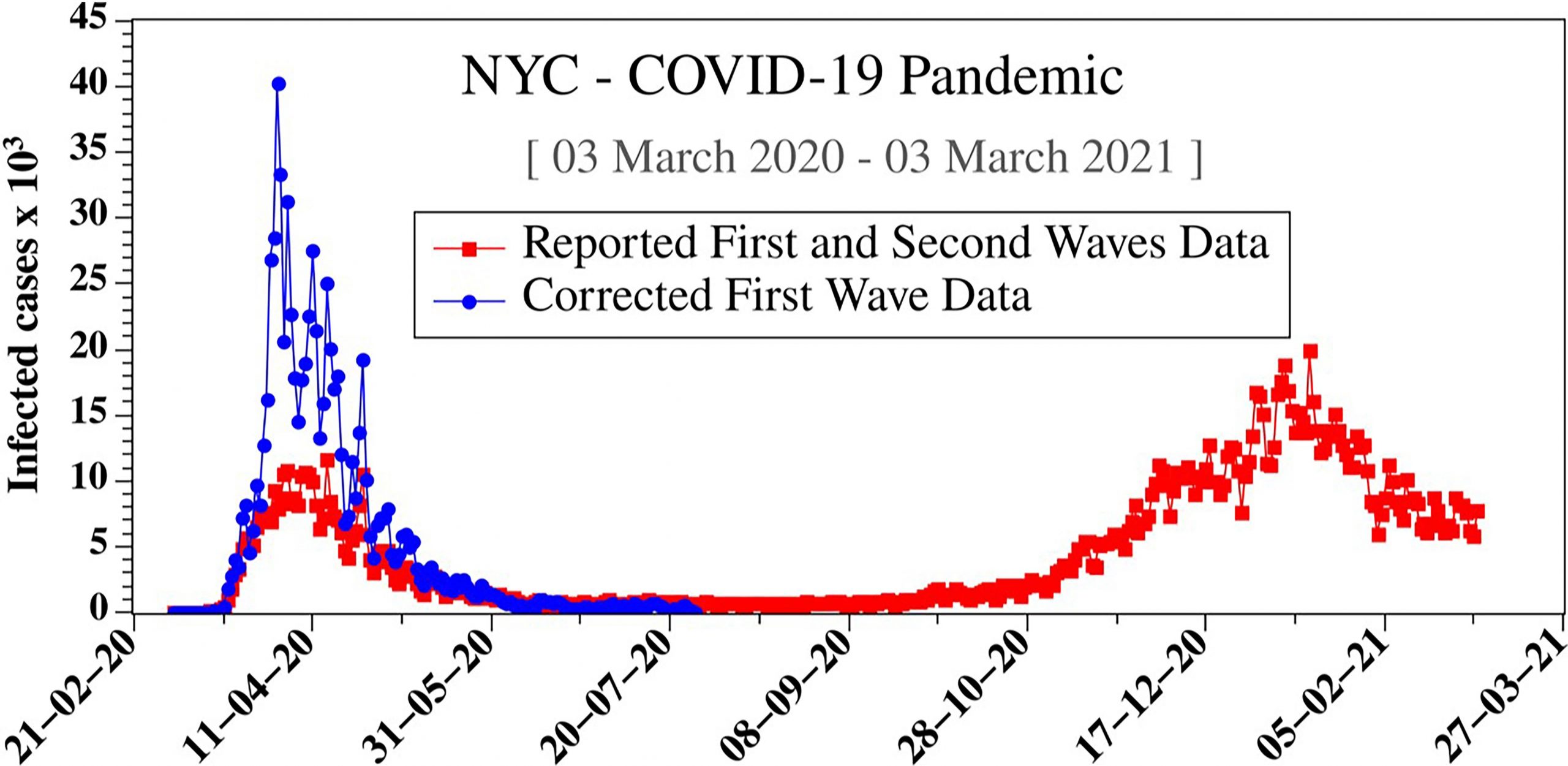
    First Wave COVID-19 Data Underestimated Pandemic
    New York City COVID-19 data, with reported first- and second-wave data, and corrected first-wave data. Credit: Talib Dbouk and Dimitris Drikakis

    Advanced uncertainty quantification model based on fluid dynamic simulations of weather effects corrects COVID-19 pandemic’s first wave data inaccuracies.

    Two COVID-19 pandemic curves emerged within many cities during the one-year period from March 2020 to March 2021.

    Oddly, the number of total daily infections reported during the first wave is much lower than that of the second, but the total number of daily deaths reported during the first wave is much higher than the second wave.

    This contradiction inspired researchers from the University of Nicosia in Cyprus to explore the uncertainty in the daily number of infections reported during the first wave, caused by insufficient contact tracing between March and April 2020.

    In Physics of Fluids, from AIP Publishing, Talib Dbouk and Dimitris Drikakis report using environmental fluid dynamics — advanced computational multiscale multiphysics modeling and simulations — to develop a constitutive relationship between weather seasonality conditions, such as temperature, relative humidity, and wind speed, and having two pandemic curves per year.

    “We integrated a new physics-based relationship into a pandemic forecast model that accurately predicted, as it was later observed, a second COVID-19 pandemic wave within many cities around the world, including New York,” said Drikakis.

    Underreporting in First Wave Confirmed by Model

    Most, if not all, of the data for the daily number of total new infections reported during the first wave of the pandemic were underestimated and used incorrectly.

    “Within the city of New York, our work shows that the daily number of new infections reported during the first wave was underestimated by a factor of four,” Dbouk said. “So, the uncertainty of first-wave data mixed with second-wave data means the general conclusions drawn can be misleading, and everyone should be aware of this.”

    The researchers’ work is the first known case of deriving an advanced uncertainty quantification model for the infected cases of the pandemic’s first wave based on fluid dynamic simulations of weather effects.

    “Our model is physics-based and can rectify first-wave data inadequacies by using second-wave data adequacy within a pandemic curve,” said Drikakis. “Our proposed approach combines an environmental weather seasonality-driven virus transmission rate with pandemic multiwave phenomena to improve the data accuracy of statistical predictions.”

    In the future, the researchers’ proposed uncertainty quantification model may help correct the worldwide total number of daily coronavirus infections reported by many cities during the first wave of a pandemic.

    Reference: “Correcting pandemic data analysis through environmental fluid dynamics” by Talib Dbouk and Dimitris Drikakis, 22 June 2021, Physics of Fluids.
    DOI: 10.1063/5.0055299

    Never miss a breakthrough: Join the SciTechDaily newsletter.
    Follow us on Google and Google News.

    American Institute of Physics COVID-19 Infectious Diseases Popular Public Health
    Share. Facebook Twitter Pinterest LinkedIn Email Reddit

    Related Articles

    Cloth COVID Masks Filter Less Than 10% of Particles – Inferior for Protection Against Airborne Viral Spread

    Researchers Show Homemade COVID Face Masks Work – Effectiveness Varies Depending on Design

    Tree Pollen Facilitates COVID-19 Virus Spread – Carries SARS-CoV-2 Particles Farther

    Simply Talking While Infected Can Spread COVID-19 – Even While Wearing Masks

    Disposable Helmet Designed to Retain Cough Droplets, Minimize COVID-19 Transmission

    Some Masks Can Be Worse Than Not Wearing One at All: Physics of How Masks Affect Airflow and COVID-19 Protection

    Scientists Compare How COVID-19 Cough Clouds Travel With and Without Face Masks

    How Effective Are Cloth Masks Against Coronavirus? [Video]

    Key Insights on How Coronavirus Spreads From Chinese Megacity of Shenzhen

    Leave A Reply Cancel Reply

    • Facebook
    • Twitter
    • Pinterest
    • YouTube

    Don't Miss a Discovery

    Subscribe for the Latest in Science & Tech!

    Trending News

    Artificial Sweeteners May Harm Future Generations, Study Suggests

    Splashdown! NASA Artemis II Returns From Record-Breaking Moon Mission

    What If Consciousness Exists Beyond Your Brain

    Scientists Finally Crack the 100-Million-Year Evolutionary Mystery of Squid and Cuttlefish

    Beyond “Safe Levels”: Study Challenges What We Know About Pesticides and Cancer

    Researchers Have Found a Dietary Compound That Increases Longevity

    Scientists Baffled by Bizarre “Living Fossil” From 275 Million Years Ago

    Your IQ at 23 Could Predict Your Wealth at 27, Study Finds

    Follow SciTechDaily
    • Facebook
    • Twitter
    • YouTube
    • Pinterest
    • Newsletter
    • RSS
    SciTech News
    • Biology News
    • Chemistry News
    • Earth News
    • Health News
    • Physics News
    • Science News
    • Space News
    • Technology News
    Recent Posts
    • Geologists Reveal the Americas Collided Earlier Than We Thought
    • 20x Difference: Study Reveals True Source of Airborne Microplastics
    • Scientists Uncover Hidden Force Powering Yellowstone’s Supervolcano
    • This Metal Melts in Your Hand – and Scientists Just Discovered Something Strange
    • Why Losing Too Much Fat Can Be Just As Dangerous as Obesity
    Copyright © 1998 - 2026 SciTechDaily. All Rights Reserved.
    • Science News
    • About
    • Contact
    • Editorial Board
    • Privacy Policy
    • Terms of Use

    Type above and press Enter to search. Press Esc to cancel.