
Close Menu
    Facebook X (Twitter) Instagram
    SciTechDaily
    • Biology
    • Chemistry
    • Earth
    • Health
    • Physics
    • Science
    • Space
    • Technology
    Facebook X (Twitter) Pinterest YouTube RSS
    SciTechDaily
    Home»Biology»Debunking the Illusion: It’s All About the Eyes, Not the Mind
    Biology

    Debunking the Illusion: It’s All About the Eyes, Not the Mind

    By University of ExeterJuly 12, 2023No Comments4 Mins Read
    Facebook Twitter Pinterest Telegram LinkedIn WhatsApp Email Reddit
    Share
    Facebook Twitter LinkedIn Pinterest Telegram Email Reddit
    Eye Optical Illusion Concept Art
    A new study by Dr. Jolyon Troscianko from the University of Exeter suggests that visual illusions are primarily caused by neural limitations in the eyes and brain, rather than complex psychological processes.

    Research from the University of Exeter indicates that visual illusions result from our eyes and brain’s neural limitations rather than complex mental processes. The study’s model successfully predicts human visual illusions and explains our ability to perceive high-contrast images, like those on high-definition TVs, despite our neurons’ limited bandwidth.

    Numerous visual illusions are caused by limits in the way our eyes and visual neurons work – rather than more complex psychological processes, new research shows.

    Researchers examined illusions in which an object’s surroundings affect the way we see its color or pattern.

    Scientists and philosophers have long debated whether these illusions are caused by neural processing in the eye and low-level visual centers in the brain, or involve higher-level mental processes such as context and prior knowledge.

    Simultaneous Contrast
    The bar in the middle of this figure is all one grey level, but it appears lighter on the left and darker on the right due to the gradient in the background. This is called simultaneous contrast, where dark surrounds make targets appear lighter, and vice-versa. Credit: Jolyon Troscianko

    In the new study Dr. Jolyon Troscianko, from the University of Exeter, co-developed a model that suggests simple limits to neural responses – not deeper psychological processes – explain these illusions.

    “Our eyes send messages to the brain by making neurons fire faster or slower,” said Dr. Troscianko, from the Centre for Ecology and Conservation on Exeter’s Penryn Campus in Cornwall.  

    “However, there’s a limit to how quickly they can fire, and previous research hasn’t considered how the limit might affect the ways we see color.”

    The model combines this “limited bandwidth” with information on how humans perceive patterns at different scales, together with an assumption that our vision performs best when we are looking at natural scenes.
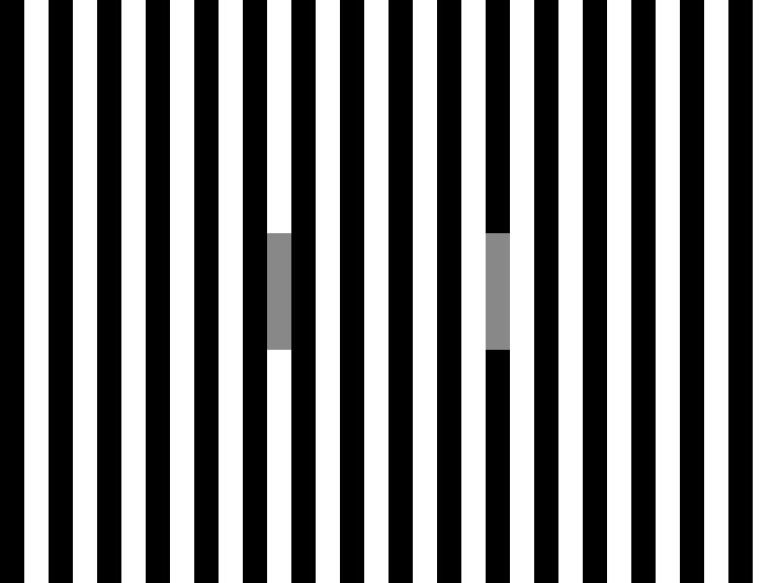
    Lightness Induction (White’s Bars)
    The two grey bars in the middle of this figure are the same grey, but the one on the left (surrounded by more black bars) appears darker. This is the opposite of the simultaneous contrast example above, because darker surroundings now make the target look darker.

    The model was developed by researchers from the Universities of Exeter and Sussex to predict how animals see color, but it was also found to correctly predict many visual illusions seen by humans.

    “This throws into the air a lot of long-held assumptions about how visual illusions work,” Dr. Troscianko said.

    He said the findings also shed light on the popularity of high-definition televisions.

    “Modern high dynamic range televisions create bright white regions that are over 10,000 times brighter than their darkest black, approaching the contrast levels of natural scenes,” Dr. Troscianko added.
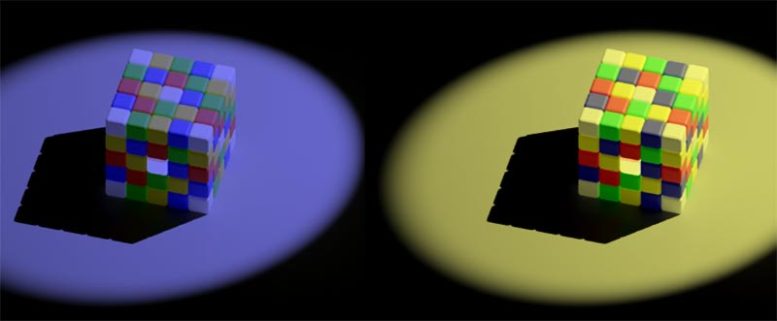
    Color Constancy
    Both cubes have what appear to be yellow and blue tiles on their top surfaces. However, the ones that look yellow on the left are in fact a grey color that is identical to the blue tiles on the right. Our model can help explain how objects appear to be the same color even when the light changes, and why in illusions such grey looks colorful. Credit: Jolyon Troscianko

    “How our eyes and brains can handle this contrast is a puzzle because tests show that the highest contrasts we humans can see at a single spatial scale is around 200:1.

    “Even more confusingly, the neurons connecting our eyes to our brains can only handle contrasts of about 10:1.

    “Our model shows how neurons with such limited contrast bandwidth can combine their signals to allow us to see these enormous contrasts, but the information is ‘compressed’ – resulting in visual illusions.

    “The model shows how our neurons are precisely evolved to use of every bit of capacity.

    “For example, some neurons are sensitive to very tiny differences in grey levels at medium-sized scales, but are easily overwhelmed by high contrasts.

    “Meanwhile, neurons coding for contrasts at larger or smaller scales are much less sensitive, but can work over a much wider range of contrasts, giving deep black-and-white differences.

    “Ultimately this shows how a system with a severely limited neural bandwidth and sensitivity can perceive contrasts larger than 10,000:1.”

    The paper, published in the journal PLOS Computational Biology, is entitled: “A model of colour appearance based on efficient coding of natural images.”

    Reference: “A model of colour appearance based on efficient coding of natural images” by Jolyon Troscianko and Daniel Osorio, 15 June 2023, PLOS Computational Biology.
    DOI: 10.1371/journal.pcbi.1011117

    Never miss a breakthrough: Join the SciTechDaily newsletter.
    Follow us on Google and Google News.

    Neuroscience Perception Popular University of Exeter Vision
    Share. Facebook Twitter Pinterest LinkedIn Email Reddit

    Related Articles

    Scientists Discover How to Stop Vision Loss Before It Starts

    Scientists Find Prehistoric Brain Circuit Still Controls Vision

    Cinema in the Mind: The Neuroscience Behind the “Continuity Illusion”

    This New Optical Illusion Is Strong Enough To Trick Our Reflexes

    Scientists Discover a New Class of Memory Cells in the Brain – The Closest Thing to a “Grandmother Neuron”

    Scientists Find Neurochemicals – Dopamine and Serotonin – Have Unexpectedly Profound Roles in the Human Brain

    Our Brains’ Information Processing Capacity Is Constrained by a Constant but Limited Energy Supply

    MIT Neuroscientists Investigate the Real Reason Behind a Classic Visual Illusion

    Mice Were Kept in the Dark for One Week – Their Brain Cell Networks Rewired and Hearing Sensitivity Changed

    Leave A Reply Cancel Reply

    • Facebook
    • Twitter
    • Pinterest
    • YouTube

    Don't Miss a Discovery

    Subscribe for the Latest in Science & Tech!

    Trending News

    Popular Sugar-Free Sweetener Linked to Liver Disease, Study Warns

    What Is Hantavirus? The Deadly Disease Raising Alarm Worldwide

    Scientists Just Discovered How the Universe Builds Monster Black Holes

    Scientists Unveil New Treatment Strategy That Could Outsmart Cancer

    A Simple Vitamin May Hold the Key to Treating Rare Genetic Diseases

    Scientists Think the Real Fountain of Youth May Be Hiding in Your Gut

    Ravens Don’t Follow Wolves, They Predict Them

    This Common Knee Surgery May Be Doing More Harm Than Good

    Follow SciTechDaily
    • Facebook
    • Twitter
    • YouTube
    • Pinterest
    • Newsletter
    • RSS
    SciTech News
    • Biology News
    • Chemistry News
    • Earth News
    • Health News
    • Physics News
    • Science News
    • Space News
    • Technology News
    Recent Posts
    • Study Reveals Dangerous Flaw in AI Symptom Checkers
    • New MRI Breakthrough Captures Stunningly Clear Images of the Eye and Brain
    • Scientists Warn Sitting Too Much Can Harm Your Body in Surprising Ways
    • Your Blood Pressure Reading Could Be Wrong Because of One Simple Mistake
    • Scientists Discover Cheap Material That Kills Deadly Superbugs
    Copyright © 1998 - 2026 SciTechDaily. All Rights Reserved.
    • Science News
    • About
    • Contact
    • Editorial Board
    • Privacy Policy
    • Terms of Use

    Type above and press Enter to search. Press Esc to cancel.