
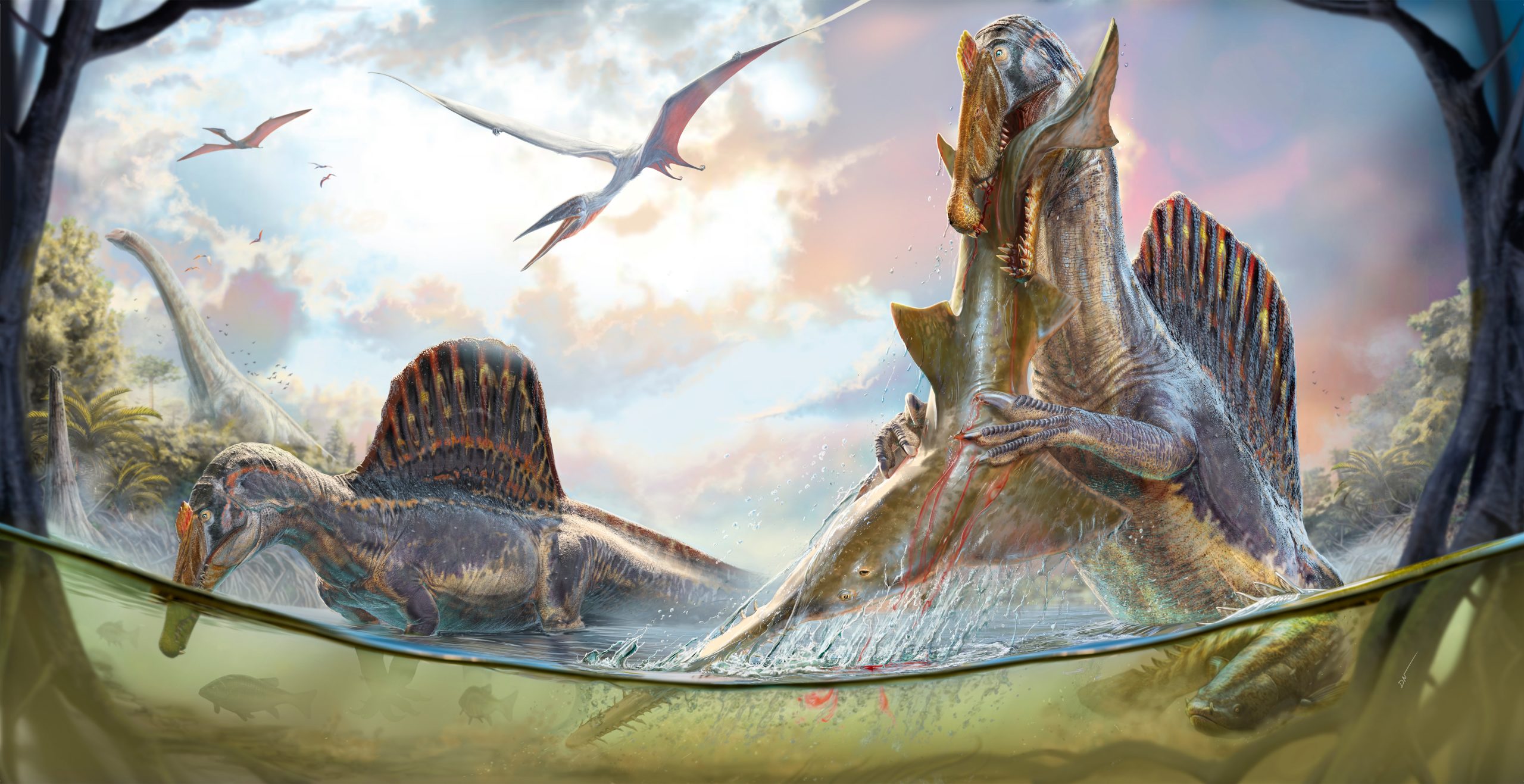
Researchers think they have discovered critical flaws in the studies advocating for aquatic hunting behavior in Spinosaurus.
Nathan Myhrvold of Intellectual Ventures, US, and his team suggest in a study recently published in the open-access journal PLOS ONE, that the theory supporting the aquatic hunting behavior of Spinosaurus may have fundamental flaws.
Paleontologists generally agree that the famous Spinosaurus was a fish-eater, but exactly how these dinosaurs caught their prey is the subject of lively debate, with some researchers suggesting that they hunted on the shore, some that they waded or swam in the shallows, and others that they were aquatic pursuit predators.
One recent study provided support for the latter hypothesis using a fairly new statistical method called phylogenetic flexible discriminant analysis (pFDA) to analyze the density and proportions of spinosaur bones. In the present study, Myhrvold and colleagues critically assess the methods of that prior research and identify significant flaws.
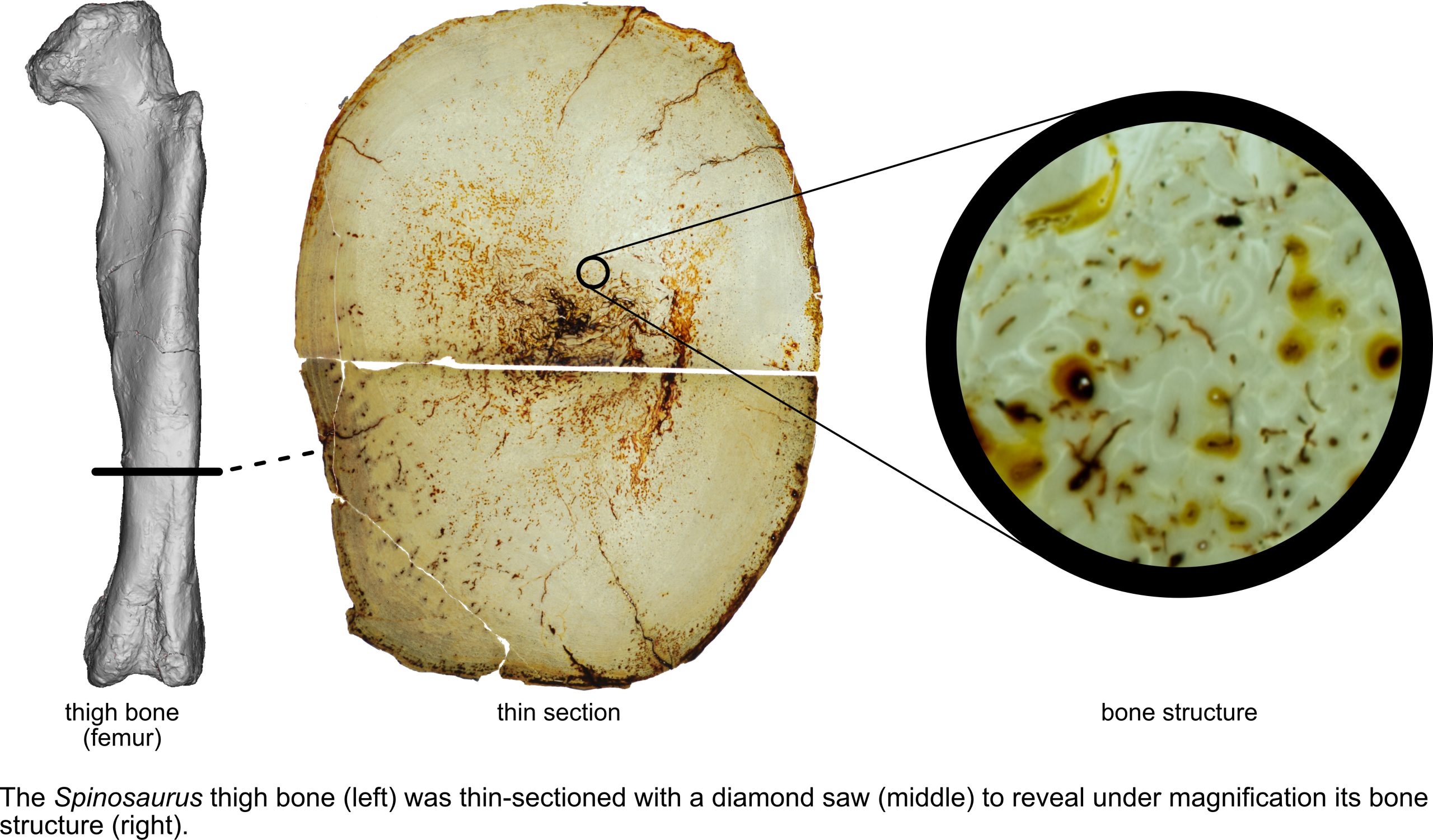
This assessment identifies inconsistencies and biases in the former study’s selection of data, as well as in the definitions of certain behavioral terms. The researchers also find that this method has low accuracy when applied to the datasets used in that study due to small sample sizes and high variability of certain data. Myhrvold and colleagues believe that there are enough problems with this methodology to invalidate the findings of the previous research.
Methodological Flaws and Recommendations
This new study does not aim to settle the debate over the lifestyle of spinosaurid dinosaurs, but it does refute the conclusions of the previous paper which supported the aquatic pursuit predator hypothesis, an idea which the authors note is also contradicted by several other studies. The authors also provide guidelines for future research, urging caution when applying pFDA to limited datasets, and highlighting limitations in the use of bone density to infer aquatic lifestyles in dinosaurs.
The authors add: “Spinosaurus, and its close relatives, are fascinating because of their unusual anatomical features, the scarcity of specimens, and the fact that scientists had not found bones from parts of its body until very recently (2020). Unlike other meat-eating dinosaurs, there are strong clues that it lived near water and ate fish or other aquatic fare. This has fueled a lot of controversy about how Spinosaurus lived—was it a fast-swimming predator that chased fish like a sea lion? Or was it an ambush predator at the water’s edge, grasping with its clawed hands like a giant version of a brown bear chasing salmon, or plunging its head into the water like a 7-ton heron from hell? Fabbri et al. attempted to resolve the lifestyle question using statistics of bone density, but we found that the statistical method and data used are inaccurate and inappropriate.”
Reference: “Diving dinosaurs? Caveats on the use of bone compactness and pFDA for inferring lifestyle” by Nathan P. Myhrvold, Stephanie L. Baumgart, Daniel Vidal, Frank E. Fish, Donald M. Henderson, Evan T. Saitta and Paul C. Sereno, 6 March 2024, PLOS ONE.
DOI: 10.1371/journal.pone.0298957
Never miss a breakthrough: Join the SciTechDaily newsletter.
Follow us on Google and Google News.
6 Comments
For something to become a myth, it first has to be known to people. Who’s ever heard of “spinosaurus”?
Grasping claws or bear grasping and wading heron are remnants spinosauridae is fully form mesoeucrocodylia its death roll predator it’s lifestyle is just like today spinosauridae gator today modern crocodilian do not grasp but they still has grasping finger claws some how this have survive the toe claws are not grasping its land claw even thou modern crocodilian mostly walk and run quadrupedal they are bipedal animal even fossil gator type mesoeucrocodylia has digitigrade finger I wonder what the claws are
Spinosauridae feature are extreme aquatic feature it’s has longostrine skull but not as flat as modern crocodilian it has different scientific name only modern crocodilian has mammal type skull dwarf caiman it has same scientific name as spinosauridae probaly dwarf crocodile have these skull too because these are land crocodilian .the nose of spinosauridae baryonyx spinosaurus behind the kink on the snout it’s more extreme aquatic than modern crocodilian
Spinosaurus has fuse nasal a extreme land feature only crocodilian has that is one of dwarf caiman I was shock it has that clearly did not have lifestyle like famous crocodilian Nile crocodile usgator it was more land base clearly was semi aquatic clearly was not like the gator or even dwarf caiman the dwarf caiman are not semi aquatic they are land crocodilian in fact they have ziphodont teeth but teeth are not serrated makes it false ziphodont it amazing they have teeth like dinosaur they are not simular to most modern crocodilian even blood are different they just look simular
Dwarf caiman are alligator so teeth are not serrated. crocodile has serrated teeth the link to baryonyx.they should never be debate about spinosauridae aquaticness clearly is aquatic the nose is very Whaley it’s very shocking spinosaurus is even more Whaley I know nose are not on top of the skull like modern crocodilian any nose push to eyes is a classic aquatic feature .land animal have there nose in front of skull not on top skull like aquatic gator the nose is push back in gator in gator type early mesoeucrocodylia the nose like land mammal and skull is high like land mammal spinosauridae t.rex .
Spinosaurus teeth count are low it’s not like fish eating crocodile baryonyx teeth count are high .spinosaurus teeth are like Nile crocodile are design to kill large land animal.nile crocodile allso hunt on land that why it’s a semi aquatic animal these teeth are space teeth like t.rex smaller teeth are for hold the larger teeth are to crush bone. clearly spinosaurus baryonyx are design to kill large animal they have death roll system the death roll is form the jaw are design to swallow big animal the death roll are not design to kill fish .baryonyx lack space teeth the teeth simular to other tetanuran dinosaur