

Observations in mice hint at role of daydreams in remodeling the brain.
- During quiet waking, brain activity in mice suggests the animals are daydreaming about a recent image.
- Having daydreams about a recently viewed image predicted how the brain would respond to the image in the future.
- The findings provide a clue that daydreams may play a role in brain plasticity.
Understanding the Brain During Daydreams
You are sitting quietly, and suddenly your brain tunes out the world and wanders to something else entirely — perhaps a recent experience, or an old memory. You just had a daydream.
Yet despite the ubiquity of this experience, what is happening in the brain while daydreaming is a question that has largely eluded neuroscientists.
Now, a study in mice, published on December 13 in Nature, has brought a team led by researchers at Harvard Medical School one step closer to figuring it out.
The researchers tracked the activity of neurons in the visual cortex of the brains of mice while the animals remained in a quiet waking state. They found that occasionally these neurons fired in a pattern similar to one that occurred when a mouse looked at an actual image, suggesting that the mouse was thinking — or daydreaming — about the image. Moreover, the patterns of activity during a mouse’s first few daydreams of the day predicted how the brain’s response to the image would change over time.
The research provides tantalizing, if preliminary, evidence that daydreams can shape the brain’s future response to what it sees. This causal relationship needs to be confirmed in further research, the team cautioned, but the results offer an intriguing clue that daydreams during quiet waking may play a role in brain plasticity — the brain’s ability to remodel itself in response to new experiences.
Exploring Daydreams and Brain Plasticity
“We wanted to know how this daydreaming process occurred on a neurobiological level, and whether these moments of quiet reflection could be important for learning and memory,” said lead author Nghia Nguyen, a PhD student in neurobiology in the Blavatnik Institute at HMS.
Scientists have spent considerable time studying how neurons replay past events to form memories and map the physical environment in the hippocampus, a seahorse-shaped brain region that plays a key role in memory and spatial navigation.
A Focus on the Visual Cortex
By contrast, there has been little research on the replay of neurons in other brain regions, including the visual cortex. Such efforts would provide valuable insights about how visual memories are formed.
“My lab became interested in whether we could record from enough neurons in the visual cortex to understand what exactly the mouse is remembering — and then connect that information to brain plasticity,” said senior author Mark Andermann, professor of medicine at Beth Israel Deaconess Medical Center, and professor of neurobiology at HMS.

In the new study, the researchers repeatedly showed mice one of two images, each consisting of a different checkerboard pattern of gray and dappled black and white squares. Between images, the mice spent a minute looking at a gray screen. The team simultaneously recorded activity from around 7,000 neurons in the visual cortex.
The researchers found that when a mouse looked at an image, the neurons fired in a specific pattern, and the patterns were different enough to discern image one from image two. More important, when a mouse looked at the gray screen between images, the neurons sometimes fired in a similar, but not identical, pattern, as when the mouse looked at the image, a sign that it was daydreaming about the image. These daydreams occurred only when mice were relaxed, characterized by calm behavior and small pupils.
Unsurprisingly, mice daydreamed more about the most recent image — and they had more daydreams at the beginning of the day than at the end, when they had already seen each image dozens of times.
But what the researchers found next was completely unexpected.
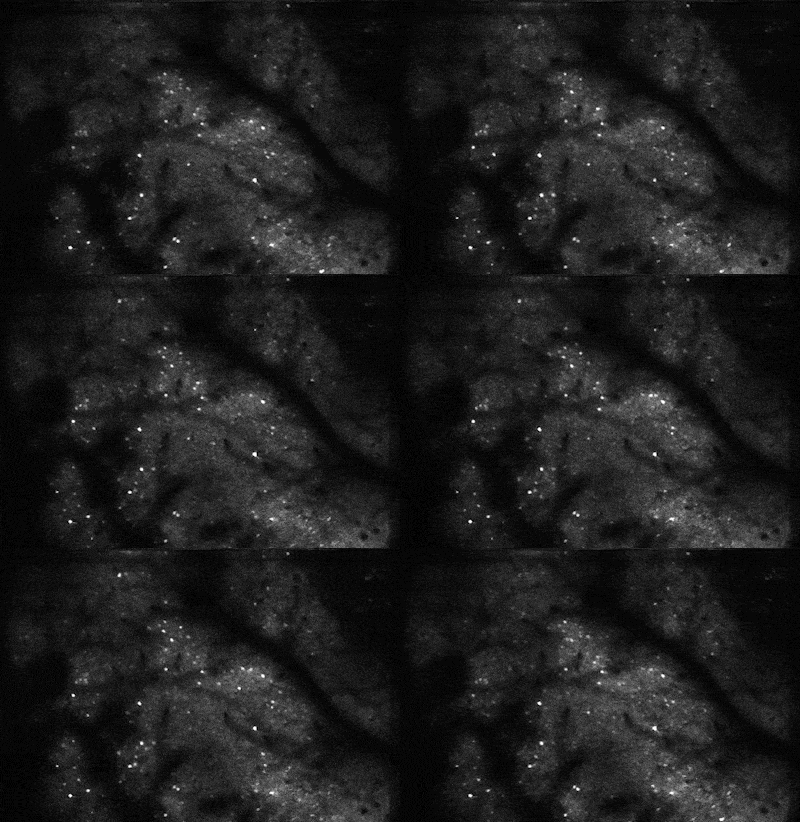
Throughout the day, and across days, the activity patterns seen when the mice looked at the images changed — what neuroscientists call “representational drift.” Yet this drift wasn’t random. Over time, the patterns associated with the images became even more different from each other, until each involved an almost entirely separate set of neurons. Notably, the pattern seen during a mouse’s first few daydreams about an image predicted what the pattern would become when the mouse looked at the image later.
“There’s drift in how the brain responds to the same image over time, and these early daydreams can predict where the drift is going,” Andermann said.
Finally, the researchers found that the visual cortex daydreams occurred at the same time as replay activity occurred in the hippocampus, suggesting that the two brain regions were communicating during these daydreams.
To Sit, Perchance To Daydream
Based on the results of the study, the researchers suspect that these daydreams may be actively involved in brain plasticity.
“When you see two different images many times, it becomes important to discriminate between them. Our findings suggest that daydreaming may guide this process by steering the neural patterns associated with the two images away from each other,” Nguyen said, while noting that this relationship needs to be confirmed.
Nguyen added that learning to differentiate between the images should help the mouse respond to each image with more specificity in the future.
These observations align with a growing body of evidence in rodents and humans that entering a state of quiet wakefulness after an experience can improve learning and memory.
Next, the researchers plan to use their imaging tools to visualize the connections between individual neurons in the visual cortex and to examine how these connections change when the brain “sees” an image.
“We were chasing this 99 percent of unexplored brain activity and discovered that there’s so much richness in the visual cortex that nobody knew anything about,” Andermann said.
Whether daydreams in people involve similar activity patterns in the visual cortex is an open question, and the answer will require additional experiments. However, there is preliminary evidence that an analogous process occurs in humans when they recall visual imagery.
Randy Buckner, the Sosland Family Professor of Psychology and of Neuroscience at Harvard University, has shown that brain activity in the visual cortex increases when people are asked to recall an image in detail. Other studies have recorded flurries of electrical activity in the visual cortex and the hippocampus during such recall.
For the researchers, the results of their study and others suggest that it may be important to make space for moments of quiet waking that lead to daydreams. For a mouse, this may mean taking a pause from looking at a series of images and, for a human, this could mean taking a break from scrolling on a smartphone.
“We feel pretty confident that if you never give yourself any awake downtime, you’re not going to have as many of these daydream events, which may be important for brain plasticity,” Andermann said.
Reference: “Cortical reactivations predict future sensory responses” by Nghia D. Nguyen, Andrew Lutas, Oren Amsalem, Jesseba Fernando, Andy Young-Eon Ahn, Richard Hakim, Josselyn Vergara, Justin McMahon, Jordane Dimidschstein, Bernardo L. Sabatini and Mark L. Andermann, 13 December 2023, Nature.
DOI: 10.1038/s41586-023-06810-1
Additional authors on the paper include Andrew Lutas, Oren Amsalem, Jesseba Fernando, Andy Young-Eon Ahn, Richard Hakim, Josselyn Vergara, Justin McMahon, Jordane Dimidschstein, and Bernardo Sabatini.
The research was supported by a National Defense Science and Engineering Fellowship, a Howard Hughes Medical Institute Gilliam Fellowship, the National Institutes of Health (F32 DK112589; DP2 DK105570; DP1 AT010971-02S1; R01 MH12343), a Davis Family Foundation award, a McKnight Scholar Award, a Harvard Mind Brain Behavior Interfaculty Initiative Faculty Research Award, the Harvard Brain Science Initiative Bipolar Disorder Seed Grant, and by Kent and Liz Dauten.
Never miss a breakthrough: Join the SciTechDaily newsletter.
Follow us on Google and Google News.