
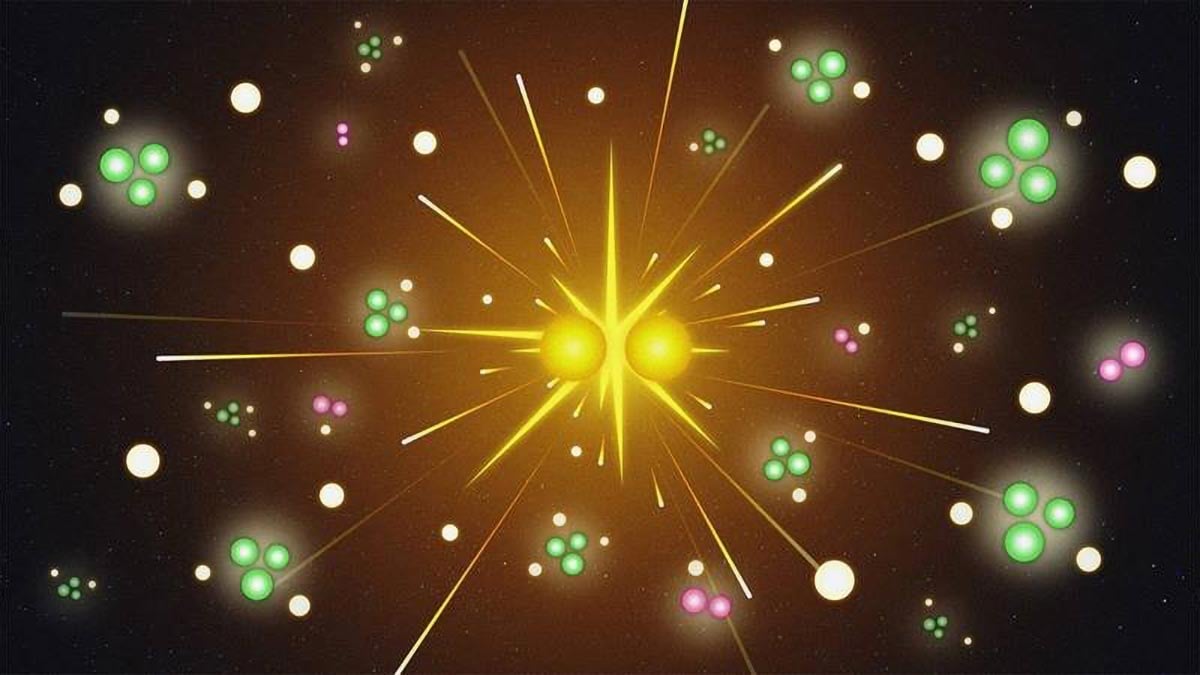
Measurements from the LHCb collaboration expand scientific understanding of how individual quarks assemble to form observable matter.
Research from the Large Hadron Collider has unveiled that quarks, the primary components of visible matter, form composite particles differently based on environmental conditions. This discovery challenges the previously held belief that baryon production from quarks is uniform, pointing to a need for revised theoretical models to explain matter formation under varying densities.
Quarks: The Building Blocks of Matter
Quarks are the basic particles that make up visible matter in the universe. The most intriguing and most puzzling property of quarks is that they are never found in isolation. Instead, they can only be observed when confined inside composite particles such as protons.
Nuclear physicists use giant particle accelerators to produce various types of quarks and study how they evolve to form observable particles. Groups of three quarks form composite particles called baryons (such as protons and neutrons), while pairs of quarks form mesons. New measurements from the Large Hadron Collider beauty (LHCb) experiment show surprising variations in the rate at which baryons are produced, defying previous expectations.
Understanding Baryons and Mesons
The atomic nuclei that form all visible matter are composed of baryons (specifically, protons and neutrons), which scientists believe formed in the early universe. Baryons inside nuclei are stable particles that do not undergo radioactive decay. However, all mesons are unstable, and they rapidly decay into lighter particles that cannot form atoms.
The existence of stable baryons versus unstable mesons is therefore what makes the existence of atoms and the universe as we know it possible. The LHCb experiment has shown that the rate of quarks forming into baryons versus mesons depends greatly on the density of their environment. This finding helps to explain the creation of the first stable particles in the early universe.
The Role of Strong Interaction
The fact that quarks must be confined is the defining feature of the strong interaction, as described by the theory of quantum chromodynamics (QCD). Calculations using QCD can predict the total number of heavy bottom quarks produced in particle collisions but cannot describe the fraction that emerge as baryons rather than mesons. Typically, researchers tune models to match data from previous experiments involving collisions of electrons with positrons, assuming that the baryon production rate is universal.
Implications of High Density Collisions
An important difference in this new research relative to previous experiments is that collisions of protons and/or nuclei at the Large Hadron Collider produce an environment with a much higher quark density.
In this research, nuclear physicists from the LHCb experiment found that the number of baryons containing b quarks depends on the environment following the collisions, and increases with higher particle densities. This shows that scientists’ assumption of the universality of baryon production is incorrect, and that interactions between the produced quarks during their evolution into visible matter influences how many baryons emerge.
These new results prove that additional theoretical mechanisms for producing baryons are required in dense collision systems, which may have been especially important when the first protons were formed in the early universe.
Reference: “Enhanced Production of Λ𝑏0 Baryons in High-Multiplicity 𝑝𝑝 Collisions at 𝑠=13 TeV” by 20 February 2024, Physical Review Letters.
DOI: 10.1103/PhysRevLett.132.081901
This research was supported by the Department of Energy Office of Science, Nuclear Physics program.
Never miss a breakthrough: Join the SciTechDaily newsletter.
Follow us on Google and Google News.
3 Comments
These new results prove that additional theoretical mechanisms for producing baryons are required in dense collision systems, which may have been especially important when the first protons were formed in the early universe.
Keep trying.
Please ask researchers to think deeply:
1. Where are the starting and ending points of time?
2. Where does the cyclical nature of material motion come from?
3. Do the so-called baryons and protons have a life cycle?
4. Where does the force of cosmic explosion or collision come from?
and so on.
Scientific research guided by correct theories can help humanity avoid detours, failures, and pomposity. Please witness the exemplary collaboration between theoretical physicists and experimentalists (https://zhuanlan.zhihu.com/p/701032654). Is this the fairy tale world of contemporary physics?
Did anyone collide actual “hadrons” in that thing?
Anyone tried more than three quarks combinations to arrive at different particles other than baryons and mesons?