
350-Mile-Deep Earthquake Used in Scientific Study To Make Elusive Measurements of the Earth’s Layers
There may be a layer of surprisingly fluid rock ringing the Earth, at the very bottom of the upper mantle, according to a new study from a University of Chicago scientist.
The finding was made by measuring the lingering movement registered by GPS sensors on islands in the wake of a deep earthquake in the Pacific Ocean near Fiji. Published on February 22 in Nature, the study demonstrates a new method to measure the fluidity of the Earth’s mantle.
“Even though the mantle makes up the largest part of Earth, there’s still a lot we don’t know about it,” said Sunyoung Park, a geophysicist with the University of Chicago and the lead author on the study. “We think there’s a lot more we can learn by using these deep earthquakes as a way to probe these questions.”
Mantle Mysteries
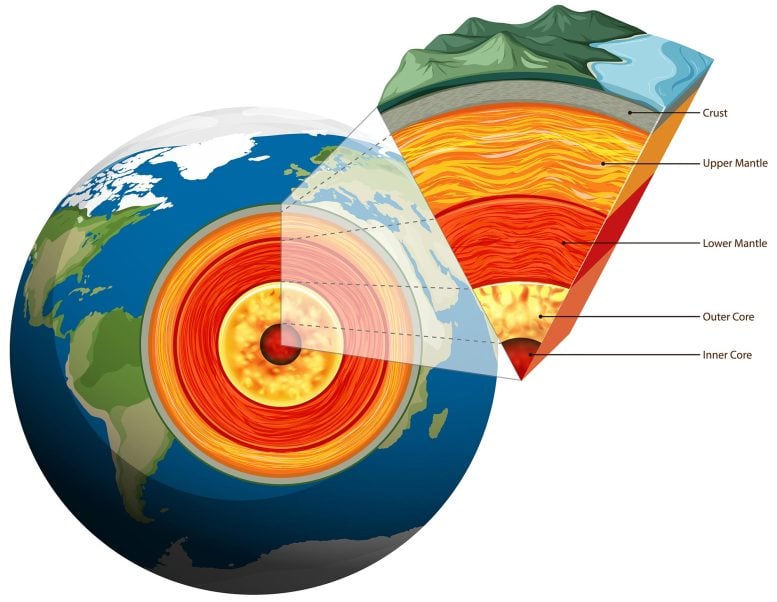
We still know surprisingly little about the Earth beneath our feet. The furthest anyone has managed to dig down is about seven and a half miles before the increasing heat literally melts the drill. Thus scientists have had to use clues like how seismic waves move to infer the different layers that make up the planet, including the crust, mantle, and core.
One thing that has stymied scientists is a precise measurement of how viscous the mantle layer is. The mantle is the layer below the crust. It’s made of rock, but at the intense temperature and pressures at that depth, the rock actually becomes viscous—flowing very slowly like honey or tar.
“We want to know exactly how fast the mantle flows, because that influences the evolution of the entire Earth—it affects how much heat the planet retains for how long, and how the Earth’s materials are cycled over time,” explained Park. “But our current understanding is very limited and includes a lot of assumptions.”
Park thought there might be a unique way to get a measurement of the mantle’s properties by studying the aftermath of very deep earthquakes.
Most of the earthquakes we hear about on the news are relatively shallow, originating in the top crust of the Earth. But occasionally, there are earthquakes that originate deep within the Earth—down to 450 miles below the surface. These earthquakes are not as well-studied as shallower ones, because they’re not as destructive to human settlements. But because they reach down into the mantle, Park thought they might offer a way to understand the behavior of the mantle.
Park and her colleagues looked at one particular such earthquake, which occurred off the coast of Fiji in 2018. The quake was magnitude 8.2, but it was so deep—350 miles (560 kilometers) down—that it did not cause any major damage or deaths.
However, when the scientists carefully analyzed the data from GPS sensors on several nearby islands, they found the Earth kept moving—after the earthquake was over.
The data revealed that in the months following the quake, the Earth was still moving, settling in the wake of the disturbance. Even years later, Tonga is still moving slowly down at a rate of about 1 centimeter per year.
“You can think of it like a jar of honey that slowly comes back to level after you dip a spoon in it—except this takes years instead of minutes,” said Park.
This is the first solid observation of the deformation following deep quakes; the phenomenon had been observed before for shallow earthquakes, but experts thought the effect would be too small to be observable for deep earthquakes.
Park and her colleagues used this observation to infer the viscosity of the mantle.
“Even though the mantle makes up the largest part of Earth, there’s still a lot we don’t know about it.”
Asst. Prof. Sunyoung Park
By examining how the Earth deformed over time, they found evidence of a layer about 50 miles thick that is less viscous (that is, “runnier”) than the rest of the mantle, sitting at the bottom of the upper mantle layer. They think this layer may extend around the entire globe.
This low-viscosity layer could explain some other observations by seismologists that suggested there are “stagnant” slabs of rock that don’t move very much, located around the same depth at the bottom of the upper mantle. “It has been hard to reproduce those features with models, but the weak layer found in this study makes it easier to do so,” Park said.
It also has implications for how Earth transports heat, cycles and mixes materials between the crust, core, and mantle over time.
“We’re really excited,” Park said. “There’s a lot more to find out with this technique.”
The other co-authors on the paper were Jean-Philippe Avouac and Zhongwen Zhan of California Institute of Technology and Adriano Gualandi of Italy’s National Institute of Geophysics and Volcanology.
Reference: “Weak upper-mantle base revealed by postseismic deformation of a deep earthquake” by Sunyoung Park, Jean-Philippe Avouac, Zhongwen Zhan and Adriano Gualandi, 22 February 2023, Nature.
DOI: 10.1038/s41586-022-05689-8
Funding: The University of Chicago, California Institute of Technology, National Science Foundation
Never miss a breakthrough: Join the SciTechDaily newsletter.
Follow us on Google and Google News.
1 Comment
Asthenosphere?