

NASA’s fifth biennial Planetary Defense Interagency Tabletop Exercise, organized in partnership with FEMA and other U.S. agencies, focused on evaluating national readiness against potential asteroid or comet impacts.
The exercise explored hypothetical scenarios involving varying degrees of threat and allowed for the assessment of current technologies and strategies, including those derived from the DART mission, aimed at deflecting potential celestial threats.
Planetary Defense Exercises
For the benefit of all, NASA released a summary of the fifth biennial Planetary Defense Interagency Tabletop Exercise. NASA’s Planetary Defense Coordination Office, in partnership with FEMA (Federal Emergency Management Agency) and with the assistance of the U.S. Department of State Office of Space Affairs, convened the tabletop exercise to inform and assess our ability as a nation to respond effectively to the threat of a potentially hazardous asteroid or comet.

Representatives from NASA, FEMA, and the planetary defense community participate in the 5th Planetary Defense Interagency Tabletop Exercise to inform and assess our ability as a nation to respond effectively to the threat of a potentially hazardous asteroid or comet. Credit: NASA/JHU-APL/Ed Whitman
Insights from Hypothetical Impact Scenarios
Although there are no known significant asteroid impact threats for the foreseeable future, hypothetical exercises provide valuable insights by exploring the risks, response options, and opportunities for collaboration posed by varying scenarios, from minor regional damage with little warning to potential global catastrophes predicted years or even decades in the future.
“The uncertainties in these initial conditions for the exercise allowed participants to consider a particularly challenging set of circumstances,” said Lindley Johnson, planetary defense officer emeritus NASA Headquarters in Washington. “A large asteroid impact is potentially the only natural disaster humanity has the technology to predict years in advance and take action to prevent.”
Challenges in Detecting and Responding to Asteroids
During the exercise, participants considered potential national and global responses to a hypothetical scenario in which a never-before-detected asteroid was identified that had, according to initial calculations, a 72% chance of hitting Earth in approximately 14 years. The preliminary observations described in the exercise, however, were not sufficient to precisely determine the asteroid’s size, composition, and long-term trajectory. To complicate this year’s hypothetical scenario, essential follow-up observations would have to be delayed for at least seven months – a critical loss of time – as the asteroid passed behind the Sun as seen from Earth’s vantage point in space.
Conducting exercises enable government stakeholders to identify and resolve potential issues as part of preparation for any real-world situation. It was held in April at the Johns Hopkins Applied Physics Laboratory (APL) in Laurel, Maryland, and brought together nearly 100 representatives from across U.S. government agencies and, for the first time, international collaborators on planetary defense.
Advancements in Asteroid Deflection Technologies
“Our mission is helping people before, during, and after disasters,” said Leviticus “L.A.” Lewis, FEMA detailee to NASA’s Planetary Defense Coordination Office. “We work across the country every day before disasters happen to help people and communities understand and prepare for possible risks. In the event of a potential asteroid impact, FEMA would be a leading player in interagency coordination.”
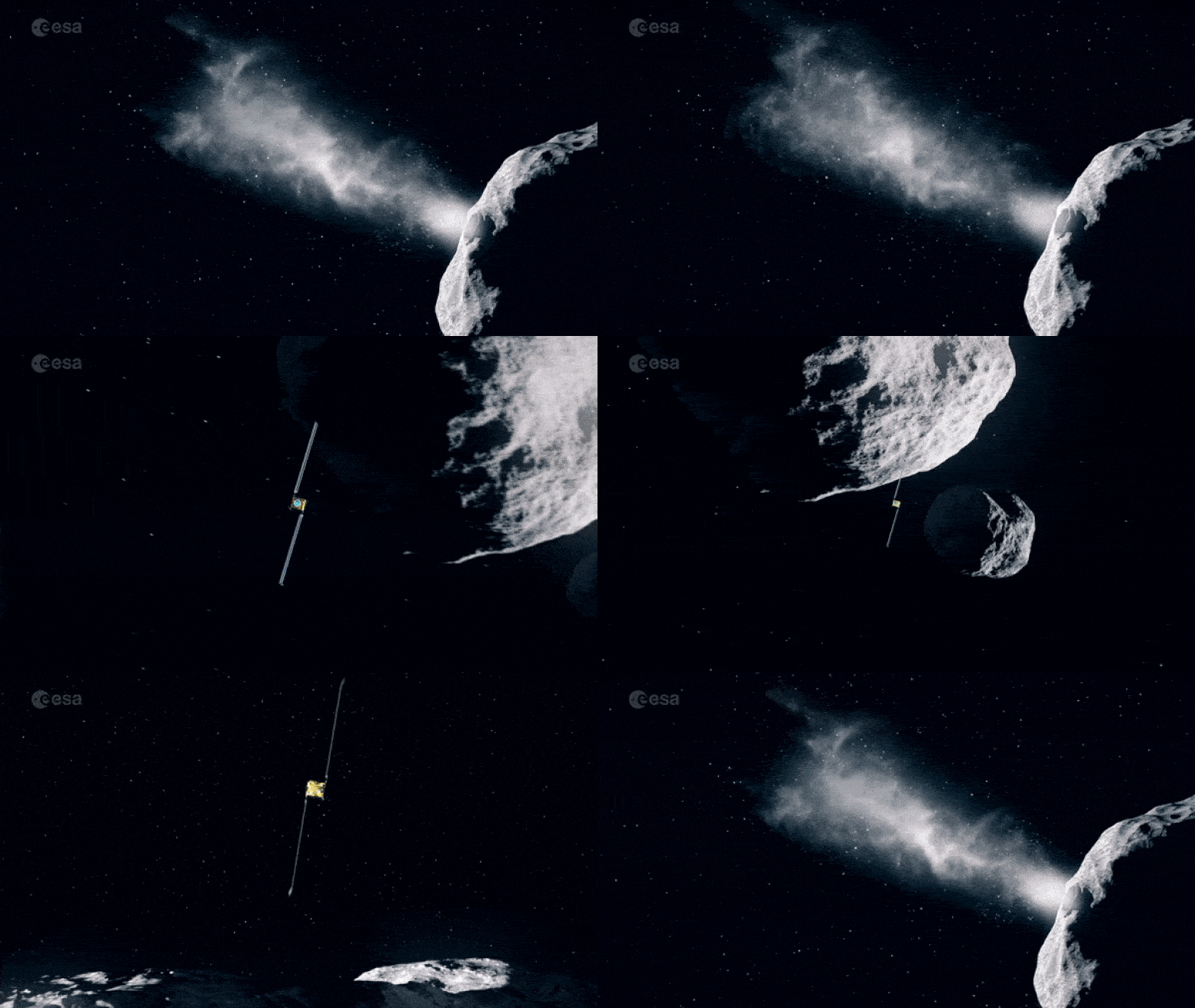
This exercise was the first to use data from NASA’s DART (Double Asteroid Redirection Test) mission, the first in-space demonstration of a technology for defending Earth against potential asteroid impacts. The DART spacecraft, which impacted the asteroid moonlet Dimorphos on September 26, 2022, confirmed a kinetic impactor could change the trajectory of an asteroid. Applying this or any type of technology to an actual impact threat would require many years of advance planning.
Continuing Development of Detection Technologies
To help ensure humanity will have the time needed to evaluate and respond to a potentially hazardous asteroid or comet, NASA continues the development of its NEO Surveyor (Near-Earth Object Surveyor), an infrared space telescope designed specifically to expedite our ability to discover and characterize most of the potentially hazardous near-Earth objects many years before they could become an impact threat. The agency’s NEO Surveyor’s proposed launch date is set for June 2028.
NASA will publish a complete after-action report for the tabletop exercise later, which will include strengths and gaps identified from analysis of the response, other discussions during the exercise, and recommendations for improvement.
Future Directions for Planetary Defense
“These outcomes will help to shape future exercises and studies to ensure NASA and other government agencies continue improving planetary defense preparedness,” said Johnson.
NASA established the Planetary Defense Coordination Office in 2016 to manage the agency’s ongoing planetary-defense efforts. Johns Hopkins APL managed the DART mission for NASA as a project of the agency’s Planetary Missions Program Office.
Never miss a breakthrough: Join the SciTechDaily newsletter.
Follow us on Google and Google News.
5 Comments
It’s a greater chance that NASA will cause a cataclysm with it’s shenanigans, than actually save us from it.
NASA Should consider using a steel net attached to a powerful craft to capture and redirect an potential asteroid.
It’s not just NASA this is international collaboration in which NASA takes part.
I think you are right it has to be a world united plan and we all do need to collaborate all this together
At least this will give us a chance to save our selves. It will need to be a world wide effort to ensure success. Hopefully we will never have to face such an catastrophic event. God willing.