
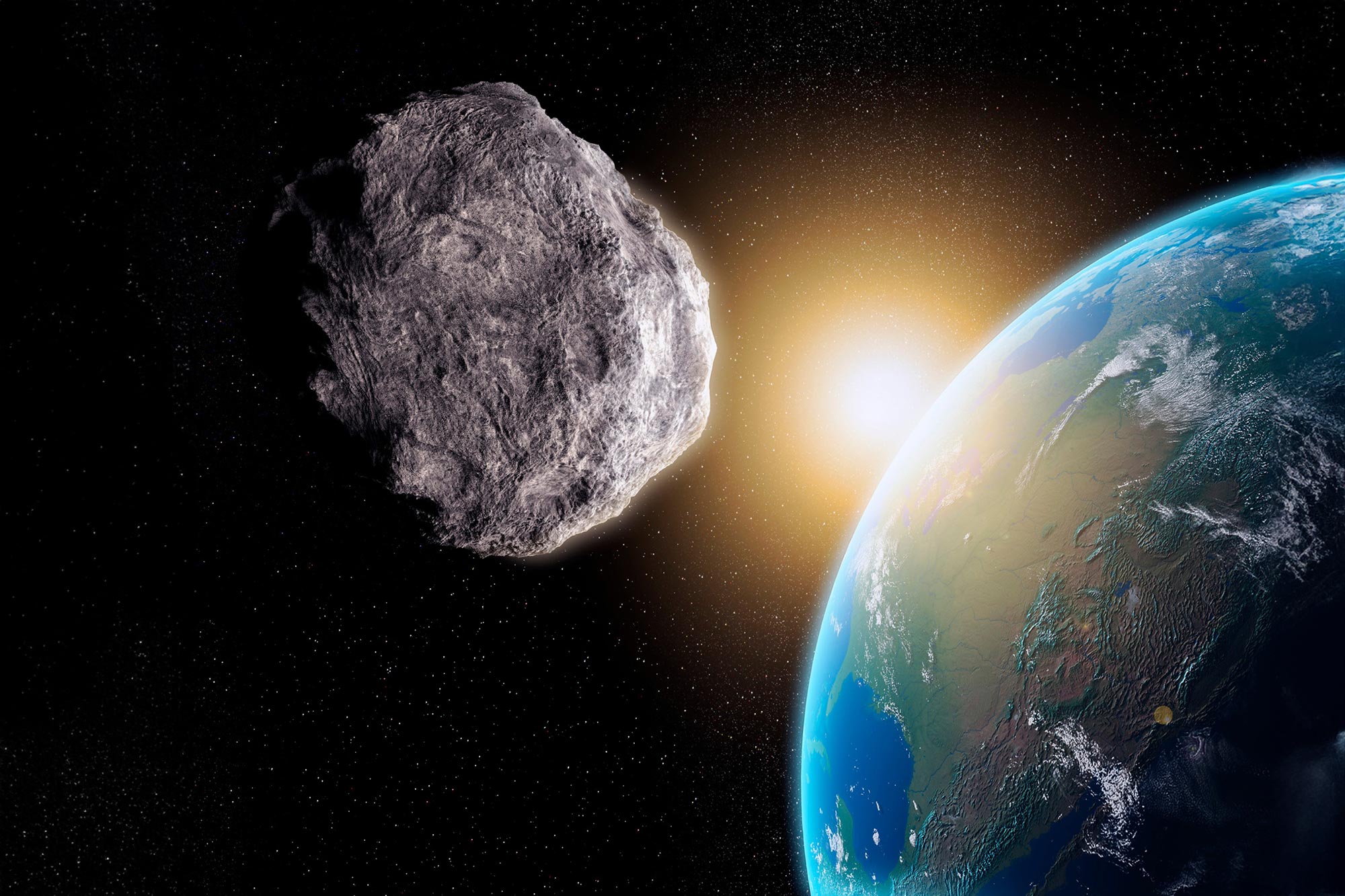
NASA’s hypothetical asteroid impact exercises, held every two years, simulate a potential Earth impact to prepare global defense responses.
These exercises incorporate realistic asteroid tracking data and emphasize international cooperation in emergency planning and asteroid deflection strategies, highlighted by recent successful tests such as DART.
Asteroid Impact Preparedness
A large asteroid impacting Earth is highly unlikely for the foreseeable future. But because the damage from such an event could be great, NASA leads hypothetical asteroid impact “tabletop” exercises every two years with experts and decision-makers from federal and international agencies to address the many uncertainties of an impact scenario. The most recent exercise took place this past April, with a preliminary report being issued on June 20.
Designing Realistic Impact Scenarios
Making such a scenario realistic and useful for all involved is no small task. Scientists from the Center for Near Earth Object Studies (CNEOS) at NASA’s Jet Propulsion Laboratory (JPL) in Southern California, which specializes in the tracking and orbital determination of asteroids and comets and finding out if any are hazards to Earth, have played a major role in designing these exercises since the first 11 years ago.
“These hypothetical scenarios are complex and take significant effort to design, so our purpose is to make them useful and challenging for exercise participants and decision-makers to hone their processes and procedures to quickly come to a plan of action while addressing gaps in the planetary defense community’s knowledge,” said JPL’s Paul Chodas, the director of CNEOS.

The Impact Scenario
This year’s scenario: A hypothetical asteroid, possibly several hundred yards across, has been discovered, with an estimated 72% chance of impacting Earth in 14 years. Potential impact locations include heavily populated areas in North America, Southern Europe, and North Africa, but there is still a 28% chance the asteroid will miss Earth. After several months of being tracked, the asteroid moves too close to the Sun, making further observations impossible for another seven months. Decision-makers must figure out what to do.
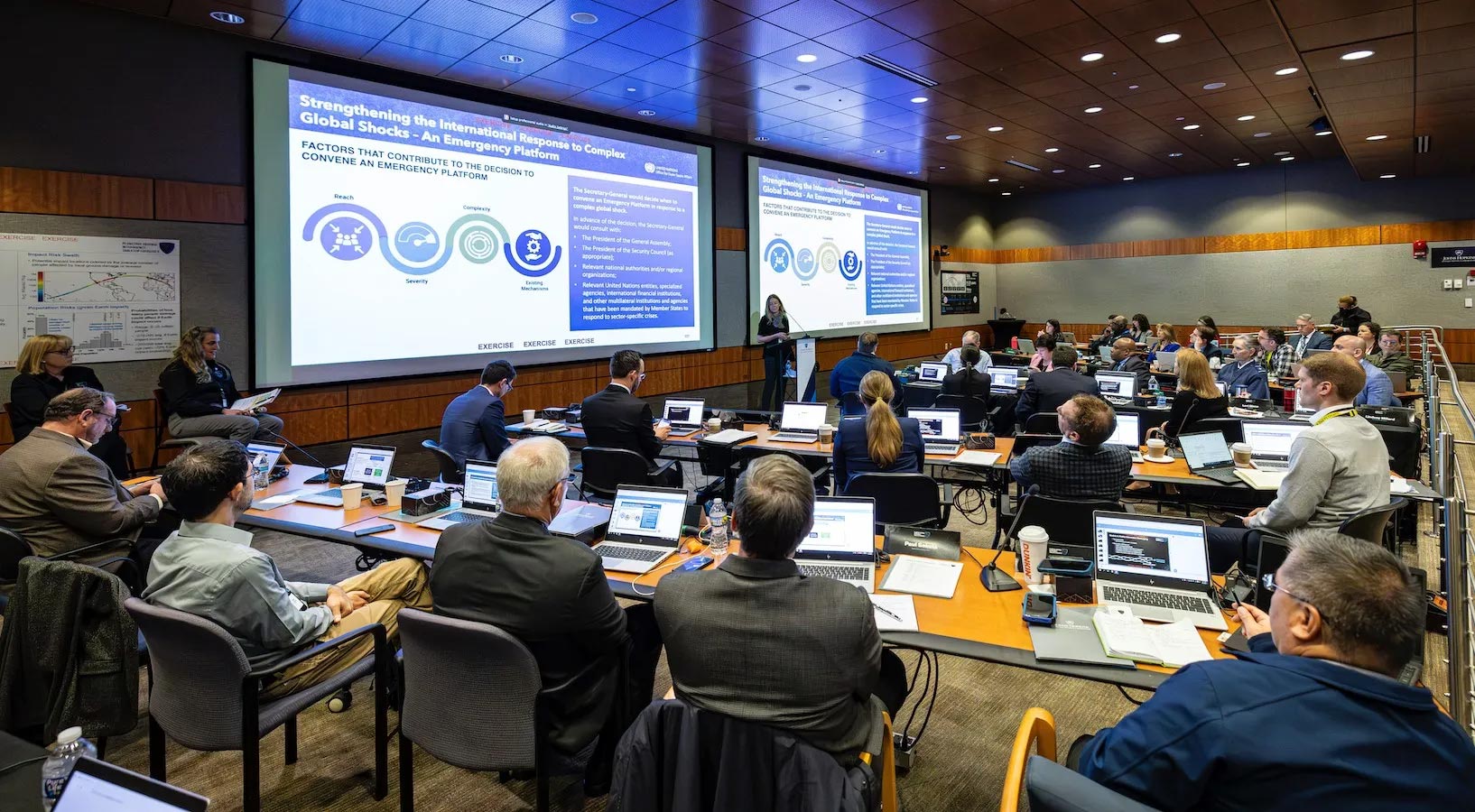
Leading the exercise were NASA’s Planetary Defense Coordination Office (PDCO), the Federal Emergency Management Agency Response Directorate, and the Department of State Office of Space Affairs. Over the course of two days in April, participants gathered at the Johns Hopkins Applied Physics Laboratory in Laurel, Maryland, which hosted the event, to consider the potential national and global responses to the scenario.
“This was a very successful tabletop exercise, with nearly 100 participants from U.S. government agencies and, for the first time, international planetary defense experts,” said Terik Daly from APL, who coordinated the exercise. “An asteroid impact would have severe national and international ramifications, so should this scenario play out for real, we’d need international collaboration.”
Reality Informs Fiction
In real life, CNEOS calculates the orbit of every known near-Earth object to provide assessments of future potential impact hazards in support of NASA’s planetary defense program. To make this scenario realistic, the CNEOS team simulated all the observations in the months leading up to the exercise and used orbital determination calculations to simulate the probability of impact.
“At this point in time, the impact was likely but not yet certain, and there were significant uncertainties in the object’s size and the impact location,” said Davide Farnocchia, a navigation engineer at JPL and CNEOS, who led the design of the asteroid’s orbit. “It was interesting to see how this affected the decision-makers’ choices and how the international community might respond to a real-world threat 14 years out.”
Exploring Deflection Strategies
Preparation, planning, and decision-making have been key focal points of all five exercises that have taken place over the past 11 years. For instance, could a reconnaissance spacecraft be sent to the asteroid to gather additional data on its orbit and better determine its size and mass? Would it also be feasible to attempt deflecting the asteroid so that it would miss Earth? The viability of this method was recently demonstrated by NASA’s Double Asteroid Redirection Test (DART), which impacted the asteroid moonlet Dimorphos on September 26, 2022, slightly changing its trajectory. Other methods of deflection have also been considered during the exercises.
But any deflection or reconnaissance mission would need many years of preparation, requiring the use of advanced observatories capable of finding hazardous asteroids as early as possible. NASA’s Near-Earth Object Surveyor, or NEO Surveyor, is one such observatory. Managed by JPL and planned for launch in late 2027, the infrared space telescope will detect light and dark asteroids, including those that orbit near the Sun. In doing so, NEO Surveyor will support PDCO’s objectives to discover any hazardous asteroids as early as possible so that there would be more time to launch a deflection mission to potential threats.
To find out the outcome of the exercise, read NASA’s preliminary summary.
Never miss a breakthrough: Join the SciTechDaily newsletter.
Follow us on Google and Google News.
74 Comments
I find it interesting that they do this, but do also wonder how realistic they can ever really be – an object from interstellar space travelling in excess of 30km/s sun relative could have a velocity of up to 100km/s relative to Earth depending on the approach angle relative to Earth’s motion. These objects, approaching from interstellar space, could have a velocity of almost 0km/hr sun relative, meaning they may take decades to enter the inner solar system and be extremely difficult to detect, on the other hand, an object could enter the solar system in excess of 100km/s sun relative, travelling from the outer solar system to the inner solar system in less than a month – if coming straight at us – that would make it hard to see and determine an orbit.
I appreciate all perspectives, and you are correct. How accurate can they really be? But humans have landed multiple crafts on Mars and the moon. The rovers are conteolled and issues rectified from 34 million miles / 54 million Km away (at closest).
NASA is incredibly phenomenal at their calculations. However, these are sheerly theoretical at this moment.
There are satelites that monitor the orbit and trajectory of some of these Heavenly bodies.
If you hear about an asteroid named wormwood, there’s gonna be trouble.
On your comment to detection of outer space objects radar that uses laser in place of radio waves the array can consist of satite mirrors causing vast wide pattern sweep like machine gunfiring in side a sub without penetration creating a mirrors of light array abroken beam of light will tell of that dark vader
🎱
I believe wormwood is apohis
Could you elaborate on NASA,s Continued Development Asteroid(s) Hunting Space Telescope(s)’ potential coverage(s) of Nearness Asteroids and/or UFO(s)?
Many thanks.—-GMBL.
I make car-parts for the American working man. Because that’s what I am. And that’s who I care about.
Don’t take no for answer either!
Would it not make more sense with technology as it is today and build a planetary defence net that could just be switched on. Any thing hitting would be rebounded back out on a different path.
Chill out and open another bottle of wine, not much we can do
Nerd
Wormwood
We have only 120 years alotted to our life span and we think we know more about inter stellar flight and trajectory than the mechanism governing our 120 years..
As Alfred Newman sprach, “What? Me worry? Waste of money over other priorities.
See if we could get some plausible ability to steer it a bit so it would hit one of the more nefarious people’s of the planet we’d really be onto something special. E.g. Chairman Xi’s house, Putin’s house, or Tehran in general would be an-across-the-board net positive for the world.
Not cool, not funny
Well I think it’s very funny and very cool. What a brilliant idea for DARPA’s next technology research programme. I am a UK tax payer and I would happily pay extra to fund such a program, no matter the cost.
The point is that impact by objects of any considerable size would kill us all regardless of where it hit….
Let it hit we are all going to die anyway. Deth is just part of life
Not a bad idea
In most cases an asteroid impacting earth would cause planetary destruction, unless it’s quite small. The fact that NASA is actively monitoring space for objects on a trajectory for earth is encouraging me to believe anything of a dangerous size would be discovered in time.
They say this every year
At least something is being done to attempt to save the planet, we all call home, should there be a problem. I don’t know about you but I for one would be extremely grateful for the theoretical knowledge gained by such exercises should such a scenario become a very bleak reality for each and every one of us.
I agree
That’s all well & good but Earth is more at risk from us & our own stupidity & maybe we should start taking strategies to combat our actions seriously!
When it comes to dangerous asteroids coming our way, I think the rule of thumb is this: if it’s big enough to be detected on time, then it’s too big to deflect. If it’s small enough to deflect, then it’s too small to be detected on time.
There may be an optimal size where timely detection and deflection are possible, but these occurrences are so rare that we’ll probably never find out.
North Korea?
It’s going to happen it’s happend over million of years in the past. I just feel for my great grand children
TG t
In reality, the world don’t have the technology to do any thing,.
Deflection is not possible for a real treat, giving the size. But that is me,
Necessity is the mother of invention. We would find a way
Yes we will find a way.
Stop all de wars and concentrate on space.we need to see de bigger picture if this planet is to survive. Thank. God they are at least looking at de possibility of saving millions of lives. It is a very real threat.
We have the technologies, but politics would most probably prevent anything useful being achieved. But we have messed up the earth so a scorched reset caused by a few thousand tons of rock smashing into us at 72,0000 km/h, would probably have long term benefits.
Look up NASA’s DART mission!
Not “don’t”, but ‘doesn’t’ [or ‘does not’ –better, when not colloquial].
I would also hope if they did find a real planet killer, they would keep it very very hush. Otherwise the world would kill itself before it ever showed up
I have always wondered if, there was a big astroid with 99% impact, would the government let us know r keep it classified. Idk but people panic so fast the damage could be done before it even makes it close to u?
Yes I agree and we wouldn’t know until it happens truth be told bc we see it in movie’s etc.
Focus on wat really matters. We’re killing the planet anyhow.
Hypothetically, if it were a earth killer they couldn’t stop , the powers that be would not tell the public so. It would be total anarchy if they did.
They ain’t scannin for no hoeasssssteroids, they on the lookout for Space Cunts. They’re bad hombres.
Revelation 8:8-9 NKJV
[8] Then the second angel sounded: And something like a great mountain burning with fire was thrown into the sea, and a third of the sea became blood. [9] And a third of the living creatures in the sea died, and a third of the ships were destroyed.
Revelation 8:10-11 NKJV
[10] Then the third angel sounded: And a great star fell from heaven, burning like a torch, and it fell on a third of the rivers and on the springs of water. [11] The name of the star is Wormwood. A third of the waters became wormwood, and many men died from the water, because it was made bitter.
Why, in a modern and all edgedly educated society, I find a reference to the bible is beyond me???? I thought this website is called scitech daily.com, not jackanory.com
Because the Holy Bible including YESHUA have been proven to be historically accurate time and time again so what better way to predict the future than analyzing the historical past! Science even leads to a creator!
That’s real talk for sure.
Amen , all Praise and Glory to our soon to come Lord and Savior Jesus Christ, while bombs and asteroids are coming down, believers are going up !!!!!
That is @ true statement.
Good point. But educated society? How many Americans voted for a man called Trump who’s an egotistical manipulative lier and scumer to be the president of this great nation. He is obviously not qualified to be even in any small community as a representative because of his rude mannerism and his valgur words of choice.
But again millions of our citizens still wants him to be a leader of this great nation, and to say or think that we have an “educated society” I think is wrong. Instead we have to examine the education we are getting and how beneficial is to our society at list in giving basic general knowledge.
We are our own gods in our minds. Heaven or He’ll will be a simple change of a computer chip in the matrix we live in.
You think it’s what?grand coincidence that SCIENCE understands the great extinction events on this planet have been facilitated by asteroid impacts and a guy 2000 some odd years ago without the benefit of the internet or even a telescope was shown visions of asteroids falling from the heavens facilitating the biblical end of days?lucky guess I suppose.. right?
What if it was generalist all the people will grow old and die but some may come death by natural accident and devish cause these things a bound to happen what others can happen
Preprogrammed.
That chip was an early predecessor to the end of days or program.
Amazing ideas.i say glory be to the lord the creater of heaven and earth.He will take charge of all our fears.
Amen.
**The Book of Dorkas, Chapter 13, Verses 4-7**
4 And lo, in the hour of the seventh trumpet, when the sky split asunder and the winds howled like a thousand voices, there came from the heavens the blazing stone of Zarkon, trailing fire and fury.
5 And as the star descended, the earth quaked, and the mountains danced, while dogs in every land did run in circles, biting at their own tails, as madness seized them.
6 The rivers boiled and the trees uprooted themselves, marching to the rhythm of the earth’s final heartbeat. Yet still, the hounds spun, yelping in the chaos, for the hour of Endrus was at hand.
7 And with a great crash, the stone of Zarkon smote the earth, and all was swallowed in a veil of shadow, leaving only the echoes of the dogs’ frantic chase in the darkness of the void.
So your invisible deity will save us, guess NASA can stop these exercises
One interesting thing that we learned from DART was the strange kind of composition of some asteroids, like a big clump of gravel, not a real “solid”, and, even with the kind of shock absorption of the “clump”, the orbit changed quite noticeably… Perhaps hyperspeed masses hitting a solid asteroid would have even more effect?
A future mission could even put a thruster-only onto a small asteroid, and use that as the “impacted”… If an “icy” body was available, it could even be used as the fuel mass for a nuclear powered thruster? And, indeed, the positive experiences with rovers and even the helicopter on Mars, have shown that remote control over long distances is very workable, and the DART mission proved very capable of autonomous in-flight guidance.
De best way to get rid of nukes is to them in space and de distance de can travel before one gets close enough. Take away de threat down here and in space. Common sence.
Focus on wat really matters. We’re killing the planet anyhow.
Ignorance is solidly confirmed when some individuals open their mouth. As demonstrated in these some posts.
Glad the human race is not choosing the path of sticking it’s head in the sand, and blindly believing it will not happen or will not have catastrophic global results.
Yes, I believe the biggest hurdle will be global political response. Face it, too many will demand control and not play well with others!
That will compound the actual event ten fold.
Well this is true and I agree and all I can say rn is all better be right with their higher power bc anything can happen at any time truth be told. So get right with God now and don’t wait till later frfr.
I hope this isn’t an exercise that for some reason coincides with an actual disaster that same day or week. I mean the US has been gaslit by its own government many in the past.
We already know how to do this…..just send a team of our finest drillers to there….
Do the math. The Earth is approximately 8,000 miles in diameter. Its average orbital velocity around the sun is simple to calculate (or you can look it up online): it’s roughly 67,000 mph. So, (rounding to keep the math simple), the earth transits a given point in its orbit in roughly 8 seconds.
This means that an asteroid or other orbital body only needs to be deflected from its orbit by at most a little more than 4 seconds to prevent an impact.
Short, short version: the solution to the problem should be well within our capability.
Bruce Willis unfortunately won’t be able to help out on this one 😢
Funny! Nor will Robert Duvall that was in the other movie. Maybe chuck. Swarznegger or Stallone can save us
I’m
Funny! Funny! Tammy
Black hole will get us first.
I think it is the blow flies and all their lies cause and effect is ringworms coming from their wormhole that’s the cause of them stretching each others bum holes
On the positive side of this end of days scenario is that humanity would very possibly be forced to work together as a team, laying down any current issues one country might have with another. Just like I’m the movie Armageddon. And maybe after the world is saved by some unknown country, the people in this world would hopefully have a lot less hate for each other and at least one big reason to love each other. Bring on the astriod Universe!!!!! My bets on humanity. Differences are assets not liabilities. And if we can’t get along to solve the problem that would wipe us all out, then I’d want to wait for earth version 449 anyways. Maybe 450 will pass. Good luck to your u all!
My question is what do we (example : people that will not see that possibility) want super advanced level defense from? If the same people will watch the cataclysm avoided, and the next day look at each other and say. “We don’t know why our defenses make this planet better. What can they defend us against? Well, nothing is going to happen.” What people don’t stay positive about is change happens when we are living, and it’s not good to exagagerate this. By not leaving our space on earth better. What if the time is here, how could we help ourselves when it is time for something to happen to us? Would avoiding an event really matter? What if planet life can end and they think it’s time or something we don’t. Do we really know what’s going to happen? Why is there a point if we can’t make our space better?