
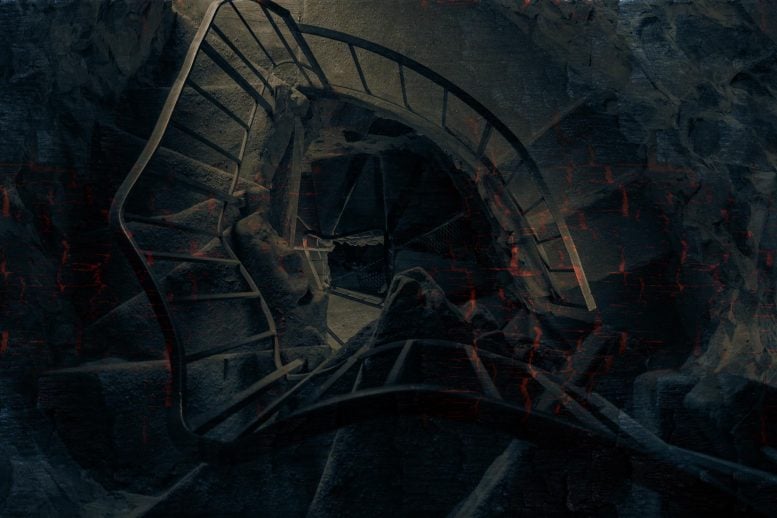
At the regional level and worldwide, the occurrence of large shallow earthquakes appears to follow a mathematical pattern called the Devil’s Staircase, where clusters of earthquake events are separated by long but irregular intervals of seismic quiet.
The finding published in the Bulletin of the Seismological Society of America differs from the pattern predicted by classical earthquake modeling that suggests earthquakes would occur periodically or quasi-periodically based on cycles of build-up and release of tectonic stress. In fact, says Yuxuan Chen of the University of Missouri, Columbia, and colleagues, periodic large earthquake sequences are relatively rare.
The researchers note that their results could have implications for seismic hazard assessment. For instance, they found that these large earthquake sequences (those with events magnitude 6.0 or greater) are “burstier” than expected, meaning that the clustering of earthquakes in time results in a higher probability of repeating seismic events soon after a large earthquake. The irregular gap between event bursts also makes it more difficult to predict an average recurrence time between big earthquakes.
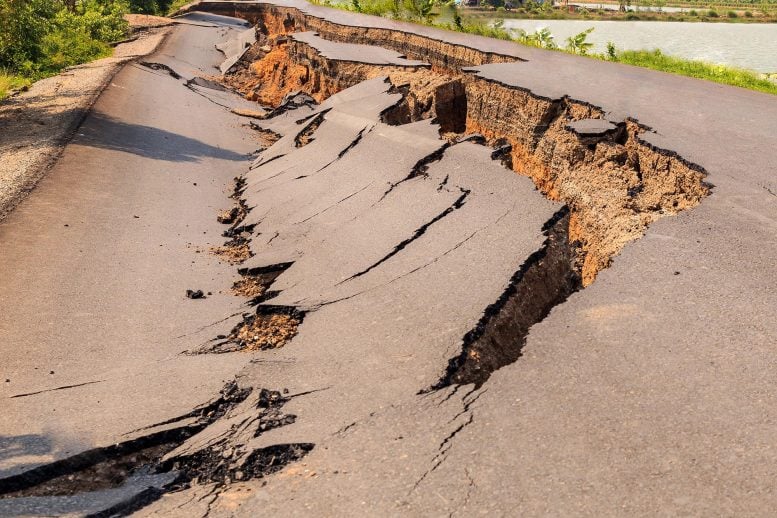
Seismologists’ catalogs for large earthquakes in a region might include too few earthquakes over too short a time to capture the whole staircase pattern, making it “difficult to know whether the few events in a catalog occurred within an earthquake cluster or spanned both clusters and quiescent intervals,” Chen and his colleagues noted.
“For this same reason, we need to be cautious when assessing an event is ‘overdue’ just because the time measured from the previous event has passed some ‘mean recurrence time’ based on an incomplete catalog,” they added.
The Devil’s Staircase, sometimes called a Cantor function, is a fractal demonstrated by nonlinear dynamic systems, in which a change in any part could affect the behavior of the whole system. In nature, the pattern can be found in sedimentation sequences, changes in uplift and erosion rates, and reversals in Earth’s magnetic field, among other examples.
Chen’s Ph.D. advisor Mian Liu had an unusual introduction to the Devil’s Staircase. “I stumbled into this topic a few years ago when I read about two UCLA researchers’ study of the temporal pattern of a notorious serial killer, Andrei Chikatilo, who killed at least 52 people from 1979 to 1990 in the former Soviet Union,” he explained. “The time pattern of his killings is a Devil’s staircase. The researchers were trying to understand how the criminal’s mind worked, how neurons stimulate each other in the brain. I was intrigued because I realized that earthquakes work in a similar way, that a fault rupture could stimulate activity on other faults by stress transfer.”
“Conceptually, we also know that many large earthquakes, which involve rupture of multiple and variable fault segments in each rupture, violate the basic assumption of the periodic earthquakes model, which is based on repeated accumulation and release of energy on a given fault plane,” Liu added.
The factors controlling the clustered events are complex, and could involve the stress that stimulates an earthquake, changes in frictional properties, and stress transfer between faults or fault segments during a rupture, among other factors, said Gang Luo of Wuhan University. He noted that the intervals appear to be inversely related to the background tectonic strain rate for a region.
The Devil’s Staircase pattern can be found in large earthquakes in the Great Basin of the U.S. West, in Australia, on the Africa-Eurasia plate boundary off the coast of western Algeria, along the Dead Sea Transform Fault, and potentially in the New Madrid seismic zone of the central U.S., said Liu, noting that the specific details of the pattern vary from region to region.
Reference: “Complex Temporal Patterns of Large Earthquakes: Devil’s Staircases” by Yuxuan Chen, Mian Liu and Gang Luo, 14 April 2020, Bulletin of the Seismological Society of America.
DOI: 10.1785/0120190148
Never miss a breakthrough: Join the SciTechDaily newsletter.
Follow us on Google and Google News.