
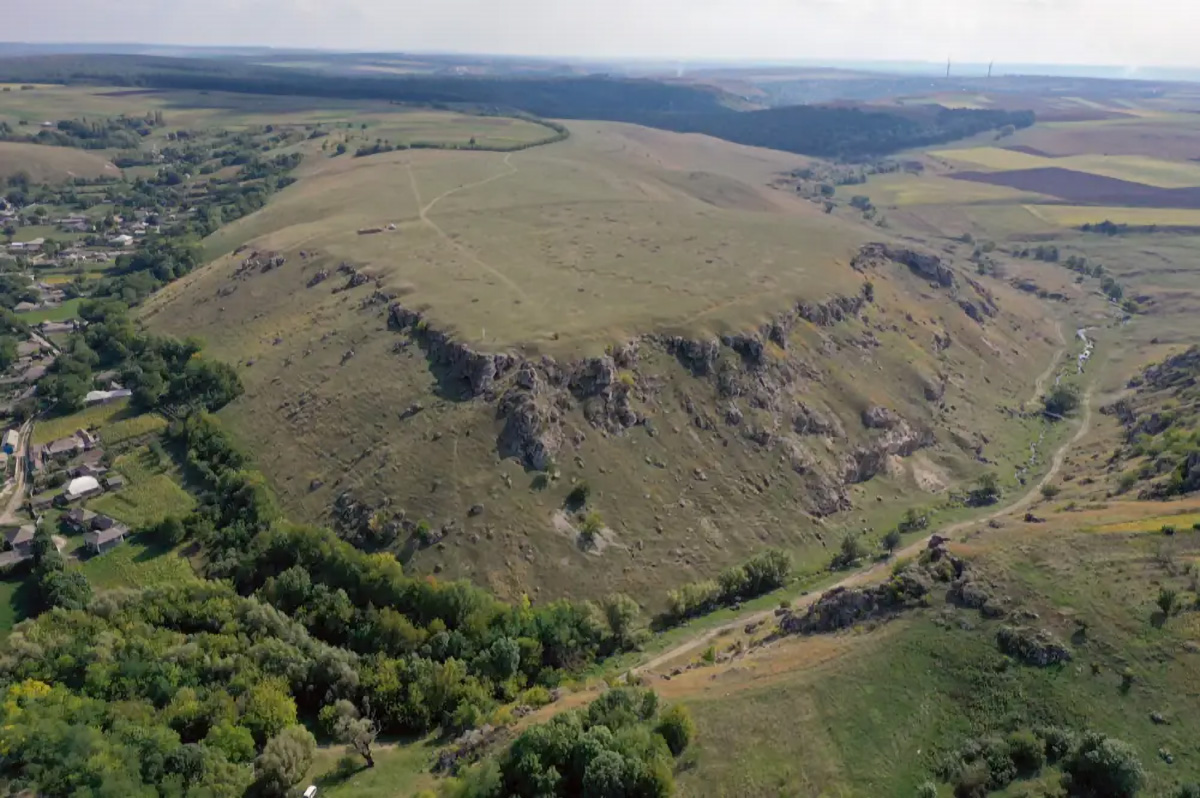
Social distancing may have roots 6,000 years ago, as research shows Neolithic villages like Nebelivka used clustered layouts to control disease spread.
The phrase “social distancing” became widely recognized in recent years as people worldwide adapted their behavior to combat the COVID pandemic. However, new research led by UT Professor Alex Bentley suggests that the concept of maintaining organized physical distance may trace back roughly 6,000 years.
Bentley, from the Department of Anthropology, published a recent study in the Journal of The Royal Society Interface. His coauthors include Simon Carrignon, a former UT postdoctoral researcher who was a research associate at the Cambridge University’s McDonald Institute for Archaeological Research while working on this project.
“New ancient DNA studies have shown that diseases such as salmonella, tuberculosis, and plague emerged in Europe and Central Asia thousands of years ago during the Neolithic Era, which is the time of the first farming villages,” said Bentley. “This led us to ask a new question, which is whether Neolithic villagers practiced social distancing to help avoid the spread of these diseases.”
Urban Planning Over the Centuries
As computational social scientists, Bentley and Carrignon have published on both ancient adaptive behaviors and the spread of disease in the modern world. This project brought these interests together. They found that the “mega-settlements” of the ancient Trypillia culture in the Black Sea region, circa 4,000 BC, were a perfect place to test their theory that boundaries of personal space have long been integral parts of public health planning.
They focused on a settlement called Nebelivka, in what is now Ukraine, where thousands of wooden homes were regularly spaced in concentric patterns and clustered in neighborhoods.
“This clustered layout is known by epidemiologists to be a good configuration to contain disease outbreaks,” said Bentley. “This suggests and helps explain the curious layout of the world’s first urban areas—it would have protected residents from emerging diseases of the time. We set out to test how effective it would be through computer modeling.”
Carrignon and Bentley adapted models developed in a previous National Science Foundation-funded project at UT. Bentley was co-investigator with research lead Professor Nina Fefferman in this work modeling the effects of social distancing behaviors on the spread of Covid-like pandemics to study what effects these practices—such as reducing interaction between neighborhoods—might have had on prehistoric settlements.
“These new tools can help us understand what the archaeological record is telling us about prehistoric behaviors when new diseases evolved,” said Bentley. “The principles are the same—we assumed the earliest prehistoric diseases were foodborne at first, rather than airborne.”
Following the Trail
Their current study simulated the spread of foodborne disease, such as ancient salmonella, on the detailed plan of Nebelivka.
They teamed with:
- John Chapman and Bisserka Gaydarska, archaeologists from England’s Durham University, who excavated Nebelivka;
- Brian Buchanan, a researcher at Eastern Washington University researcher who did a detailed digital map of the site;
- and Mike O’Brien, a cultural evolution expert from Texas A&M in San Antonio.
They ran the archeological data through millions of simulations to test the effects of different possible disease parameters.
“The results revealed that the pie-shaped clustering of houses at Nebelivka, in distinct neighborhoods, would have reduced the spread of early foodborne diseases,” said Bentley. “Fighting disease might also explain why the residents of Nebelivka regularly burned their wooden houses to replace them with new ones. The study shows that neighborhood clustering would have helped survival in early farming villages as new foodborne diseases evolved.”
Applications for Today
With their success in modeling from sparse archaeological data, this approach could be applied to contemporary and future situations when disease data are sparse, even for airborne illnesses.
“In the early 2020 days of the Covid epidemic, for example, few US counties were reporting reliable infection statistics,” said Bentley. “By running millions of simulations with different parameter values, this approach—known as ‘Approximate Bayesian Computation’—can be applied to test different models versus contemporary disease data, such as infection numbers in US counties over time.”
The team’s mix of ancient solutions and modern applications exemplifies the innovative approaches that Volunteer researchers in the College of Arts and Sciences bring to making lives better for Tennesseans and beyond.
Reference: “Modelling cultural responses to disease spread in Neolithic Trypillia mega-settlements” by R. Alexander Bentley, Simon Carrignon, Bisserka Gaydarska, John Chapman, Brian Buchanan and Michael J. O’Brien, 30 September 2024, Journal of the Royal Society Interface.
DOI: 10.1098/rsif.2024.0313
Never miss a breakthrough: Join the SciTechDaily newsletter.
Follow us on Google and Google News.
4 Comments
Considering that these people probably left behind descendants, my guess would be the separation of peoples had more to do with an arbitrary class system based primarily on physical attributes, as we saw in Rwanda, and then based upon that, certain dietary restrictions might be made on what they were allowed to hunt or forage for, a system from which serfs and like would be a natural consequence of and slavery, both in Europe, and wherever else its Empires saw fit; a system of depravity that is still very much with us today.
This is supposed to be a scientific magazine, but they too use the erroneous term “social distancing”. Woo even came up with it? It’s about PHYSICAL distancing, because people physically separate from each other to prevent the contagion.
Social distancing is when you’re just giving each other cold shoulder.
Good distinction. Social distancing is what happens with a caste system where people don’t interact, regardless of where they eat and sleep.
Social distancing is the term that was widely used during the pandemic. Glad I could clear that up for you. I have never seen or heard the term “physical distancing” before, and it seems redundant.