
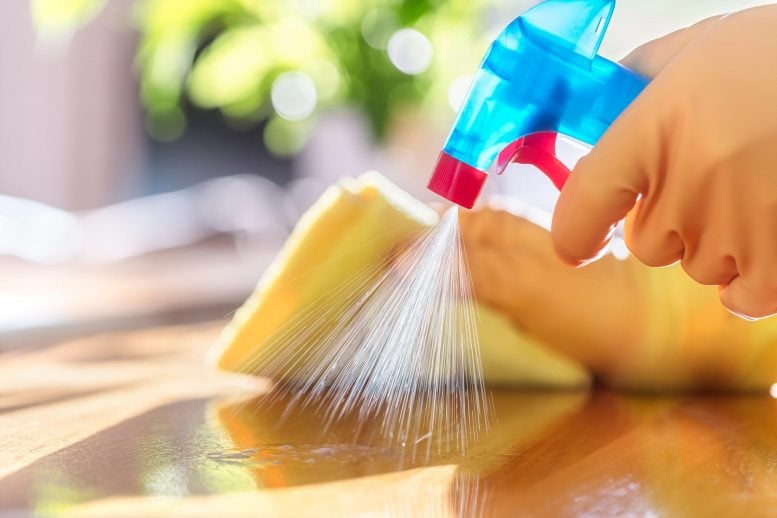
The overuse of antimicrobial chemicals known as quaternary ammonium compounds (QACs) during the COVID-19 pandemic has been linked to health issues, antimicrobial resistance, and environmental harm, according to scientists. They recommend reducing unnecessary use, cleaning with soap and water, and requiring full disclosure of QACs in all products.
The COVID-19 pandemic has boosted the unnecessary use of antimicrobial chemicals linked to health problems, antimicrobial resistance, and environmental harm, warn more than two dozen scientists in the peer-reviewed journal Environmental Science & Technology. Their critical review details how quaternary ammonium compounds (QACs) are increasingly marketed and used in home, healthcare, education, and workplace settings despite the availability of safer alternatives and in some cases limited evidence of reduced disease transmission.
“Disinfectant wipes containing QACs are often used on children’s school desks, hospital exam tables, and in homes where they remain on these surfaces and in the air,” said Courtney Carignan, a co-author and assistant professor at Michigan State University. “Our review of the science suggests disinfecting with these chemicals in many cases is unhelpful or even harmful. We recommend regular cleaning with soap and water and disinfecting only as needed with safer products.”
Environmental and Antimicrobial Resistance Concerns
Human studies have found associations between QACs and asthma, dermatitis, and inflammation. Laboratory animal studies also raise concerns about potential links to infertility, birth defects, and more. Further, there has been evidence dating back to the 1950s that QACs contribute to antimicrobial resistance, making certain bacteria species resistant both to QACs themselves and to critical antibiotics.
“It’s ironic that the chemicals we’re deploying in vain for one health crisis are actually fueling another,” said Erica Hartmann, a co-author and professor at Northwestern University. “Antimicrobial resistance was already contributing to millions of deaths per year before the pandemic. Overzealous disinfection, especially with products containing QACs, threaten to make it worse.”
QACs are increasingly used in disinfectant solutions, wipes, hand sanitizers, sprays, and foggers, and are also being incorporated into personal care products, textiles, paints, medical instruments, and more. Since the pandemic, levels of these chemicals in the environment and our bodies have increased in parallel.
One of the most common QACs is benzalkonium chloride, but others can be identified on ingredient labels with names that end in “ammonium chloride” or similar. However, disclosure and regulation of QACs varies widely. For example, pesticide labels are required to list QACs but paint labels are not. Most QACs are not regulated at all, nor are they comprehensively screened for health hazards.
Recommendations for Safer Practices and Policies
The scientists recommend eliminating uses of QACs that are either unnecessary or where their effectiveness has not been demonstrated. For example, disinfection with QACs often has no benefit over cleaning with plain soap and water. Other recommendations include requiring full disclosure of QACs in all products and closely monitoring their levels in people and the environment.
“Drastically reducing many uses of QACs won’t spread COVID-19,” said Carol Kwiatkowski, a co-author and scientist at the Green Science Policy Institute. “In fact, it will make our homes, classrooms, offices, and other shared spaces healthier.”
Reference: “Quaternary Ammonium Compounds: A Chemical Class of Emerging Concern” by William A. Arnold, Arlene Blum, Jennifer Branyan, Thomas A. Bruton, Courtney C. Carignan, Gino Cortopassi, Sandipan Datta, Jamie DeWitt, Anne-Cooper Doherty, Rolf U. Halden, Homero Harari, Erica M. Hartmann, Terry C. Hrubec, Shoba Iyer, Carol F. Kwiatkowski, Jonas LaPier, Dingsheng Li, Li Li, Jorge G. Muñiz Ortiz, Amina Salamova, Ted Schettler, Ryan P. Seguin, Anna Soehl, Rebecca Sutton, Libin Xu and Guomao Zheng, 8 May 2023, Environmental Science & Technology.
DOI: 10.1021/acs.est.2c08244
Never miss a breakthrough: Join the SciTechDaily newsletter.
Follow us on Google and Google News.
5 Comments
Wait,what?
But you told us that it was safe to wipe everything down with all this gunk!?
So much for “settled science”
Soap and water is best. Too many frightened idiots.
Way back in 1987, a radio show called The Bioneers said that anti-bacterial soaps (now, hand sanitizers) WOULD create supergerms if we kept using them. Yet no news about this. And 30 years later ignorant school still recommend them. This article says they’ve known since the 50s! We are bought&sold by corps & govt and we don’t care enough to learn.
I put “ignorant school nurses…”
Hmmm…
I remember when my sister was born in 1965, my mom used Phisoderm, a hand sanitizer, which back then had an antibacterial in it and soon after the government banned it and it could no longer be sold. I wondered how can this type of cleaner make a comeback? I think SG had it right… corporate greed over our health.