
International Research Team Analyzes February 2023 Ohio Train Derailment
A train derailment in East Palestine, Ohio on February 3, 2023, led to the combustion of vinyl chloride, prompting an international team of researchers to analyze the environmental consequences. Published in Frontiers of Environmental Science & Engineering, the study emphasized the importance of accurate risk assessment and considered various questions related to the chemical accident. The team concluded that there were no good solutions to avoid both the explosion and environmental risks, stressing the need to address chemical risks at their source. They suggested substituting hazardous chemicals with eco-friendly alternatives, ensuring safer handling, and implementing stricter transportation management. The researchers aim to contribute to a healthier environment free of toxic chemicals.
On February 3, 2023, a train derailed in the United States near East Palestine, Ohio, leading to the combustion of vinyl chloride. Following that accident, an international team of researchers undertook an in-depth analysis of the environmental consequences of the accident.
Their analysis is published in the journal Frontiers of Environmental Science & Engineering on March 15, 2023.
In their analysis, the team examined a series of questions related to the environmental risk and management of the chemical accident. “We emphasized that it is unscientific to overestimate or underestimate the environmental risk of this event, and that an accurate environmental risk assessment requires comprehensive environmental monitoring data, which is currently far from complete. However, based on the chemical amount, nature, and combustion conditions, the potential environmental risks of the leaked chemicals and their combustion by-products deserve attention,” said Bin Wang, an associate professor at Tsinghua University.
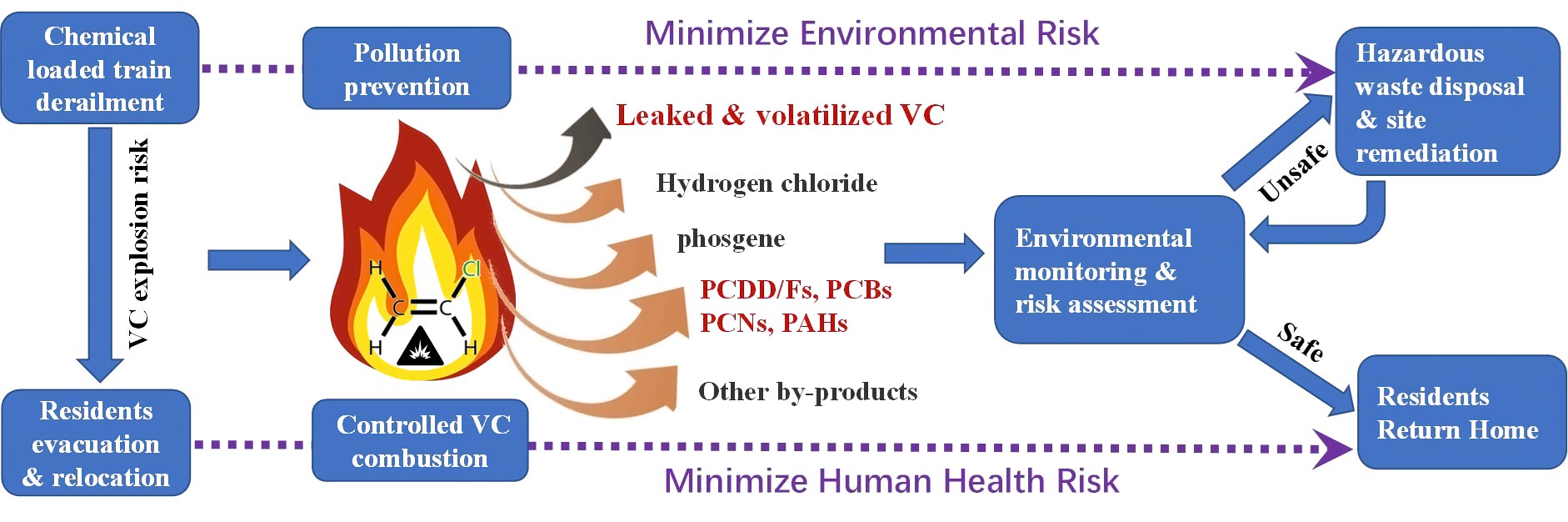
The first question the team explored was whether or not vinyl chloride should be burned on the spot after the train derailed. The team noted that moving the derailed chemical tank cars can be very difficult and dangerous, so it is better to deal with the chemical at the scene of the accident. There was a risk of explosion, which is more dangerous and uncontrollable than ignition.
The second question the team examined was whether or not the vinyl chloride burned under control in this accident. They noted that emergency responders carried out a “controlled combustion” after the train derailed. However, even with controlled combustion, hazardous by-products can be generated. Because of the hazardous effects of vinyl chloride and its combustion byproducts, it was necessary to evacuate the local residents.
The third question the team raised was what environmental risk was caused by the combustion of vinyl chloride in this accident. They noted that publicly there were conflicting views about the environmental risk. Some believed that the risk was very high, fearing that the accident would pollute Lake Erie and the Ohio River, which provides drinking water for millions of people. Others held the opposing view felt that the environmental risk was very small. Based on the view that the risk was small, the mandatory evacuation order was revoked on February 8, when monitoring showed that the water and air were safe. The team suggests that both of these opposing views might be wrong. They note that the accident has surely caused environmental and health risks to some extent. While the pollution in the air would quickly decrease, chemicals in the soil and groundwater will continue to pollute the environment over a long period of time unless they are cleaned up.
The fourth question the team examined was what follow-up work should be done. At this point there is not enough information to conduct a comprehensive risk assessment. Follow-up work that includes monitoring and evaluation, hazardous waste disposal, site remediation, and resident relocation is needed. This comprehensive risk assessment and remediation will take time. While this assessment is happening, local residents should be relocated to avoid potential exposure to the toxic chemicals. If the assessment confirms that the environment is free of risks, then the residents can return to their homes.
Long-Term Implications and Recommendations
“In this emergency case, there were actually no good solutions to simultaneously avoid explosion and environmental risks after the train derailment. Hence it is better to solve the chemical risks from the source. We also need to bridge the gap between chemical safety management and environmental risk management,” said Wang. The team notes that while modern industry and agriculture require the use of more and more chemicals, these chemicals can pollute the environment. They suggest ways to reduce the risks by substituting highly hazardous chemicals for more environment-friendly ones, through safer handling of chemicals, and with stricter transportation management.
Since long before the February 2023 train derailment, the research team has been engaged in research on environmental risk assessment and control of chemicals, including the chemicals themselves and their by-products. “With regard to the emerging contaminant control action being carried out in China, we expect to be able to more closely link environmental pollutants and their source chemicals to coordinate chemical safety management and environmental risk management. We hope that our research and proposals can contribute to a healthy environment free of toxic chemicals,” said Wang.
Reference: “Insight of chemical environmental risk and its management from the vinyl chloride accident” by Bin Wang, Liping Heng, Qian Sui, Zheng Peng, Xuezhi Xiao, Minghui Zheng, Jianxin Hu, Heidelore Fiedler, Damià Barceló and Gang Yu, 15 March 2023, Frontiers of Environmental Science & Engineering.
DOI: 10.1007/s11783-023-1652-x
The research team includes Bin Wang, Tsinghua University and Research Institute for Environmental Innovation (Suzhou); Liping Heng, Beihang University; Qian Sui, East China University of Science and Technology; Zheng Peng and Xuezhi Xiao, Ministry of Ecology and Environment of China; Minghui Zheng, Chinese Academy of Sciences; Jianxin Hu, Peking University; Heidelore Fiedler, Örebro University; Damià Barceló, Spanish Council for Scientific Research; and Gang Yu, Tsinghua University and the Research Institute for Environmental Innovation (Suzhou) and Beijing Normal University.
Never miss a breakthrough: Join the SciTechDaily newsletter.
Follow us on Google and Google News.
1 Comment
” They suggest ways to reduce the risks by substituting highly hazardous chemicals for more environment-friendly ones, through safer handling of chemicals, and with stricter transportation management.”
This may be the best observation of the study!!