
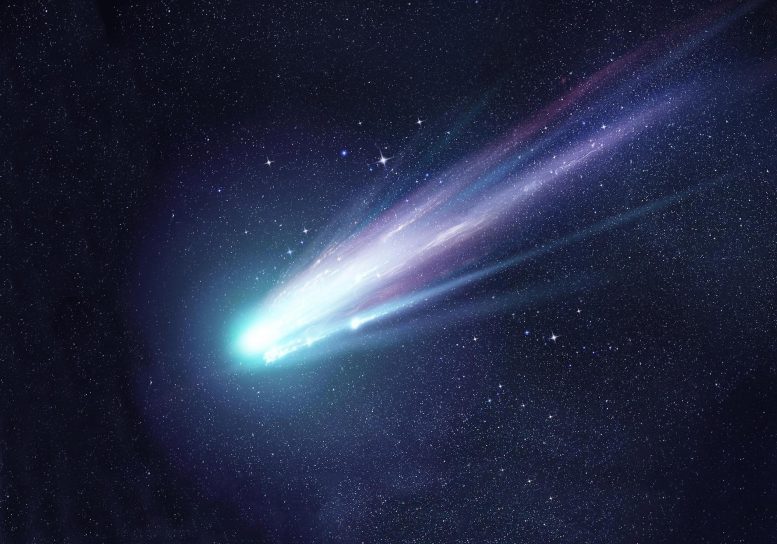
Nathan Kaib discovered that cometary fading, usually seen in comets near Earth, also occurs beyond Saturn, even in much colder conditions. This fading, driven by orbit shrinkage due to giant planets’ gravity, explains why fewer comets on smaller orbits are observed.
As comets approach the Sun, they release gas and dust known to astronomers as cometary activity. For comets passing near or inside Earth’s orbit, this activity slows over successive orbits. University of Oklahoma astronomer Nathan Kaib has found this same comet-fading phenomenon occurs as comets make repeated passages through the more distant region beyond Saturn.
Kaib, an associate professor in the Homer L. Dodge Department of Physics and Astronomy in the Dodge Family College of Arts and Sciences at OU, is the lead author of the article “Comet Fading Begins Before Saturn,” published in Science Advances.
“Long-period comets, those that take at least hundreds of years to go around the Sun once, spend most of their lives thousands of times further from the Sun than the Earth is,” said Kaib. “However, sometimes they develop highly elliptical orbits and, in turn, make regular incursions toward the Sun and its nearby planets. As these comets approach the Sun, its intense heat turns their icy surfaces into gas.
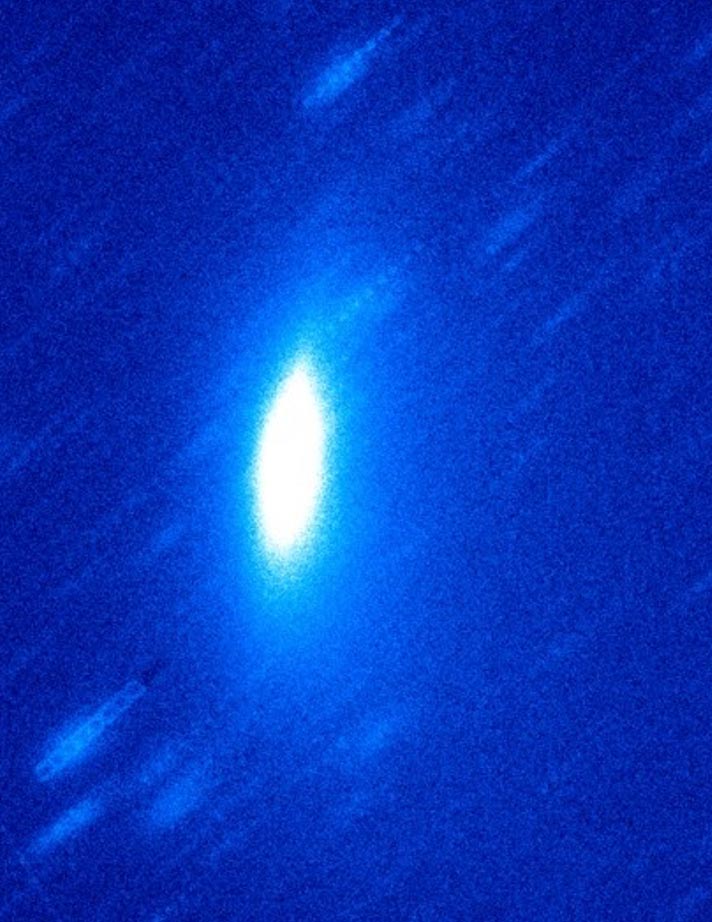
This cometary activity is what gives comets their striking appearance in the sky and makes them relatively easy for astronomers to find. As extreme heating from the Sun steadily depletes their surface ice supply, the activity of comets passing near Earth diminishes, or fades, over time.”
Comet Fading in the Outer Solar System
In this study, Kaib discovered that this fading phenomenon also occurs among comets passing through the outer solar system near or beyond Saturn’s orbit. What makes his findings surprising is that such comets experience much weaker heating from the Sun compared to those nearer Earth. In fact, unlike nearer comets, the Sun’s heating is so weak that water-based ice cannot evaporate on these comets.
By running computer simulations of comets traveling near the outer solar system’s giant planets, Kaib showed the gravity of the giant planets quickly shrinks the orbits of distant comets so they make smaller excursions away from the Sun in between passages through the outer solar system.
“We should therefore expect that the outer solar system has many more comets on these shrunken orbits compared to those on larger orbits,” he said. “Instead, astronomers see the opposite; distant comets with shrunken orbits are almost entirely absent from astronomers’ observations, and comets with larger orbits dominate our census of the outer solar system. Rapid comet fading that occurs during this orbit-shrinking explains this paradox, since it will effectively make older comets invisible to astronomers’ searches.”
Implications for Near-Earth Comet Studies
Given that distant comets are hard to study due to their remoteness, astronomers’ understanding of comets is mostly based on studying the ones on orbits near Earth. Kaib’s finding suggests that passages through the outer solar system may alter the physical properties of many near-Earth comets before they are discovered.
“Fading among distant comets was discovered by combining the results of computer simulations of comet production with the current catalog of known distant comets,” said Kaib. “These distant comets are faint and extremely difficult to detect, and comet-observing campaigns have taken great pains to build this catalog over the past 20 years. Without it, this current work would not have been possible.”
Kaib expects the Legacy Survey of Space and Time, a 10-year mission to survey the southern sky at the Vera C. Rubin Observatory in Chile, to rapidly increase comet discoveries.
“The comet fading characterized in my work will be critical to properly understanding and interpreting this imminent deluge of newly discovered comets,” he said.
The computer simulations for this work were performed at the OU Supercomputing Center for Education & Research. Kaib is currently on sabbatical leave at Case Western Reserve University in Cleveland, Ohio.
Reference: “Comet fading begins beyond Saturn” by Nathan A. Kaib, 30 March 2022, Science Advances.
DOI: 10.1126/sciadv.abm9130
Never miss a breakthrough: Join the SciTechDaily newsletter.
Follow us on Google and Google News.
1 Comment
I love space photo, please send me some pictures