

Twisting tungsten disulfide crystals allows researchers to control electron movement and enhance optical properties, unlocking new possibilities for quantum materials and photonic applications.
In 2018, a discovery in materials science sent shock waves throughout the community. A team showed that stacking two layers of graphene—a honeycomb-like layer of carbon extracted from graphite—at a precise “magic angle” turned it into a superconductor, says Ritesh Agarwal of the University of Pennsylvania. This sparked the field of “twistronics,” revealing that twisting layered materials could unlock extraordinary material properties.
Building on this concept, Agarwal, Penn theoretical physicist Eugene Mele, and collaborators have taken twistronics into new territory. In a study published in Nature, they investigated spirally stacked tungsten disulfide (WS₂) crystals and discovered that, by twisting these layers, light could be used to manipulate electrons. The result is analogous to the Coriolis force, which curves the paths of objects in a rotating frame, like how wind and ocean currents behave on Earth.
“What we discovered is that by simply twisting the material, we could control how electrons move,” says Agarwal, Srinivasa Ramanujan Distinguished Scholar in the School of Engineering and Applied Science. This phenomenon was particularly evident when the team shined circularly polarized light on WS₂ spirals, causing electrons to deflect in different directions based on the material’s internal twist.
The origins of the team’s latest findings trace back to the early days of the COVID-19 pandemic lockdowns when the lab was shut down and first author Zhurun (Judy) Ji was wrapping up her Ph.D.
Unable to conduct physical experiments in the space, she shifted her focus to more theoretical work and collaborated with Mele, the Christopher H. Browne Distinguished Professor of Physics in the School of Arts & Sciences. Together, they developed a theoretical model for electron behavior in twisted environments, based on the speculation that a continuously twisted lattice would create a strange, complex landscape where electrons could exhibit new quantum behaviors.
“The structure of these materials is reminiscent of DNA or a spiral staircase. This means that the usual rules of periodicity in a crystal—where atoms sit in neat, repeating patterns—no longer apply,” Ji says.
Experimental Breakthroughs
As 2021 arrived and pandemic restrictions lifted, Agarwal learned during a scientific conference that former colleague Song Jin of the University of Wisconsin-Madison was growing crystals with a continuous spiral twist. Recognizing that Jin’s spirally twisted WS₂ crystals were the perfect material to test Ji and Mele’s theories, Agarwal arranged for Jin to send over a batch. The experimental results were intriguing.
Mele says the effect mirrored the Coriolis force, an observation that is usually associated with the mysterious sideways deflections seen in rotating systems. Mathematically, this force closely resembles a magnetic deflection, explaining why the electrons behaved as though a magnetic field were present even when there was none. This insight was crucial, as it tied together the twisting of the crystal and the interaction with circularly polarized light.
Agarwal and Mele compare the electron response to the classic Hall effect wherein current flowing through a conductor is deflected sideways by a magnetic field. But, while the Hall effect is driven by a magnetic field, here “the twisting structure and the Coriolis-like force were guiding the electrons,” Mele says. “The discovery wasn’t just about finding this force; it was about understanding when and why it appears and, more importantly, when it shouldn’t.”
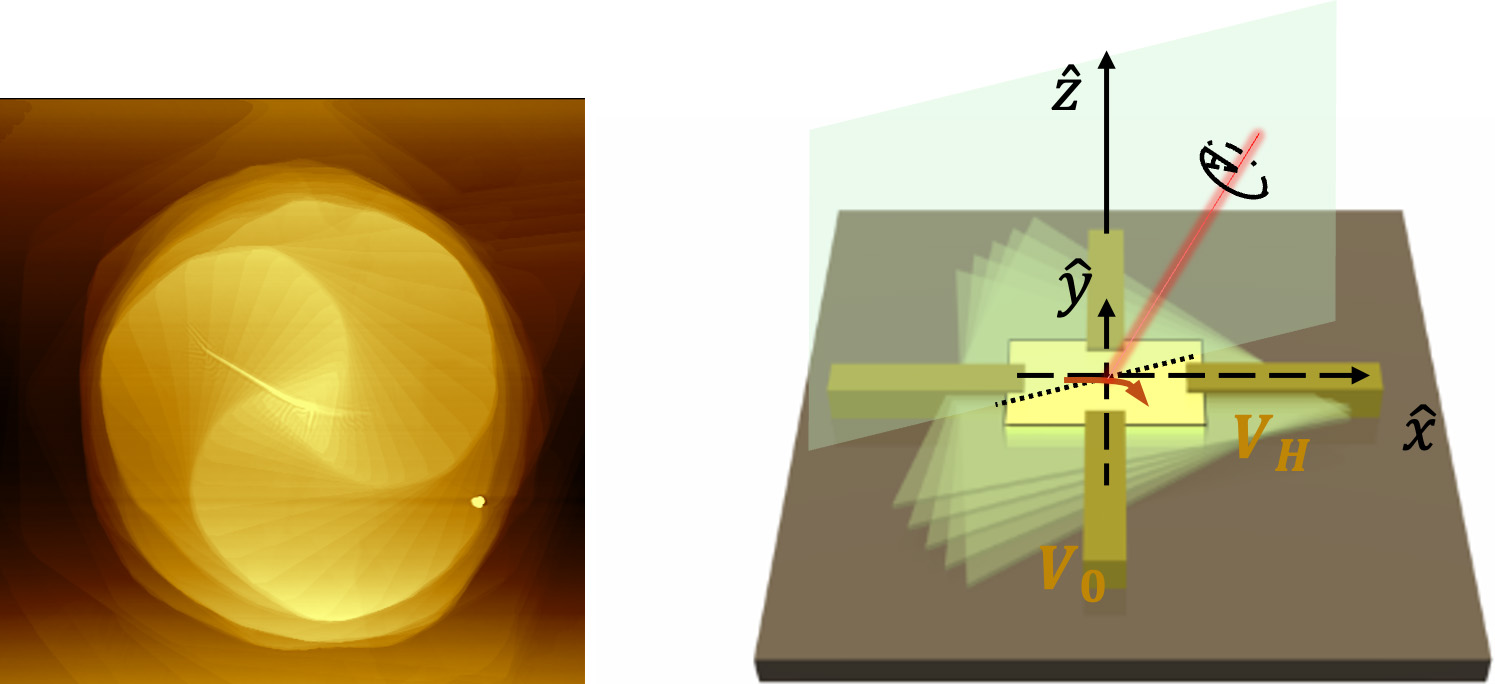
One of the major challenges, Mele adds, was that, once they recognized this Coriolis deflection could occur in a twisted crystal, it seemed that the idea was working too well. The effect appeared so naturally in the theory that it appeared hard to switch off even in scenarios where it shouldn’t exist. It took nearly a year to establish the exact conditions under which this phenomenon could be observed or suppressed.
Agarwal likens the behavior of electrons in these materials to “going down a slide at a water park. If an electron went down a straight slide, like conventional material lattices, everything would be smooth. But, if you send it down a spiraling slide, it’s a completely different experience. The electron feels forces pushing it in different directions and come out the other end altered, kind of like being a little ‘dizzy.’”
This “dizziness” is particularly exciting to the team because it introduces a new degree of control over electron movement, achieved purely through the geometric twist of the material. What’s more, the work also revealed a strong optical nonlinearity, meaning that the material’s response to light was amplified significantly.
“In typical materials, optical nonlinearity is weak,” Agarwal says, “but in our twisted system, it’s remarkably strong, suggesting potential applications in photonic devices and sensors.”
Moiré Patterns and Quantum Behaviors
Another aspect of the study was the moiré patterns, which are the result of a slight angular misalignment between layers that plays a significant role in the effect. In this system, the moiré length scale—created by the twist—is on par with the wavelength of light, making it possible for light to interact strongly with the material’s structure.
“This interaction between light and the moiré pattern adds a layer of complexity that enhances the effects we’re observing,” Agarwal says, “and this coupling is what allows the light to control electron behavior so effectively.”
When light interacted with the twisted structure, the team observed complex wavefunctions and behaviors not seen in regular two-dimensional materials. This result ties into the concept of “higher-order quantum geometric quantities,” like Berry curvature multipoles, which provide insight into the material’s quantum states and behaviors. These findings suggest that the twisting fundamentally alters the electronic structure, creating new pathways for controlling electron flow in ways that traditional materials cannot.
And finally, the study found that by slightly adjusting the thickness and handedness of the WS₂ spirals, they could fine-tune the strength of the optical Hall effect. This tunability suggests that these twisted structures could be a powerful tool for designing new quantum materials with highly adjustable properties.
“We’ve always been limited in how we can manipulate electron behavior in materials. What we’ve shown here is that by controlling the twist, we can introduce completely new properties,” Agarwal says. “We’re really just scratching the surface of what’s possible. With the spiral structure offering a fresh way for photons and electrons to interact, we’re stepping into something completely new. What more can this system reveal?”
Reference: “Opto-twistronic Hall effect in a three-dimensional spiral lattice” by Zhurun Ji, Yuzhou Zhao, Yicong Chen, Ziyan Zhu, Yuhui Wang, Wenjing Liu, Gaurav Modi, Eugene J. Mele, Song Jin and Ritesh Agarwal, 18 September 2024, Nature.
DOI: 10.1038/s41586-024-07949-1
This research was supported by the U.S. Air Force (Award FA9550-20-1-0345), National Science Foundation (grants NSF-2323468, NSF-2323470, NSF-2230240, DMR-1720530, NNCI-1542153, and NSF-QII-TAQS-#1936276), the Department of Energy (Grant DE FG02 84ER45118), and Office of Naval Research (Grant N00014-22-1-2378).
Never miss a breakthrough: Join the SciTechDaily newsletter.
Follow us on Google and Google News.
1 Comment
Mysterious Electron-Path-Deflecting Effect Unlocks New Quantum Behaviors.
Ask the researchers:
1. Are the New Quantum Behaviors related to topological vortices?
2. Is the continuous spiral twist related to topological vortices in nature?
3. Are the hypothetical particles (including so-called Quantum ) high-dimensional spacetime matter or low dimensional spacetime matter?
4. Is topological vortex high-dimensional spacetime matter or low dimensional spacetime matter?
5. Can low dimensional spacetime matter be the understructure of high-dimensional spacetime matter?
6. Which is easier to understand, topological materials or so-called quantum materials?
7. Is quantum material a topological material?
8. How do you understand the cat in quantum mechanics that is both dead and alive?
9. Is the topological vortex left-handed or right-handed?
10. Is the spacetime vortex a fact?
11. Which is easier to understand, topological vortex gravity or quantum gravity?
12. Doesn’t physics want a unified standard for basic materials?
and so on.
Scientific research guided by correct theories can help people avoid detours, failures, and exaggeration. The physical phenomena observed by researchers in experiments are always appearances, never the natural essence of things. The natural essence of things needs to be extracted and sublimated based on mathematical theories via appearances , rather than being imagined arbitrarily.
Everytime scientific revolution, the scientific research space brought by the new paradigm expands exponentially. Physics should not ignore the analyzable physical properties of topological vortices.
(1) Traditional physics: based on mathematical formalism, experimental verification and arbitrary imagination.
(2) Topological Vortex Theory (TVT): Although also based on mathematics (such as topology), it focuses more on non intuitive geometry and topological structures, challenging traditional physical intuition.
Topological Vortex Theory (TVT) points out the limitations of the Standard Model in describing the large-scale structure of the universe, proposes the need to consider non-standard model components such as dark matter and dark energy, and suggests that topological vortex fields may be key to understanding these phenomena. Topological vortex theory (TVT) heralds innovative technologies such as topological electronics, topological smart batteries, topological quantum computing, etc., which may bring low-energy electronic components, almost inexhaustible currents, and revolutionary computing platforms, etc.
Topology tells us that topological vortices and antivortices can form new spacetime structures via the synchronous effect of superposition, deflection, or twisting of them. Mathematics does not tell us that there must be God particles, ghost particles, fermions, or bosons present. When physics and mathematics diverge, arbitrary imagination will make physics no different from theology. Topological vortex research reflections on the philosophy and methodology of science help us understand the nature essence of science and the limitations of scientific methods. This not only has guiding significance for scientific research itself, but also has important implications for science education and popularization.
All things follow certain laws, which can be revealed through observation and research ( such as topological structures ). Today, so-called official (such as PRL, Nature, Science, PNAS, etc.) in physics stubbornly believes that two sets of cobalt-60 rotating in opposite directions can become two sets of objects that mirror each other, is a typical case that pseudoscience is rampant and domineering.
Please witness the exemplary collaboration between theoretical physicists and experimentalists (https://scitechdaily.com/microscope-spacecrafts-most-precise-test-of-key-component-of-the-theory-of-general-relativity/#comment-854286). It is normal to make mistakes in scientific research, but what is abnormal is to stubbornly adhere to erroneous positions and not repent.
Let us continue to witness via facts the dirtiest and ugliest era in the history of sciences and humanities in human society. The laws of nature will not change due to misleading of certain so-called academic publications or endorsements from certain so-called scientific awards.
As some comments have stated ( https://scitechdaily.com/super-photons-unveiled-sculpting-light-into-unbreakable-communication-networks/#comment-861546 ): Fortunately, we have enough pieces to put the puzzle together properly, and there are folks who have chosen to forego today’s societal structures in order to do exactly that.
Additionally, some comments have stated ( https://scitechdaily.com/science-made-simple-what-is-nuclear-fission/#comment-862083 ): You have been spewing this type of nonsensical word salad for several years now. Outrage doesn’t equal competence. If anything, your inability to convince anyone is a sign of your incompetence. Ask the commenter:Today, so-called official (such as PRL, Nature, Science, PNAS, etc.) in physics stubbornly believes that two sets of cobalt-60 rotating in opposite directions can become two sets of objects that mirror each other, and it even won awards. These so-called academic publications blatantly talk nonsense, which is a public humiliation of the normal intellectual level of the public. Do you think this is human misfortune or personal misfortune?
Isn’t this the evil consequence of the Physics Review family misleading science? Academic circle is not Entertainment industry. Have some people really never know what shame is?