
Close Menu
    Facebook X (Twitter) Instagram
    SciTechDaily
    • Biology
    • Chemistry
    • Earth
    • Health
    • Physics
    • Science
    • Space
    • Technology
    Facebook X (Twitter) Pinterest YouTube RSS
    SciTechDaily
    Home»Space»Don’t Miss: Mars-Saturn and Jupiter-Venus Conjunctions Happening This Month!
    Space

    Don’t Miss: Mars-Saturn and Jupiter-Venus Conjunctions Happening This Month!

    By NASAApril 4, 20221 Comment3 Mins Read
    Facebook Twitter Pinterest Telegram LinkedIn WhatsApp Email Reddit
    Share
    Facebook Twitter LinkedIn Pinterest Telegram Email Reddit
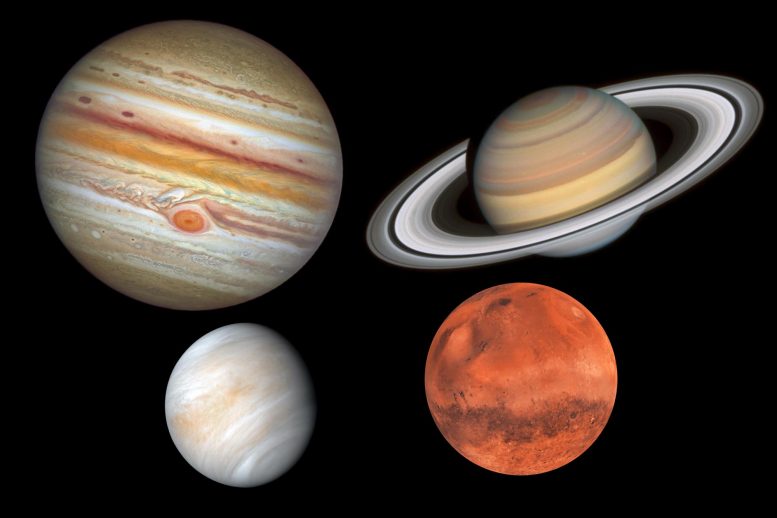
    Jupiter Venus Saturn Mars Conjunctions
    Mars-Saturn and Jupiter-Venus Conjunctions Happening in the month of April 2022.

    Skywatchers, you have the opportunity to see not just one, but two planetary conjunctions during the month of April 2022!

    A conjunction is a celestial event in which two planets, a planet and the Moon, or a planet and a star appear close together in Earth’s night sky. Conjunctions have no profound astronomical significance, but they are nice to view. In our Solar System, conjunctions occur frequently between planets because the planets orbit around the Sun in approximately the same plane – the ecliptic plane – and thus trace similar paths across our sky.

    The first planetary meet up occurs on the mornings of April 4 and 5 before sunrise and includes Mars and Saturn, with Saturn being the brightest. These two planets will come together, appearing as almost a single point of light. However, if you grab your binoculars, you’ll easily see the scene with the planets switching positions on each morning.

    Mars-Saturn Conjunction Illustration
    An illustration of the Mars-Saturn conjunction looking east in Huntsville, Alabama, at 6:00 a.m. on the morning of April 4, 2022. Credit: NASA/Marshall

    We will also see a bright Jupiter ascend quickly in the morning twilight, heading towards Venus in the final week of April. Catch a great view of the planets on the morning of April 27, which will include a waxing Moon.

    Jupiter and Venus will then meet in conjunction during the morning of April 30 – appearing to nearly collide into each other. Due to the glare from both planets, observers will see them merge into one very bright, spectacular glow!

    Jupiter-Venus Conjunction Illustration
    An illustration of the Jupiter-Venus conjunction looking east in Huntsville, Alabama, at 6:00 a.m. on the morning of April 30, 2022. Credit: NASA/Marshall

    Venus’s orbit is closer to the Sun than the Earth’s, and Jupiter’s orbit is much farther away, so the proximity is an illusion, occurring only because Earth, Venus, and Jupiter happen to be approximately aligned. This celestial event will continue on the morning of May 1, but the positions of the planets, Jupiter and Venus, will be reversed.

    If you want to know what else is in the sky for April, check out the latest “What’s Up” video from Jet Propulsion Laboratory:


    The gathering of planets in the morning sky increases from three to four, as Jupiter joins the party. Two close conjunctions – between Mars and Saturn, and Venus and Jupiter – provide highlights at the beginning and end of the month. And the Big Dipper hosts a surprise: a double star you just might be able to “split” with your own eyes.

    Never miss a breakthrough: Join the SciTechDaily newsletter.
    Follow us on Google and Google News.

    Astronomy NASA Planets Popular
    Share. Facebook Twitter Pinterest LinkedIn Email Reddit

    Related Articles

    Jupiter’s Great Red Spot Enigma: Unexplained Oscillations Baffle Astronomers

    Unlocking Uranus: NASA’s Dual Observations Pave the Way to Discovering New Worlds

    The Great Escape: NASA’s Hubble and MAVEN Help Solve Mystery of Mars’ Vanishing Water

    Don’t Miss the “Planetary Parade” – Witness Six Planets Align in a Rare Display

    New Earth-Sized Planet Discovered Orbiting a Star That Will Live 100 Billion Years

    Jupiter Unveiled: Hubble Captures the Giant’s Roaring Storms and Volcanic Moon Io

    NASA Discovery Alert: A “Super-Earth” in the Habitable Zone Only 137 Light-Years Away

    Cyclones in Space? See How Hubble Uncovered Extreme Weather on a Distant Planet

    Saturn’s Seasonal Spectacle: Hubble’s Ultra-Sharp Vision Unveils Ring Spoke Phenomenon

    1 Comment

    1. Gina Brown on April 4, 2022 10:34 am

      Wow!

      Reply
    Leave A Reply Cancel Reply

    • Facebook
    • Twitter
    • Pinterest
    • YouTube

    Don't Miss a Discovery

    Subscribe for the Latest in Science & Tech!

    Trending News

    Scientists Discover Gut Signal That Turns Off Sugar Cravings

    Scientists Discover Rogue Gene That Could Unlock New Cancer Treatments

    Constantly Tired? Scientists Say These Vitamin Deficiencies May Be Why

    A Surprising Discovery Inside Fish Could Change What We Know About the Ocean

    Scientists May Have Finally Solved the Mystery of the Strange Hum Heard Around the World

    A Cannibal Star Finally Solves One of Astronomy’s Biggest Mysteries

    Scientists Finally Uncover How a “Forever Chemical” Causes Birth Defects

    Scientists Uncover the Earliest Brain Changes That May Predict Alzheimer’s Decades Before Symptoms

    Follow SciTechDaily
    • Facebook
    • Twitter
    • YouTube
    • Pinterest
    • Newsletter
    • RSS
    SciTech News
    • Biology News
    • Chemistry News
    • Earth News
    • Health News
    • Physics News
    • Science News
    • Space News
    • Technology News
    Recent Posts
    • The Laser That Once Filled a Lab Now Fits on a Tiny Chip
    • Scientists Recreate a Nuclear Fireball and Uncover Fallout’s Hidden Chemistry
    • The Next Computing Revolution May Come From Stacking Chips Like Skyscrapers
    • These Tiny Gut Particles Could Be Accelerating Aging Throughout the Body
    • Cancer’s “Undruggable” Protein Has a Dangerous New Superpower
    Copyright © 1998 - 2026 SciTechDaily. All Rights Reserved.
    • Science News
    • About
    • Contact
    • Editorial Board
    • Privacy Policy
    • Terms of Use

    Type above and press Enter to search. Press Esc to cancel.