
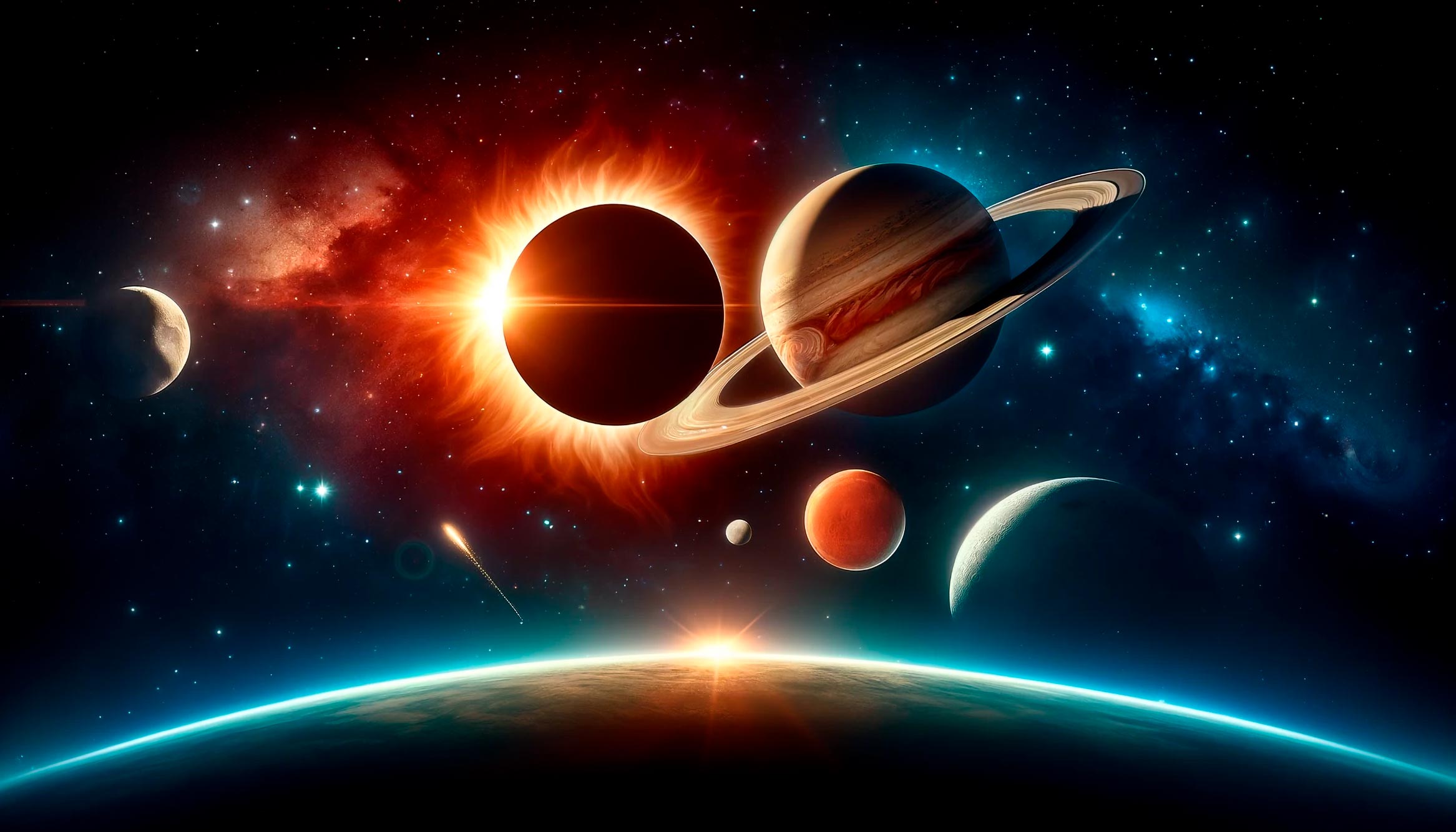
What are some skywatching highlights in April 2024? Catch Mars and Saturn rising, and Jupiter hangs out with Comet 12P. Plus NASA has you covered for the total eclipse whether you’re headed to totality or watching from afar.
Total Eclipse Time!
A total solar eclipse sweeps across the U.S. on April 8. U.S. areas outside totality will enjoy a partial eclipse and can join NASA’s live eclipse webcast!
Highlights
- All month – Jupiter is a brilliant, steady light low in the western sky following sunset.
- April 8 – Total solar eclipse across the U.S., as the Moon’s shadow moves from Texas northward through Maine. Outside the path of totality, the rest of the continental U.S. will experience a partial eclipse. The amount of the Sun covered by the Moon at maximum eclipse depends on your distance from the path of totality.
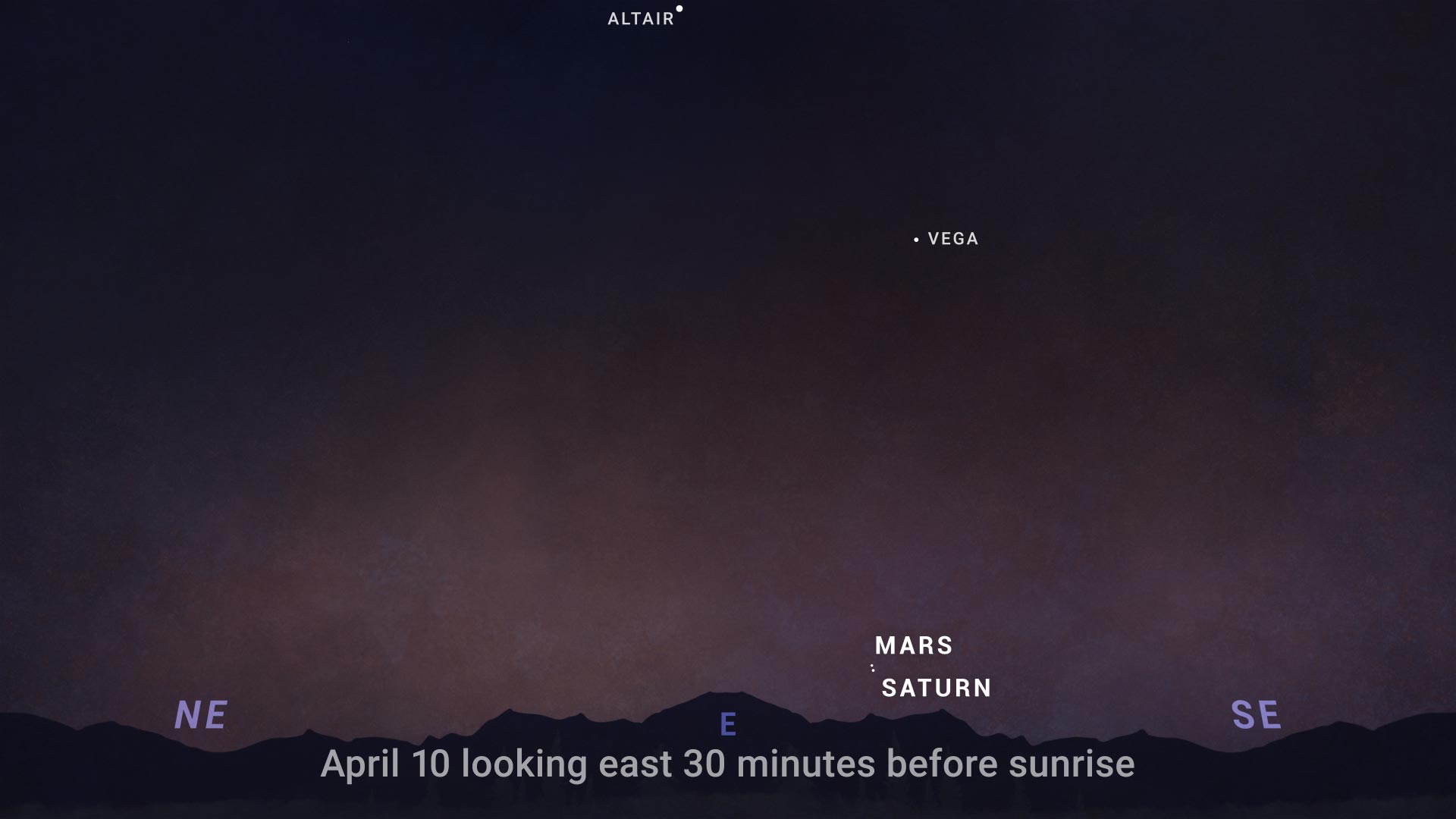
- April 8-12 – Mars and Saturn rise together in the hour or so preceding sunrise. They’re closest on April 10 & 11 – about half a degree apart, or the width of the full Moon.)
- April 10 – Find the slim lunar crescent (only 7% illuminated) hanging above brilliant Jupiter in the west after sunset. Comet 12P is visible with binoculars or a small telescope about 6 degrees below the Moon, just below and to the right of Jupiter.
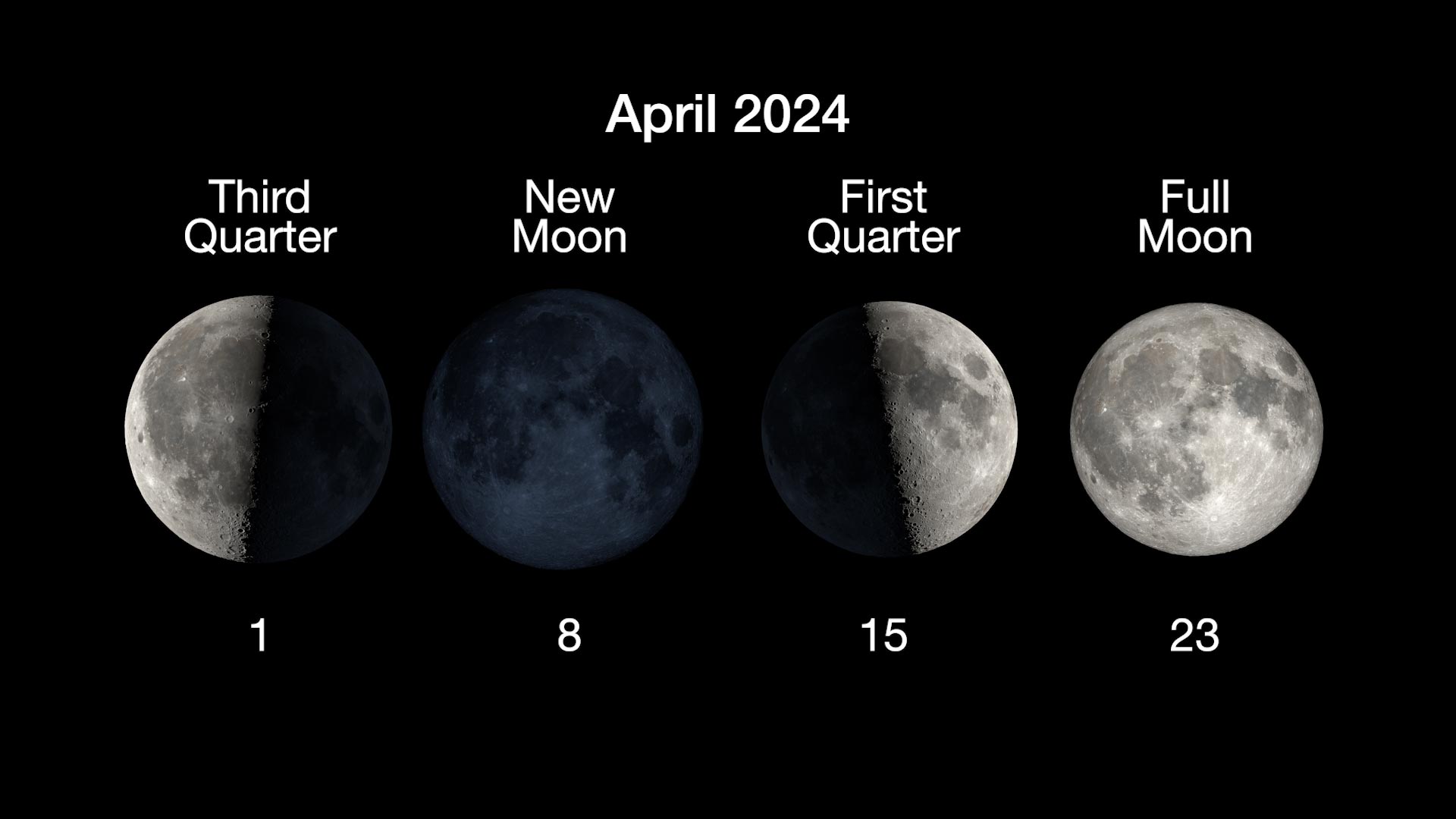
- April 23 – Full moon
Video Transcript
What’s Up for April? Some easy-to-spot planets, there’s still time to observe comet 12P, and how to enjoy this month’s solar eclipse if you’re not in the path of totality.
For several days in the first half of April, early risers can watch Mars and Saturn rising together in the morning. Taking a look about half an hour before sunrise, you can find them low in the east, about 10 degrees above the horizon. They’re at their closest on April 10th and 11th, but still really close in the sky the whole second week of April.
Now, on the evening of April 10th you can find the Moon with Jupiter in the west. Jupiter’s easy to identify as a bright, unflickering light, low in the west following sunset, all month. Being just a couple of days after its “new moon” phase, the Moon shows only 7% of its illuminated surface on this evening, making for a beautiful crescent shining there with the giant planet Jupiter.
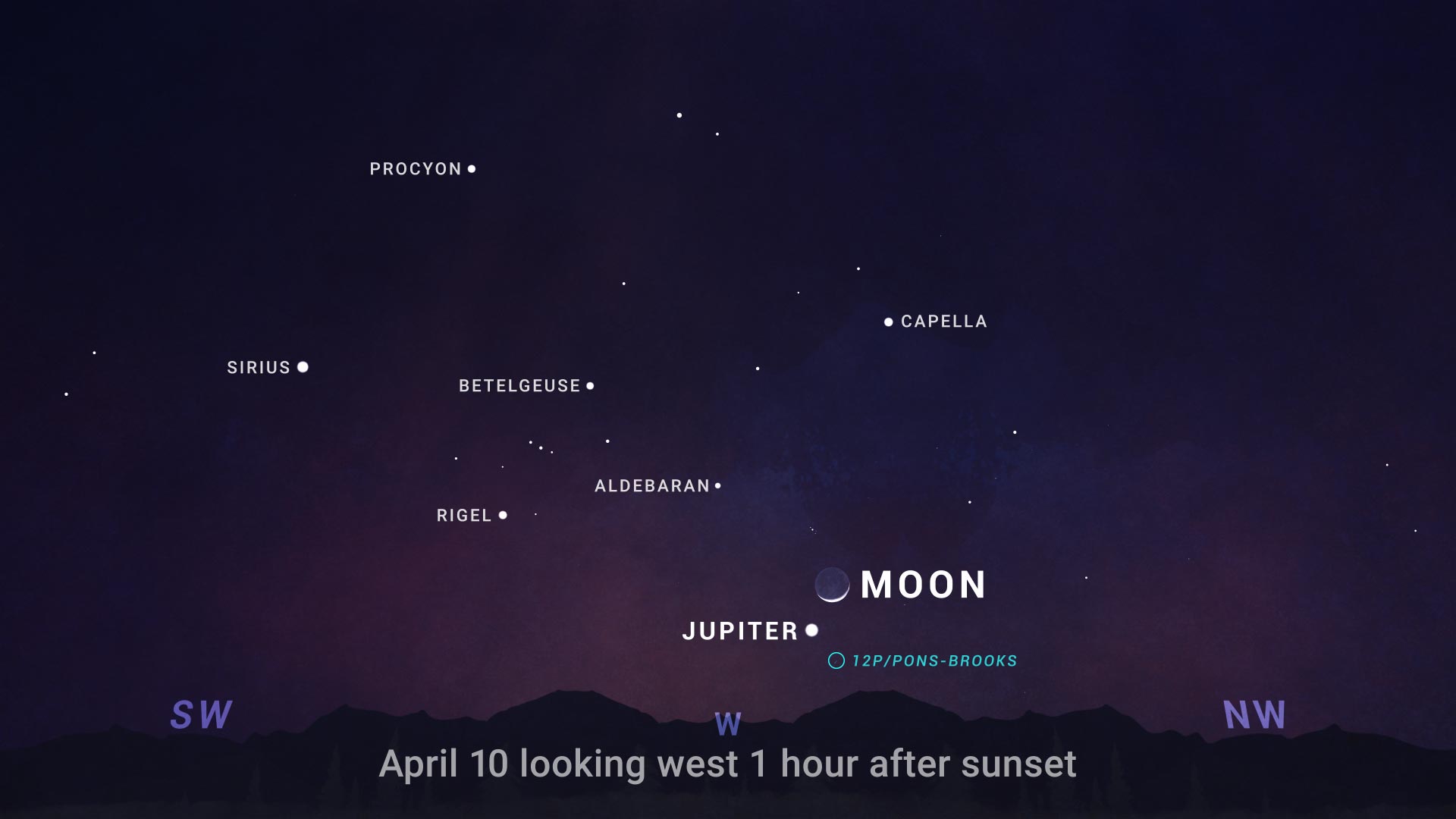
This is also a good night to have a look for comet 12P/Pons-Brooks, which has been getting brighter, and is easily observable with binoculars or a small telescope, especially if you can get away from bright city lights. The comet will be just beneath the Moon, and just right of Jupiter, but you’ll have to be quick, as it drops below 10 degrees elevation an hour after sunset and then sets an hour later. So you’ll want a clear view toward the horizon, and be looking for it as twilight ends. If you want to catch this comet, do it soon, because it will be too close to the Sun in the sky to observable after mid-April, and later when it makes its closest approach to Earth, it will be on its way outward from the Sun and growing fainter.
2024 Total Solar Eclipse
There’s a total solar eclipse on the way, and it’s kind of a big deal. We’ve been really fortunate to have two total eclipses visible across a wide swath of the U.S. recently, first in 2017, and now on April 8th, 2024. The next time such an eclipse will cross the States is 21 years from now. If you live in or near the path of totality, or you’re traveling there to experience the eclipse, you’re in for an incredible experience.
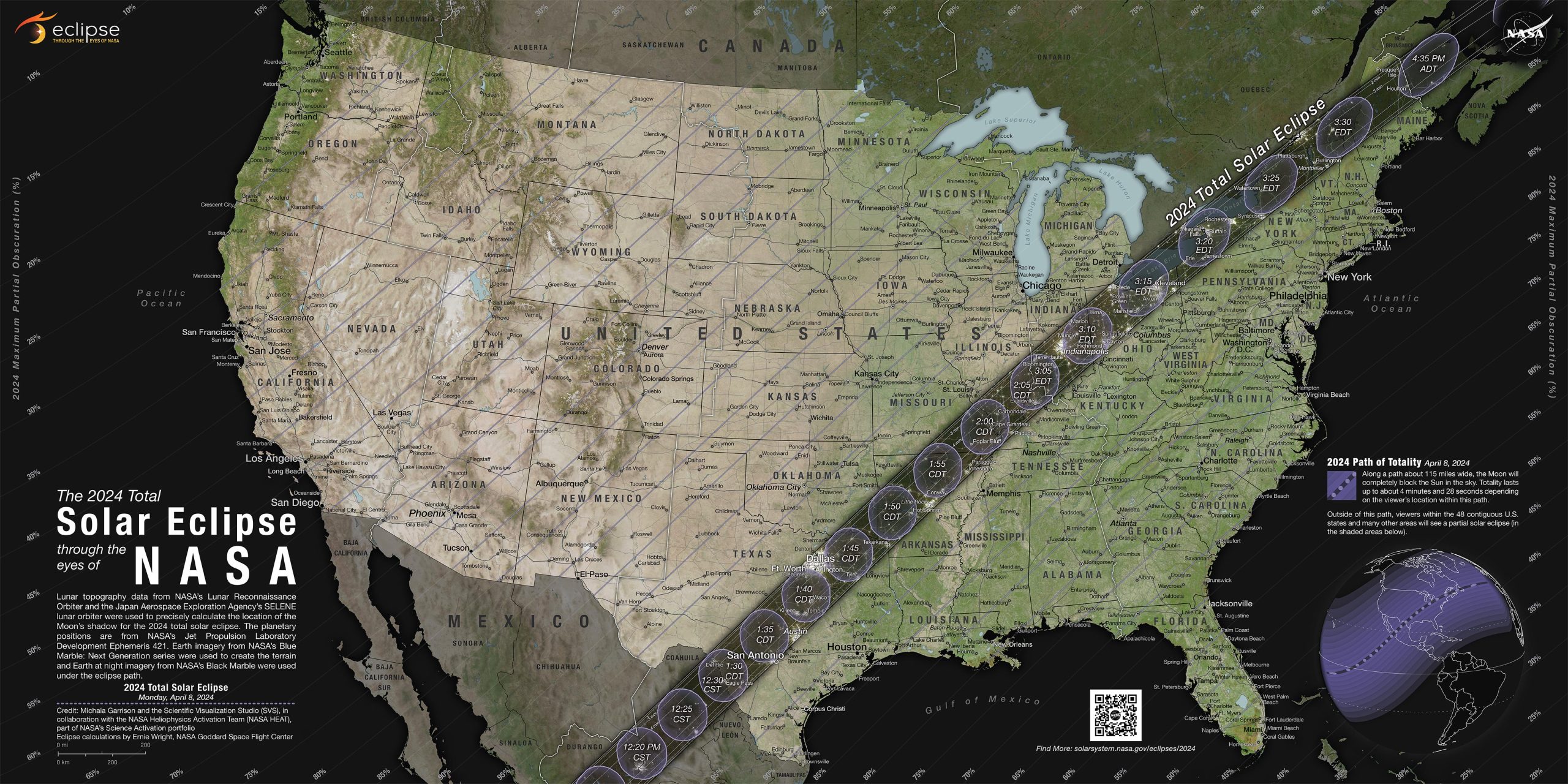
But what if you’re not going to be able to experience totality for this eclipse in person? What can you expect, and how can you still enjoy it? Well for starters, NASA has you covered with a live webcast, from multiple locations, as the Moon’s shadow moves across the country. So join us for the total eclipse online, whatever your plans.
If you’re anywhere in the continental U.S. outside of totality, you’ll still experience a partial solar eclipse. The amount of the Sun to be covered by the Moon at maximum eclipse depends on how far you are from the path of totality.
In observing a partial eclipse, you’ll still need to use specialized eye protection, such as eclipse glasses, a pinhole projector, or a telescope with a solar filter. One of the easiest methods is something most of us have in our kitchen – a regular colander. These make excellent pinhole cameras that project the eclipse onto the ground. And barring that, the sun dapples that filter through the tree leaves do something very similar. It’s also fun to note the eerie way the sunlight dims during the eclipse, especially in places where the Moon covers 80% or more of the Sun’s disk.
NASA has a bunch of eclipse resources to help you get ready for this awe-inspiring celestial event. There’s info on safe-viewing, citizen science opportunities, and you’ll even find our “eclipse explorer,” where you can find eclipse details for your specific zip code.
From wherever you’re observing, solar eclipses are remarkable events. So observe safely, and join our live webcast, because it’s an event you surely don’t want to miss.
Here are the phases of the Moon for April.
Never miss a breakthrough: Join the SciTechDaily newsletter.
Follow us on Google and Google News.
4 Comments
Will the lunar eclipse pass in some parts of Africa
Very Greate knowledge amazing veray greatetopic nice 🇮🇳🇮🇳🇮🇳🇮🇳🇮🇳🇮🇳🇮🇳🇮🇳🇮🇳🇮🇳🇮🇳🇮🇳🇮🇳🇮🇳
i gary w. engelman have recently discovered two blac k holes at the center core of earth!!! also two black holes at the center core of every planetary sphere in space!!!gary w. engelman has also discovered that black holes 🕳 do not collided!they join together in the ying/yang positions and begin forming, layering,creating a planetary sphere around themselves!!! after these great discoveries and new knowledge of black hole technologies i gary w. engelman unlocked alien orb technologies discovering usi g two scaled-down versions of black holes with prestaged nano materials around them could be joined together to form,layer,the nano materials around themselves,creating a nano sphere similar or compared to alien orb technologies with beyond quantum computing capabilities and beyond compression flight capabilities exceeding light speed velocities due to the fact the nano spheres have black hole propulsion at there center core using dark matter as propulsion!!!! .
i gary w. engelman have recently discovered two blac k holes at the center core of earth!!! also two black holes at the center core of every planetary sphere in space!!!gary w. engelman has also discovered that black holes 🕳 do not collided!they join together in the ying/yang positions and begin forming, layering,creating a planetary sphere around themselves!!! after these great discoveries and new knowledge of black hole technologies i gary w. engelman unlocked alien orb technologies discovering usi g two scaled-down versions of black holes with prestaged nano materials around them could be joined together to form,layer,the nano materials around themselves,creating a nano sphere similar or compared to alien orb technologies with beyond quantum computing capabilities and beyond compression flight capabilities exceeding light speed velocities due to the fact the nano spheres have black hole propulsion at there center core using dark matter as propulsion!!!! .