
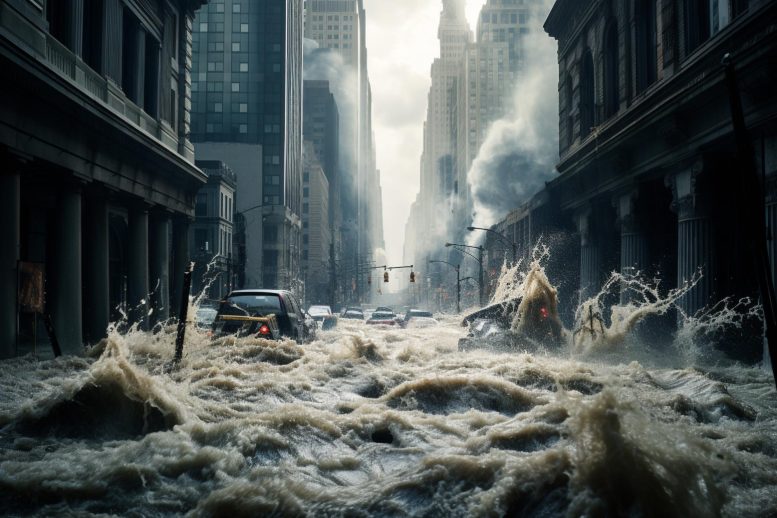
Some floods are so severe they rarely strike more than once a century, but rising seas could threaten coastal communities with yearly extreme floods by the end of the 21st century.
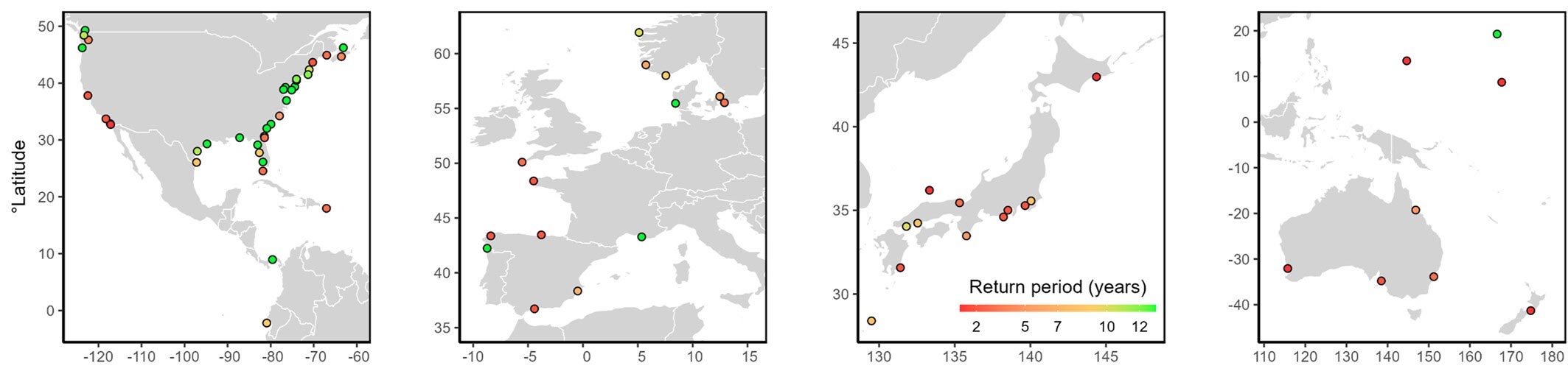
Most coastal communities will encounter 100-year floods annually by the end of the century, even under a moderate scenario where carbon dioxide emissions peak by 2040, a new study finds. And as early as 2050, regions worldwide could experience 100-year floods every nine to fifteen years on average.
A 100-year flood is an extreme water level that has a 1% chance of being exceeded in any given year and is based on historical data. Despite the name, 100-year floods can strike the same area multiple years in a row or not at all within a century. However, a new study finds that those historical trends will no longer provide an accurate outlook for future floods.
“The threshold that we expect to be exceeded once every hundred years on average is going to be exceeded much more frequently in a warmer climate until they are no longer considered 100-year events,” said Hamed Moftakhari, a civil engineer and professor at the University of Alabama who supervised the project. The study was published recently in Earth’s Future, AGU’s journal for interdisciplinary research on the past, present, and future of our planet and its inhabitants.
Sea Level Rise: A Looming Threat
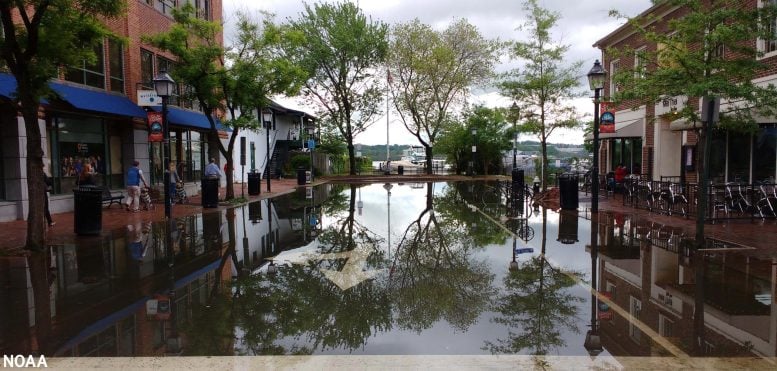
On the coast, extreme floods can be caused by water pushed inland by storms, tides, and waves, but this study focuses on a component that contributes to flooding over a much longer time scale — sea level rise. As higher seas creep up the shore, coastal infrastructure will be closer to the water, making storms, tides, and waves more likely to impact communities.
The researchers used data from more than 300 tide gauges around the world to conduct trend analyses and estimate future extreme sea levels under two carbon emission scenarios outlined by the International Panel on Climate Change: if carbon dioxide emissions continue to rise through the end of the century, and if carbon dioxide emissions reach their peak by 2040 and then decline. In both scenarios, they found that sea level rise will lead to an increase in 100-year flood events in most of the locations they studied.
A proactive approach to land planning, urban development, and coastal protective measures could help communities reduce flooding and avoid disaster, Moftakhari said, and that starts with realistic forecasts of future coastal conditions.
Challenges in Predicting Flood Patterns
Engineers who design structures such as sea dikes, seawalls, and breakwaters to protect communities from these extreme floods rely on a concept known as stationarity to predict future water levels.
“In stationarity, we assume that the patterns we have observed in the past are going to remain unchanged in the future, but there are a lot of factors under climate change that are modulating these patterns,” said Moftakhari. “We can’t assume stationarity in coastal flooding anymore.”
Previous studies relied on stationary estimates of extreme sea levels to predict 100-year floods, but this study used non-stationary methods and found that the shift in extreme sea levels will not be uniform for many tide-gauge locations.
As the climate changes, warmer ocean temperatures and meltwater from glaciers are causing sea levels to rise, increasing the frequency and severity of coastal flooding. As a result, engineers need accurate estimates of future flood risk that don’t assume our changing future will reflect historic coastal patterns.
“What makes it so challenging is that the majority of tools, design guidelines, manuals of practice and more are all based on the assumption of stationarity,” said Moftakhari. “They need to be updated to enable us to keep pace with the rate of change.”
Local Solutions for Diverse Challenges
More than 600 million people live in low-lying coastal regions, according to another study. That number is expected to rise. Well-designed coastal defense structures play an important role in coastal communities’ ability to withstand major flooding.
While the mean sea level is rising, the outcome won’t be the same everywhere. Higher latitudes may experience a drop in sea levels as heavy ice sheets melt and the land underneath rises. Alternatively, regions like the Gulf of Mexico are experiencing rates of sea level rise that are faster than the global average because the land is gradually sinking. According to Moftakhari, coastal communities will require unique solutions based on local information to match their needs.
“We know that mean sea level is rising, the question is: how are we going to deal with it?” said Moftakhari. “We’ve already seen that many portions of the coast are permanently inundated and losing land, and many coastal cities and islands are experiencing flooding much more frequently than in the past — it’s time to learn how to deal with non-stationarity.”
But Moftakhari said he is determined to remain optimistic, reminding us that disasters are the outcome of human decision-making, not hazards alone. “Don’t forget that this is all about the level of water that we expect to experience without mitigation measures,” he said. “There will be technological advancements that could enhance the resilience of communities.”
Reference: “Coevolution of Extreme Sea Levels and Sea-Level Rise Under Global Warming” by Georgios Boumis, Hamed R. Moftakhari and Hamid Moradkhani, 5 July 2023, Earth’s Future.
DOI: 10.1029/2023EF003649
Never miss a breakthrough: Join the SciTechDaily newsletter.
Follow us on Google and Google News.
1 Comment
“… the Gulf of Mexico are experiencing rates of sea level rise that are faster than the global average because the land is gradually sinking.”
That is also true of most of the eastern seaboard of the US. Those localities that are experiencing the greatest problems are typically experiencing significant subsidence, either from natural compaction of sediments, or withdrawal of freshwater.
The article makes it sound like the primary culprit is sea level rise from warming, when it is secondary to subsidence.