
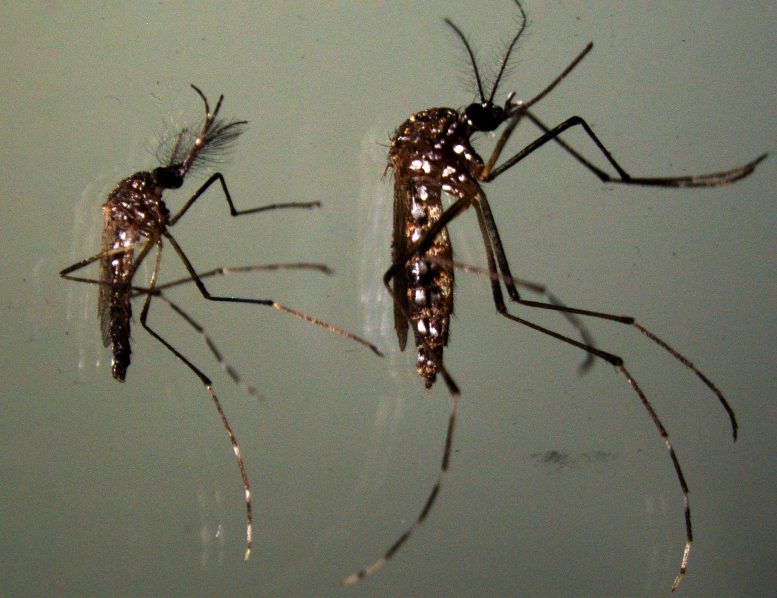
Zika-carrying mosquito eggs can survive drying due to metabolic changes, offering potential control strategies.
Eggs of the mosquito that carries Zika virus can tolerate extended desiccation by altering their metabolism, according to a new study published on October 24th in the open access journal PLOS Biology by Anjana Prasad, Sunil Laxman, and colleagues at the Institute for Stem Cell Science and Regenerative Medicine in Bengaluru, India and the Indian Institute of Technology in Mandi, India. The finding offers potential new ways to control the spread of this mosquito.
Desiccation and Survival
Cells are made mostly of water, and desiccation is a potentially fatal event for any organism, since the structures of many proteins and other cellular molecules are dependent on adequate hydration. While many types of microbes have evolved mechanisms to survive drying out, only a few animals have. Among them is the mosquito Aedes aegypti, the carrier of a variety of viral diseases, including, Zika, dengue, yellow fever, and Chikungunya. Originally found in North Africa, Ae. aegypti has expanded globally, and is now a threat in warm, moist regions throughout the world.
Metabolic Adjustments and Protection
Aedes eggs require from 48 to 72 hours to hatch into larvae, and the authors first showed that eggs must be at least 15 hours old to survive desiccation; eggs that were dried out before this stage failed to hatch when rehydrated. They then compared the proteomes of viable eggs that had and had not been desiccated, and found multiple major changes in metabolic pathways within the desiccated eggs. These included increases in the levels of those enzymes in the tricarboxylic acid (Krebs) cycle that promote lipid metabolism, and a decrease in enzymes of glycolysis and ATP-producing parts of the TCA cycle, which together shunted cellular metabolism toward the production and use of fatty acids. Overall, the level of metabolism was reduced, while the levels of the amino acids arginine and glutamine were increased. In addition, enzymes that reduce the damaging effects of oxidative stress, a known consequence of dehydration, were also increased.
The Role of Polyamines
When linked together, arginine molecules form polyamines, which are known to help protect nucleic acids, proteins, and membranes from a variety of insults. Here, the authors showed that the eggs accumulate polyamines, suggesting that they may be a key aspect of desiccation tolerance. To test this, they fed egg-laying female mosquitoes an inhibitor of polyamine synthesis. The eggs that they laid were significantly less able to survive desiccation than eggs from untreated females. A second inhibitor, this one of fatty acid metabolism, also reduced egg viability after desiccation. Finally, they showed that this fatty acid inhibitor reduced polyamine synthesis, indicating that one role of the increase in fatty acid breakdown is to supply the energy needed for production of protective polyamines.
Implications and Future Directions
“Given the importance of Ae. aegypti as a primary vector for numerous viral diseases that affect nearly half the world’s population,” Laxman said, “as well as the rapid geographical expansion of this mosquito vector, these results provide a foundation for reducing Aedes egg survival and global spread. Additionally, some of the specific inhibitors described here that reduce desiccation resistance in Ae. aegypti eggs, as well as new ones affecting other steps in the egg desiccation tolerance pathway, may prove useful as vector-control agents.”
Laxman adds, “Aedes mosquito eggs can indefinitely survive after drying up completely, and hatch into viable larvae. The embryos rewire their metabolism upon drying, to protect themselves through desiccation, and revive after water becomes available again.”
Reference: “Eggs of the mosquito Aedes aegypti survive desiccation by rewiring their polyamine and lipid metabolism” by Anjana Prasad, Sreesa Sreedharan, Baskar Bakthavachalu and Sunil Laxman, 24 October 2023, PLOS Biology.
DOI: 10.1371/journal.pbio.3002342
Funding: No specific funding was obtained for this study. DST-INSPIRE (IF190149 to SS) and DBT/Wellcome Trust India Alliance (IA/I/19/1/504286 to BB) supported individual fellowships. These funders had no role in study design, data collection and analysis, support for experiments, decision to publish, or preparation of the manuscript. Intramural support was provided by the Tata Institute for Genetics and Society (to BB), and DBT-inStem (to SL).
Never miss a breakthrough: Join the SciTechDaily newsletter.
Follow us on Google and Google News.