
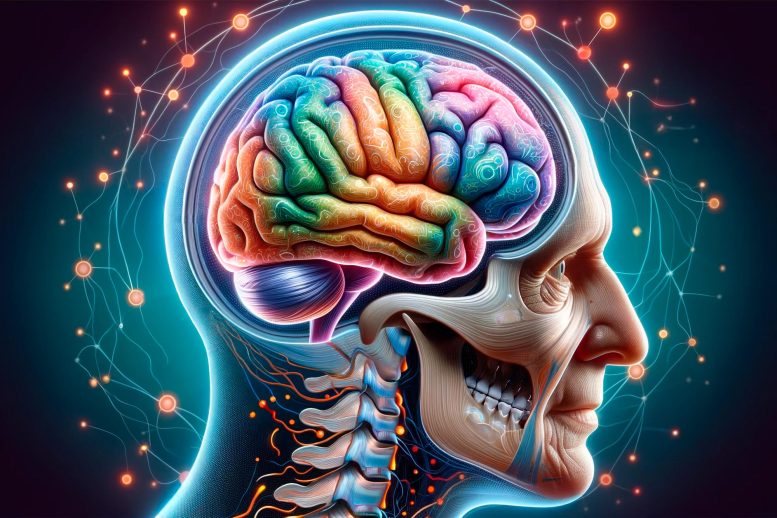
Researchers have established a first potential therapeutic target for a type of early-onset dementia.
Most neurodegenerative diseases, including dementias, involve proteins aggregating into filaments called amyloids. In most of these diseases, researchers have identified the proteins that aggregate, allowing them to target these proteins for diagnostic tests and treatments.
But, in around 10% of cases of frontotemporal dementia, scientists had yet to identify the rogue protein. Now, scientists have pinpointed aggregated structures of the protein TAF15 in these cases.
The Nature of Frontotemporal Dementia
Frontotemporal dementia results from the degeneration of the frontal and temporal lobes of the brain, which control emotions, personality, and behavior, as well as speech and understanding of words. It tends to start at a younger age than Alzheimer’s disease, often being diagnosed in people aged 45 to 65, although it can also affect younger or older people.
In a paper published today in the journal Nature, research led by scientists from the Medical Research Council (MRC) Laboratory of Molecular Biology, in Cambridge, UK, has identified aggregated structures of a protein that could provide a target for the future development of diagnostic tests and treatments.
Breakthrough in Molecular Understanding
Dr. Benjamin Ryskeldi-Falcon, who led the study at the MRC Laboratory of Molecular Biology, said: “This discovery transforms our understanding of the molecular basis of frontotemporal dementia. It is a rare finding of a new member of the small group of proteins known to aggregate in neurodegenerative disease.
“Now that we have identified the key protein and its structure, we can start to target it for the diagnosis and therapy of this type of frontotemporal dementia, similar to strategies already in the pipeline for targeting the aggregates of amyloid-beta and tau proteins that characterize Alzheimer’s disease.”
Advanced Techniques Uncover New Insights
The scientists used cutting-edge cryo-electron microscopy (cryo-EM) to study protein aggregates from the brains of four people who had this type of frontotemporal dementia at atomic resolution. The donated brains were identified by Tammaryn Lashley at the University College London Queen Square Institute of Neurology and Bernardino Ghetti at the Indiana University School of Medicine.
In this type of dementia, scientists had long thought that a protein called FUS aggregated, based on similarities with other neurodegenerative diseases.
Using cryo-EM, the researchers at the MRC Laboratory of Molecular Biology were able to identify that the protein aggregates from each brain had the same atomic structure. Surprisingly, the protein was not FUS – it was another protein called TAF15.
Dr. Stephan Tetter, also from the MRC Laboratory of Molecular Biology, who is first author on the paper, said: “This is an unexpected result because, before this study, TAF15 was not known to form amyloid filaments in neurodegenerative diseases and no structures of the protein existed. Cryo-EM is transforming our understanding of the molecular pathology of dementia and neurodegenerative diseases more broadly by giving us insights that were beyond the capabilities of previous technologies.”
Dr. Ryskeldi-Falcon added: “The technical challenge of performing cryo-EM meant that we were only able to look at the brains of four individuals. However, now that we know the key protein and its structure, we have the potential to develop tools to screen for these abnormal protein aggregates in hundreds of patient samples to test how widespread they are.”
Frontotemporal Dementia and Motor Neuron Disease
Some people who have frontotemporal dementia also have motor neuron disease, a condition in which individuals progressively lose control over their muscles. In this study, two of the individuals who donated their brains had signs of both diseases. For these individuals, the researchers identified the same aggregated structure of TAF15 in brain regions associated with motor neuron disease.
Dr. Ryskeldi-Falcon said: “The presence of the same TAF15 aggregates in two individuals who had frontotemporal dementia and signs of motor neuron disease raises the possibility that TAF15 may contribute to both diseases. We are now studying whether aberrant aggregated TAF15 is present in people who have motor neurone disease in the absence of frontotemporal dementia.”
This study was funded by the Medical Research Council, Alzheimer’s Research UK, the US National Institutes of Health, the Alzheimer’s Society, the Association for Frontotemporal Degeneration, the Swiss National Science Foundation, and the Leverhulme Trust.
Dr. Charlotte Durkin, Head of the Medical Research Council’s Molecular and Cellular Medicine Board, said:
“Decades of world-leading research at the MRC Laboratory of Molecular Biology brought the breakthrough of cryoelectron microscopy — gaining Dr. Richard Henderson a Nobel Prize in 2017. This latest study identifying the protein linked to a type of frontotemporal dementia continues the MRC LMB’s success in elucidating dementia-related protein structures by cryoEM, which includes the first structure for the key dementia protein tau. Knowing the identity and basic structure of these filaments in this rare form of early-onset dementia is vital to developing early diagnostic tests and drugs to combat their formation.”
Reference: “TAF15 amyloid filaments in frontotemporal lobar degeneration” by Stephan Tetter, Diana Arseni, Alexey G. Murzin, Yazead Buhidma, Sew Y. Peak-Chew, Holly J. Garringer, Kathy L. Newell, Ruben Vidal, Liana G. Apostolova, Tammaryn Lashley, Bernardino Ghetti and Benjamin Ryskeldi-Falcon, 6 December 2023, Nature.
DOI: 10.1038/s41586-023-06801-2
Never miss a breakthrough: Join the SciTechDaily newsletter.
Follow us on Google and Google News.