

Close Menu
    Facebook X (Twitter) Instagram
    SciTechDaily
    • Biology
    • Chemistry
    • Earth
    • Health
    • Physics
    • Science
    • Space
    • Technology
    Facebook X (Twitter) Pinterest YouTube RSS
    SciTechDaily
    Home»Chemistry»Efficiency Unlocked: Novel Catalyst Model Sets New Standards in Fuel Cell Technology
    Chemistry

    Efficiency Unlocked: Novel Catalyst Model Sets New Standards in Fuel Cell Technology

    By Tohoku UniversityMay 21, 2024No Comments4 Mins Read
    Facebook Twitter Pinterest Telegram LinkedIn WhatsApp Email Reddit
    Share
    Facebook Twitter LinkedIn Pinterest Telegram Email Reddit
    Chemistry Catalyst Concept
    Researchers at Tohoku University have developed a novel method to predict the performance of molecular metal-nitrogen-carbon (M-N-C) catalysts, which are essential for the advancement of fuel cell technology. Their study highlights a new predictive tool that relies on computer simulations to study the interactions between electric fields and pH levels. This breakthrough provides a more efficient pathway for developing catalysts that operate effectively in different environmental conditions, potentially overcoming one of the major hurdles in the widespread adoption of fuel cell technology.

    Tohoku University researchers have devised a method to predict the performance of new catalysts for fuel cells, potentially hastening the development of more efficient clean energy solutions.

    Tohoku University researchers have created a reliable means of predicting the performance of a new and promising type of catalyst. Their breakthrough will speed up the development of efficient catalysts for both alkaline and acidic environments, thereby saving time and effort in future endeavors to create better fuel cells.

    Details of their research were recently published in the journal Chemical Science.
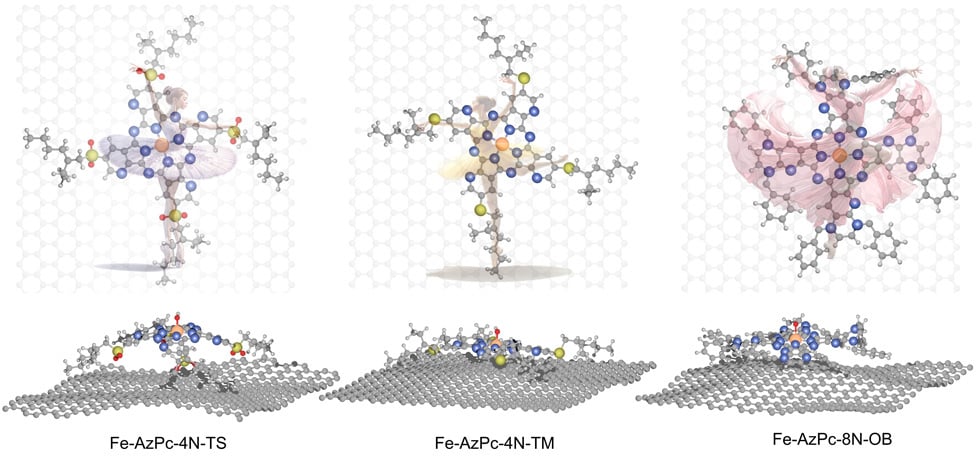
    Structures of Long Chain Fe Azaphthalocyanines Molecular Catalysts
    Structures of long-chain Fe-Azaphthalocyanines (AzPc) molecular catalysts. After DFT geometric relaxations with more than 650 atoms, different “dancing patterns” emerged due to the varying interactions between the molecular side chains and the graphene substrate. Credit: Hao Li, Hiroshi Yabu et al.

    Fuel cell technology has often been touted as a promising solution for clean energy; however, issues with catalyst efficiency have impeded its broad adoption.

    Molecular metal-nitrogen-carbon (M-N-C) catalysts boast distinctive structural properties and excellent electrocatalytic performance, particularly for the oxygen reduction reaction (ORR) in fuel cells. They offer a cost-effective alternative to platinum-based catalysts.

    Unique Properties of M-N-C Catalysts

    One such variant of M-N-C catalysts are metal-doped azaphthalocyanine (AzPc). These possess unique structural properties, characterized by long stretching functional groups. When these catalysts are placed on a carbon substrate, they take on three-dimensional shapes, much like a dancer placed onto a stage. This shape change influences how well they work for ORR at different pH levels.
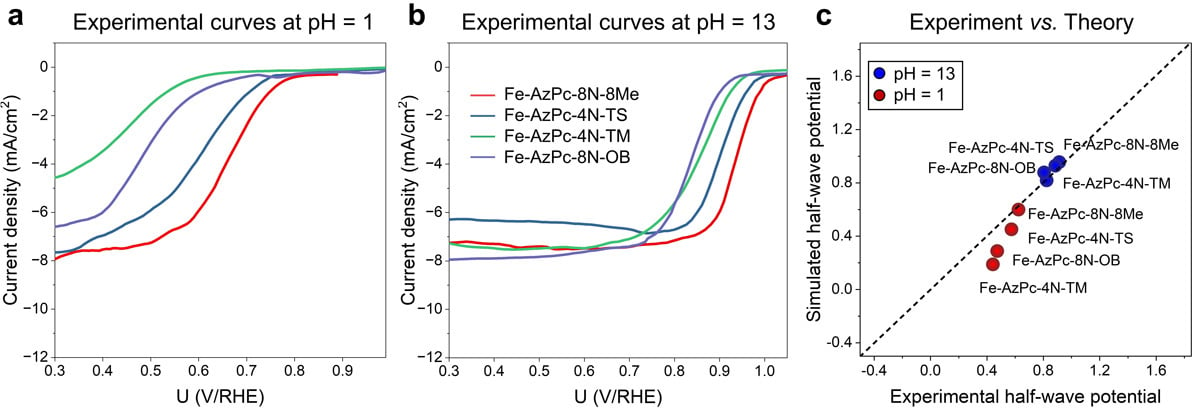
    Experimental RDE Polarization Curves
    Experimental RDE polarization curves are provided at pH = 1 and pH = 13. This figure offers direct comparisons between the experimental and simulated half-wave potentials. Credit: Hao Li, Hiroshi Yabu et al.

    Still, translating these beneficial structural properties into increased performances is a challenge, one that requires significant modeling, validation, and experimentation, which is resource intensive.

    “To overcome this, we used computer simulations to study how the performance of carbon-supported Fe-AzPcs catalyst for oxygen reduction reactions changes with different pH levels, by looking at how electric fields interact with the pH and the surrounding functional group,” says Hao Li, associate professor at Tohoku University’s Advanced Institute for Materials Research (WPI-AIMR) and corresponding author of the paper.
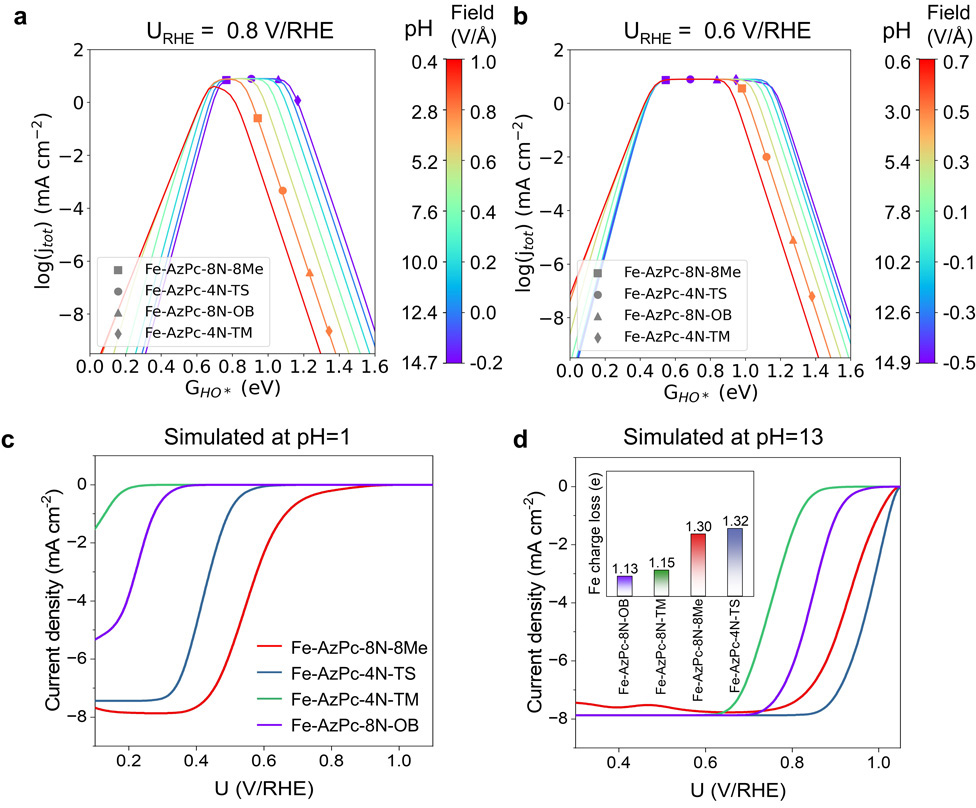
    pH Dependent ORR Volcano Models and the Simulated LSV Curves of Fe AzPc Derivatives
    pH-dependent ORR volcano models and the simulated LSV curves of Fe-AzPc derivatives. pH-field dependent volcanos. The left and right sides of the color bar represent the correlation between the electric field and pH. This figure serves as a benchmark for our experiments. Credit: Hao Li, Hiroshi Yabu et al.

    In analyzing Fe-AzPcs performance in ORR, Li and his colleagues incorporated large molecular structures with complex long-chain arrangements, or ‘dancing patterns,’ with arrangements of over 650 atoms.

    Crucially, the experimental data revealed that the pH-field coupled microkinetic modeling closely matched the observed ORR efficiency.

    “Our findings suggest that evaluating the charge transfer occurring at the Fe-site, where the Fe atom usually loses approximately 1.3 electrons, could serve as a useful method for identifying suitable surrounding functional groups for ORR,” adds Li. “We have essentially created a direct benchmark analysis for the microkinetic model to identify effective M-N-C catalysts for ORR across various pH conditions.”

    Reference: “Benchmarking pH-field coupled microkinetic modeling against oxygen reduction in large-scale Fe–azaphthalocyanine catalysts” by Di Zhang, Yutaro Hirai, Koki Nakamura, Koju Ito, Yasutaka Matsuo, Kosuke Ishibashi, Yusuke Hashimoto, Hiroshi Yabu and Hao Li, 15 March 2024, Chemical Science.
    DOI: 10.1039/D4SC00473F

    Never miss a breakthrough: Join the SciTechDaily newsletter.
    Follow us on Google and Google News.

    Catalysts Energy Tohoku University
    Share. Facebook Twitter Pinterest LinkedIn Email Reddit

    Related Articles

    New Electrocatalyst Turns Carbon Dioxide Into Liquid Fuel

    Converting Carbon Dioxide to Methanol Efficiently Using a Bioinspired Tandem Catalytic System

    Turning Seawater Into Fuel With a Low-Cost Catalyst

    How a Widely Used Catalyst Splits Water Finally Explained at an Atomic Level

    More Efficient, Environmentally Friendly Ethylene Production With New Catalyst

    Artificial Photosynthesis Uses Sunlight to Recycle CO2 Into ‘Green Methane’

    Gasification Goes Green: Low-Temp Photocatalyst Slashes Carbon Footprint for Syngas

    Solving a Riddle That Would Provide the World With Entirely Clean, Renewable Energy

    Stanford Researchers Discover a New Route to Carbon-Neutral Fuels From Carbon Dioxide

    Leave A Reply Cancel Reply

    • Facebook
    • Twitter
    • Pinterest
    • YouTube

    Don't Miss a Discovery

    Subscribe for the Latest in Science & Tech!

    Trending News

    Your Blood Pressure Reading Could Be Wrong Because of One Simple Mistake

    Astronomers Stunned by Ancient Galaxy With No Spin

    Physicists May Be on the Verge of Discovering “New Physics” at CERN

    Scientists Solve 320-Million-Year Mystery of Reptile Skin Armor

    Scientists Say This Daily Walking Habit May Be the Secret to Keeping Weight Off After Dieting

    New Therapy Rewires the Brain To Restore Joy in Depression Patients

    Giant Squid Detected off Western Australia in Stunning Deep-Sea Discovery

    Popular Sugar-Free Sweetener Linked to Liver Disease, Study Warns

    Follow SciTechDaily
    • Facebook
    • Twitter
    • YouTube
    • Pinterest
    • Newsletter
    • RSS
    SciTech News
    • Biology News
    • Chemistry News
    • Earth News
    • Health News
    • Physics News
    • Science News
    • Space News
    • Technology News
    Recent Posts
    • New Stroke Study Challenges Decades-Old Medical Beliefs
    • These Simple Plant Foods Are Linked to Lower Blood Pressure
    • Common Blood Pressure Drug Supercharges Cancer Treatment in Surprising New Study
    • Key Magic Mushroom Ingredient Increases Laziness and Reduces Aggression
    • Researchers Solve 15-Year Mystery Behind Cancer-Causing Gut Toxin
    Copyright © 1998 - 2026 SciTechDaily. All Rights Reserved.
    • Science News
    • About
    • Contact
    • Editorial Board
    • Privacy Policy
    • Terms of Use

    Type above and press Enter to search. Press Esc to cancel.