

Two decades after the first proof of photon entanglement, the ATLAS and CMS experiments have observed quantum entanglement between top quarks and their antiparticles at the Large Hadron Collider.
This breakthrough confirms entanglement at high energies and offers a new perspective on quantum mechanics. Meanwhile, the vast number of top quark pairs produced at the LHC allows for extensive studies, further bolstered by advanced machine learning techniques in measuring spin entanglement and systematic uncertainties.
Quantum Entanglement in Particle Physics
Recently, and about two decades after the first solid proof of entanglement between two photons by Anton Zeilinger and his team, the ATLAS and CMS experiments reported the observation of quantum entanglement between the top quark and its antiparticle simultaneously produced at rest at the Large Hadron Collider.
Confirming the quantum entanglement between the heaviest fundamental particles, the top quarks, has opened up a new avenue to explore the quantum nature of our world at energies far beyond what is accessible, e.g., in quantum optics. At the same time, the large production rate of top quark pairs at the Large Hadron Collider provides a gigantic data sample of top quarks, offering a unique opportunity for these studies.
Einstein’s Challenge to Quantum Mechanics
In quantum mechanics, two particles are entangled if we know the state of one of them when measuring the other. This is true even if the two initially entangled particles are placed very far away from each other before the measurement. This is what Einstein referred to as “spooky action at a distance”: although the information cannot travel faster than the speed of light, the second particle is guaranteed to be found in a corresponding state instantly when the measurement of the first one is performed. In 1934, Einstein and his collaborators proposed a thought experiment that, according to them, was exposing the inconsistency of quantum mechanics.
To solve the paradox, they suggested that our description of entanglement is incomplete and that there are other quantities at play in the system that we cannot access experimentally. Entanglement would then be the result of our ignorance about these hidden variables.
Advanced Techniques in Measuring Entanglement
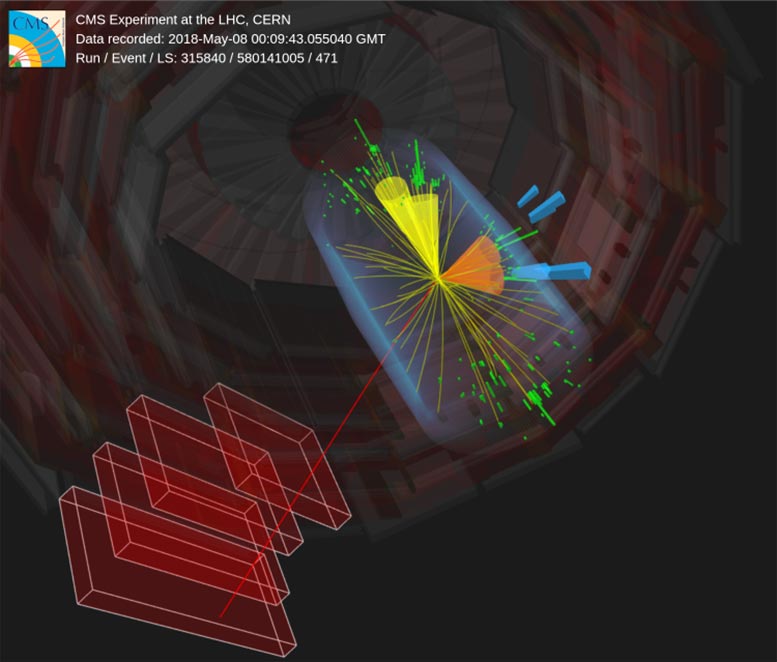
In a new measurement, the CMS collaboration examines, for the first time, the spin entanglement of a top quark and a top antiquark that are simultaneously produced at a very high speed with respect to each other. The two particles are therefore far apart before decaying, i.e., their distance is larger than what can be covered by information transferred at the speed of light. The correlation between the spins of the quark and of the antiquark is measured by looking at the angular distributions of their decay products.
The analysis brings into play state-of-the-art machine learning methods to correctly assign the top (anti)quark decay products and to improve the modeling of systematic uncertainties. The observed levels of entanglement, characterized by the parameter ΔE, are shown in Fig. 1 for two different kinematic regions.

The first bin corresponds to top quarks produced with transverse momentum less than 50 GeV, while in the last bin the top quark pairs have high invariant mass, i.e., are moving with a large velocity with respect to each other. The measured ΔE is greater than 1 in both kinematic regions, confirming entanglement between the two particles. In the second bin, in particular, the top quark-antiquark pairs are moving at such a large relative speed that only in 10% of the cases they would have a chance to communicate. There, the entanglement is significantly higher than ΔE critical, which is the level of entanglement that could be explained by information exchange via hidden variables at the speed of light. Therefore, the measurement shows that there is indeed “spooky action at a distance” between the heaviest known particles.
Credit: CERN
Never miss a breakthrough: Join the SciTechDaily newsletter.
Follow us on Google and Google News.
1 Comment
Outdated theories may mislead researchers. Artificial intelligence based on topological vortex self-organization (including chip manufacturing, battery construction, and communication methods) is the direction of human scientific development.
Despite the hardships of scientific research, there have always been different landscapes along the way. The physical phenomena observed by researchers are always superficial, not the natural essence of things. The natural essence of things needs to be refined and sublimated via the phenomena observed in experiments. Learning widely from others’ strong points may inspire you. If researchers are willing to further consider, you can browse https://zhuanlan.zhihu.com/p/701333717 and https://zhuanlan.zhihu.com/p/463666584.
Good luck to the researchers.