
Close Menu
    Facebook X (Twitter) Instagram
    SciTechDaily
    • Biology
    • Chemistry
    • Earth
    • Health
    • Physics
    • Science
    • Space
    • Technology
    Facebook X (Twitter) Pinterest YouTube RSS
    SciTechDaily
    Home»Chemistry»Electron Secrets at the Heart of Clean Energy Breakthrough
    Chemistry

    Electron Secrets at the Heart of Clean Energy Breakthrough

    By National Institutes of Natural SciencesSeptember 1, 20241 Comment5 Mins Read
    Facebook Twitter Pinterest Telegram LinkedIn WhatsApp Email Reddit
    Share
    Facebook Twitter LinkedIn Pinterest Telegram Email Reddit
    Photogenerated Electrons Contribute to Photocatalytic H2 Evolution Reaction on Metal-Loaded Oxides
    Schematic illustration of how the photogenerated electrons contribute to photocatalytic H2 evolution reaction on metal-loaded oxides. Not the free electrons in metal cocatalysts but the electrons trapped in the periphery of cocatalysts directly contribute to the photocatalysis. This discovery was achieved by synchronizing periodic excitations of photocatalysts with a Michelson interferometer on operando FT–IR spectroscopy. Credit: Shinichiro Kinoshita

    Researchers have made a significant breakthrough in photocatalysis, identifying that electrons trapped near metal cocatalysts, rather than free electrons, are crucial for hydrogen evolution.

    This discovery, facilitated by using a Michelson interferometer in operando FT-IR spectroscopy, overturns previous beliefs and opens new avenues for designing advanced catalysts that could enhance sustainable energy practices.

    History and Challenges in Photocatalysis

    Since the discovery of photoelectrochemical hydrogen evolution by Honda and Fujishima in 1972, heterogeneous photocatalysis has been intensively investigated and is still a hot topic in science and technology. In particular, understanding of reactive electron species and active reaction sites on photocatalytic reduction reaction are vital for designing and manufacturing innovative catalysts with improved evolution activity of hydrogen as sustainable energy carrier.

    However, despite its fundamental importance, microscopic understanding on photocatalysis remains a highly challenging issue owing to an inherent difficulty in experimentally observing and extracting weak spectroscopic signals originating from the photoexcited reactive electron species. This is predominantly due to inevitable temperature increment for catalyst samples under actual photocatalytic reaction conditions upon continuous photon irradiation. In this case, the weak signals derived from reactive photoexcited electron species are readily overwhelmed by intense background signals originating from thermally excited nonreactive electrons.
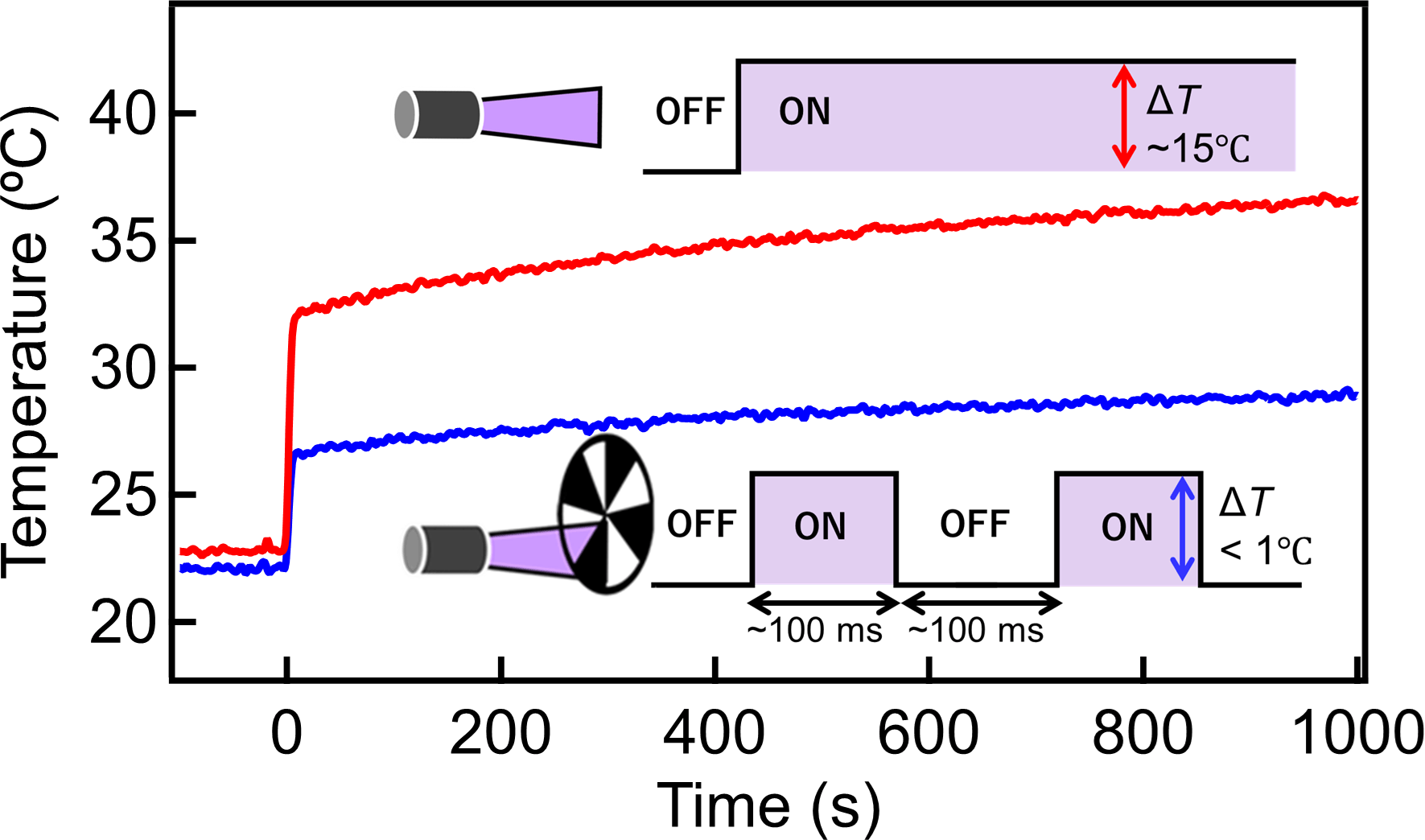
    Photocatalyst Particles Effect of Chopping
    Typical time profiles of the net temperature of the Pt/Ga2O3 photocatalyst particles subjected to (red line) continuous UV irradiation (∼90 mW cm–2) and (blue line) periodic UV irradiation with ∼5 Hz modulation at a partial pressure of methane gas (PCH4) of 30 kPa and a partial pressure of water vapor (PH2O) of 2 kPa. Inset: Schematic of the continuous and periodic UV irradiation. During periodic UV irradiation, excitation light irradiation (ON) and nonirradiation (OFF) are periodically repeated by an optical chopper; this significantly suppresses the increase in the instantaneous temperature of the sample. Credit: Hiromasa Sato, Toshiki Sugimoto

    Advancements in Reactive Electron Identification

    Researchers (Dr. Hiromasa Sato and Prof. Toshiki Sugimoto) at Institute for Molecular Science / The Graduate University for Advanced Studies, SOKENDAI succeeded in significantly suppressing the signals derived from thermally excited electrons and observing the reactive photogenerated electrons contributing to the photocatalytic hydrogen evolution.

    Such innovation was achieved by a new method based on synchronization of the millisecond periodic excitations of photocatalysts with a Michelson interferometer used for FT–IR spectroscopy. This demonstration was achieved for metal-loaded oxide photocatalysts under steam methane reforming and water splitting conditions.
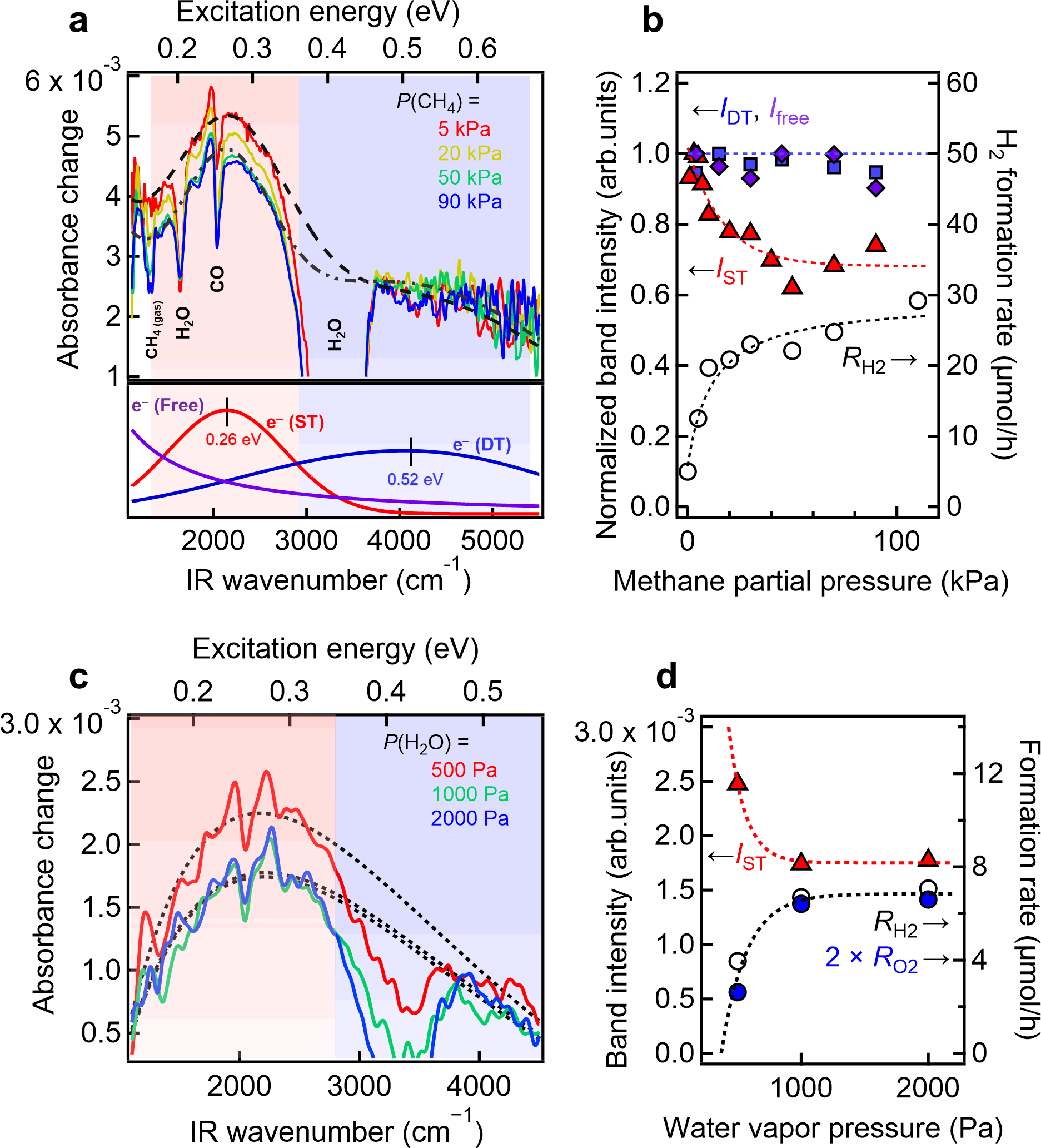
    Photocatalyst Particles Operando IR Spectra
    Operando IR spectra of electron species and correlations between the band intensity and formation rates of gaseous products. (a) Operando IR absorbance-change spectra of the Pt/Ga2O3 samples measured under steam methane reforming at PH2O = 2 kPa and different PCH4 values. Typical IR spectra of free electrons (purple), electrons in shallowly trapped (ST) states (red), and electrons in deeply trapped (DT) states (blue) are shown in the bottom panel. (b) Intensities of absorption bands corresponding to free electrons (Ifree), ST electrons (IST), and DT electrons (IDT) as a function of PCH4. PCH4 dependence of the H2 formation rate is shown on the right axis. (c) Operando IR absorbance-change spectra of the Pt/Ga2O3 samples measured under water splitting in the presence of small amount of methane gas (5 kPa). (d) Intensities of absorption bands corresponding to ST electrons (IST) as a function of PH2O. PH2O dependence of the formation rates of H2 and O2 derived from water splitting reaction is shown on the right axis. Credit: Hiromasa Sato, Toshiki Sugimoto

    Although it has long been conventionally believed that loaded metal cocatalysts function as sinks for reactive photogenerated electrons and active sites for reduction reactions, they found that the free electron species in the metal cocatalysts were not directly involved in the photocatalytic reduction reaction. Alternatively, the electrons shallowly trapped in the in-gap states of oxides contributed to enhancing the hydrogen evolution rate upon the loading of metal cocatalyst.

    The electron abundance in the in-gap states, especially metal-induced semiconductor surface states, was clearly correlated to the reaction activity, suggesting that such metal-induced semiconductor surface states formed in the periphery of the metal cocatalyst play key roles in the photocatalytic hydrogen evolution.
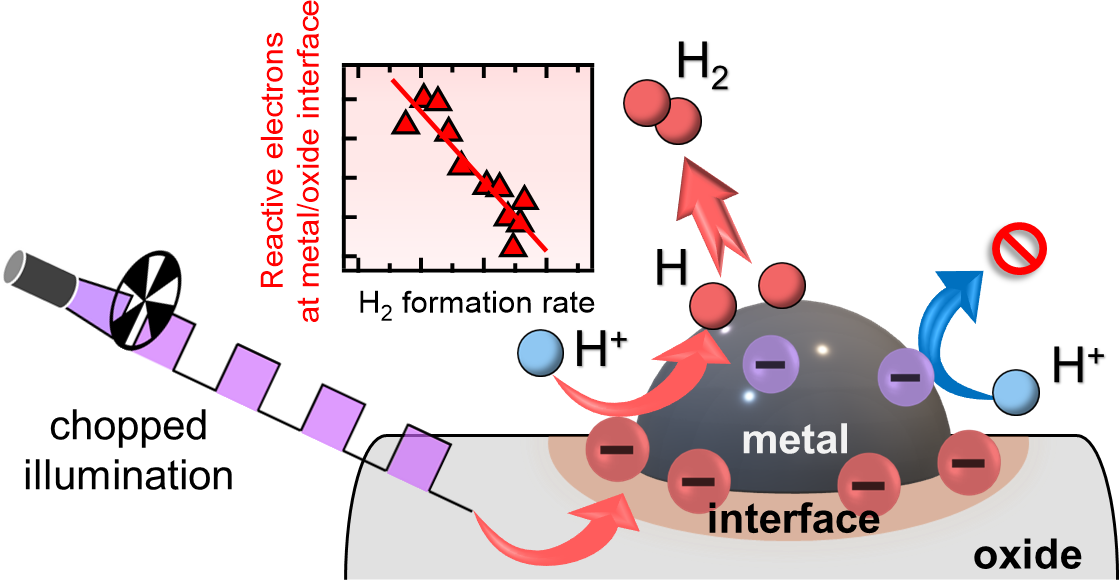
    ST Electrons Contribute to Photocatalytic Hydrogen Evolution Reaction
    Schematic illustration of how the ST electrons contribute to photocatalytic H2 evolution reaction. This reaction is initiated by the reduction of protons by the ST electrons on the metal-induced semiconductor surface states at the periphery of the metal cocatalysts. The H atoms produced in the reduction reaction diffuse on the metal cocatalyst and associate to evolve H2 molecules. Credit: Hiromasa Sato, Toshiki Sugimoto

    Shifting Paradigms and Future Potential

    These microscopic insights shift a paradigm on the traditionally believed role of metal cocatalysts in photocatalysis and provide a fundamental basis for rational design of the metal/oxide complex interfaces as promising platforms for nonthermal hydrogen evolution.

    Furthermore, the new approach of operando infrared spectroscopy is widely applicable to other various catalytic reaction systems and materials driven by the aid of photons and/or external electric field/potential. Therefore, the new approach would have great potential to uncover hidden key factors to enhance catalyst performance toward innovation of environmentally friendly energy technology for next-generation sustainable society.

    Reference: “Direct Operando Identification of Reactive Electron Species Driving Photocatalytic Hydrogen Evolution on Metal-Loaded Oxides” by Hiromasa Sato and Toshiki Sugimoto, 27 August 2024, Journal of the American Chemical Society.
    DOI: 10.1021/jacs.3c14558

    Never miss a breakthrough: Join the SciTechDaily newsletter.
    Follow us on Google and Google News.

    Catalysts Energy Green Energy Hydrogen Molecular Physics National Institutes of Natural Sciences
    Share. Facebook Twitter Pinterest LinkedIn Email Reddit

    Related Articles

    99% Efficient and Dirt Cheap – Is This the Holy Grail of Hydrogen?

    Green Energy Breakthrough: Catalyst Slashes Iridium Use by 95% in Hydrogen Electrolyzers

    The Green Spark: A Catalyst Transforming Water Into Energy Wealth

    Unleashing Hydrogen’s Potential: Baking Soda As the Key to Renewable Energy Storage

    Light-Powered Nanomaterial Catalyst Could Be Key for Hydrogen Economy

    Oxygen Evolution Reaction Breakthrough for Efficient Hydrogen Generation

    Advanced New Catalysts for More Efficient Clean Hydrogen Production

    Solving a Riddle That Would Provide the World With Entirely Clean, Renewable Energy

    Stanford Researchers Discover a New Route to Carbon-Neutral Fuels From Carbon Dioxide

    1 Comment

    1. Boba on September 1, 2024 5:34 pm

      There is no clean energy. There are only degrees of “dirty”. And the more of us there is on Earth, the less that degree matters, because the environment will buckle under billions of anything.

      Reply
    Leave A Reply Cancel Reply

    • Facebook
    • Twitter
    • Pinterest
    • YouTube

    Don't Miss a Discovery

    Subscribe for the Latest in Science & Tech!

    Trending News

    Popular Sugar-Free Sweetener Linked to Liver Disease, Study Warns

    What Is Hantavirus? The Deadly Disease Raising Alarm Worldwide

    Scientists Just Discovered How the Universe Builds Monster Black Holes

    Scientists Unveil New Treatment Strategy That Could Outsmart Cancer

    A Simple Vitamin May Hold the Key to Treating Rare Genetic Diseases

    Scientists Think the Real Fountain of Youth May Be Hiding in Your Gut

    Ravens Don’t Follow Wolves, They Predict Them

    This Common Knee Surgery May Be Doing More Harm Than Good

    Follow SciTechDaily
    • Facebook
    • Twitter
    • YouTube
    • Pinterest
    • Newsletter
    • RSS
    SciTech News
    • Biology News
    • Chemistry News
    • Earth News
    • Health News
    • Physics News
    • Science News
    • Space News
    • Technology News
    Recent Posts
    • Why Are So Many New Fathers Dying? Scientists Say the U.S. Has a Dangerous Blind Spot
    • Scientists Identify Simple Supplement That Greatly Reduces Alzheimer’s Damage
    • You May Have a Dangerous Type of Cholesterol Even if Your Tests Look Normal
    • Study Reveals Dangerous Flaw in AI Symptom Checkers
    • New MRI Breakthrough Captures Stunningly Clear Images of the Eye and Brain
    Copyright © 1998 - 2026 SciTechDaily. All Rights Reserved.
    • Science News
    • About
    • Contact
    • Editorial Board
    • Privacy Policy
    • Terms of Use

    Type above and press Enter to search. Press Esc to cancel.