
Close Menu
    Facebook X (Twitter) Instagram
    SciTechDaily
    • Biology
    • Chemistry
    • Earth
    • Health
    • Physics
    • Science
    • Space
    • Technology
    Facebook X (Twitter) Pinterest YouTube RSS
    SciTechDaily
    Home»Physics»Encoded Photons Using Quantum Cryptography Sent a Record Distance
    Physics

    Encoded Photons Using Quantum Cryptography Sent a Record Distance

    By SciTechDailyNovember 20, 2012No Comments3 Mins Read
    Facebook Twitter Pinterest Telegram LinkedIn WhatsApp Email Reddit
    Share
    Facebook Twitter LinkedIn Pinterest Telegram Email Reddit
    quantum-cryptography-transmission
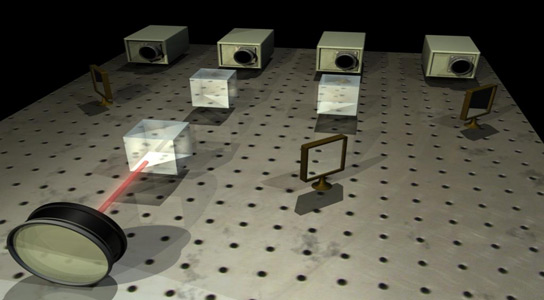
    Model of quantum cryptography. Credit: Image by Barry Sanders FInstP FOSA FAIP, iCORE, Quantum Information Science

    Quantum encryption systems, which encode signals into a series of single photons, have had trouble sending them along optical fibers. Until now, it has been unfeasible to piggyback these photons onto existing telecommunications lines. Now using a technique for detecting dim light signals, physicists have enabled the transmission of a quantum key along 90 km (56 miles) of noisy optical fiber.

    The scientists published their findings in the journal Physics Review X. Finally quantum cryptography may enter mainstream technology.

    Quantum systems cannot be measured without being noticeably disrupted. People can encode encryption keys into a series of photons and share it, knowing that any eavesdropper will trip the system’s alarms. However, such systems haven’t been able to transmit keys along telecommunication lines, because other data traffic swamps the encoded signal. As a result, quantum cryptography has had only some niche applications, like connecting offices to nearby backup sites using expensive dark fibers that carry no other signals.

    Physicists have tried to solve the problem by sending photons along a shared fiber on a quantum channel, at a characteristic wavelength. The trouble is that the fiber scatters light from the normal data into that wavelength, polluting the quantum channel with stray photons. Andrew Shields, a researcher at the Toshiba Cambridge Research Laboratory, UK, and his colleagues have developed a detector that picks out photons from this channel only if they strike it at a precise instant, calculated on the basis of when the encoded photons were sent.

    Designing such a detector was difficult. Standard detectors use semiconducting devices that create an avalanche of electrical charges when struck by a single photon. It takes more than one nanosecond for the avalanche to grow large enough to stand out against the detector’s internal electrical hiss, which is much longer than the window of 100 picoseconds needed to filter out a single photon.

    The detector activates for 100 picoseconds, every nanosecond. The detector measures the difference between the signal recorded during one operational cycle and the signal from the preceding cycle, when no matching photo was likely detected. This cancels out the background hum and has enabled the team to transmit a quantum key along a 90-kilometer fiber, which carried noisy data at 1 billion bits per second in both directions. The team’s goal is to try this technique along a real telecommunications line.

    There is a hypothesis that quantum signals cannot be transmitted beyond the range of a large city of 100 kilometers (62 miles), since scattering accumulates over distance. It would be impossible to filter them all out, even with a precisely timed detector.

    Reference: “Coexistence of High-Bit-Rate Quantum Key Distribution and Data on Optical Fiber” by K. A. Patel, J. F. Dynes, I. Choi, A. W. Sharpe, A. R. Dixon, Z. L. Yuan, R. V. Penty and A. J. Shields, 20 November 2012, Physics Review X.
    DOI: 10.1103/PhysRevX.2.041010

    Never miss a breakthrough: Join the SciTechDaily newsletter.
    Follow us on Google and Google News.

    Communication Optical Physics Photons Quantum Cryptography Telecommunications
    Share. Facebook Twitter Pinterest LinkedIn Email Reddit

    Related Articles

    Einstein Meets Newton: Scientists Demonstrate New Aspect of Wave-Particle Duality

    Quantum Teleportation Becomes Reality on Active Internet Cables

    Quantum Leap: Innovative Breakthrough in Entangling Light and Sound

    Laser Storms: Physicists Create “Light Hurricanes” for 16x Faster Data Transmission

    Super Photons Unveiled: Sculpting Light Into Unbreakable Communication Networks

    Light Takes a Quantum Leap Into One Dimension

    Breaking Barriers in Optics: The Power of Coherence Entropy

    Quantum Magic: How “Super Photons” Are Shaping the Future of Physics

    Molecules as Antennas Transmit Signals of Single Photons

    Leave A Reply Cancel Reply

    • Facebook
    • Twitter
    • Pinterest
    • YouTube

    Don't Miss a Discovery

    Subscribe for the Latest in Science & Tech!

    Trending News

    Common Laxative May Help Reverse Depression-Related Brain Fog

    Younger Generations Are Aging Faster – and It May Be Fueling a Surge in Cancer

    New Discovery Could Unlock Quantum Computers the Size of a Coin

    Shingles Vaccine Linked to 24% Lower Dementia Risk in Older Adults

    Scientists Found a Wordle Trick That Solves 99% of Puzzles

    A Hidden Galaxy Called Shadow Blaster May Explain One of Astronomy’s Biggest Mysteries

    These 3 Common Sleep Habits May Be Aging Your Brain Faster

    Rare Goblin Shark Spotted Alive in Its Natural Habitat for the First Time

    Follow SciTechDaily
    • Facebook
    • Twitter
    • YouTube
    • Pinterest
    • Newsletter
    • RSS
    SciTech News
    • Biology News
    • Chemistry News
    • Earth News
    • Health News
    • Physics News
    • Science News
    • Space News
    • Technology News
    Recent Posts
    • 520-Million-Year-Old Fossils Solve One of Evolution’s Biggest Mysteries
    • This Extraordinary Desert Mouse Defies Aging – and It Could Change Human Longevity
    • A Simple Blood Test Can Reveal the True Age of Your Brain, Heart, and Other Organs
    • This Popular Workout Supplement May Give Cancer Immunotherapy a Big Boost
    • Scientists Built a Mars Rover That “Swims” Through Sand
    Copyright © 1998 - 2026 SciTechDaily. All Rights Reserved.
    • Science News
    • About
    • Contact
    • Editorial Board
    • Privacy Policy
    • Terms of Use

    Type above and press Enter to search. Press Esc to cancel.