
Two of the final stages in the 2024 cycling event traverse high mountain passes in the Western Alps.
In 2024, the Tour de France will feature a unique route, beginning in Florence, Italy, and concluding in Nice, France, avoiding the traditional Paris finish due to the Olympic Games. The race covers diverse terrains across France, Italy, Monaco, and San Marino, with challenging climbs in the Apennines, Pyrénées, and Massif Central. Key stages include grueling ascents to La Bonette and Col de Turini, with the final stage as an individual time trial from Monaco to Nice.
Tour de France 2024: A New Route and Olympic Proximity
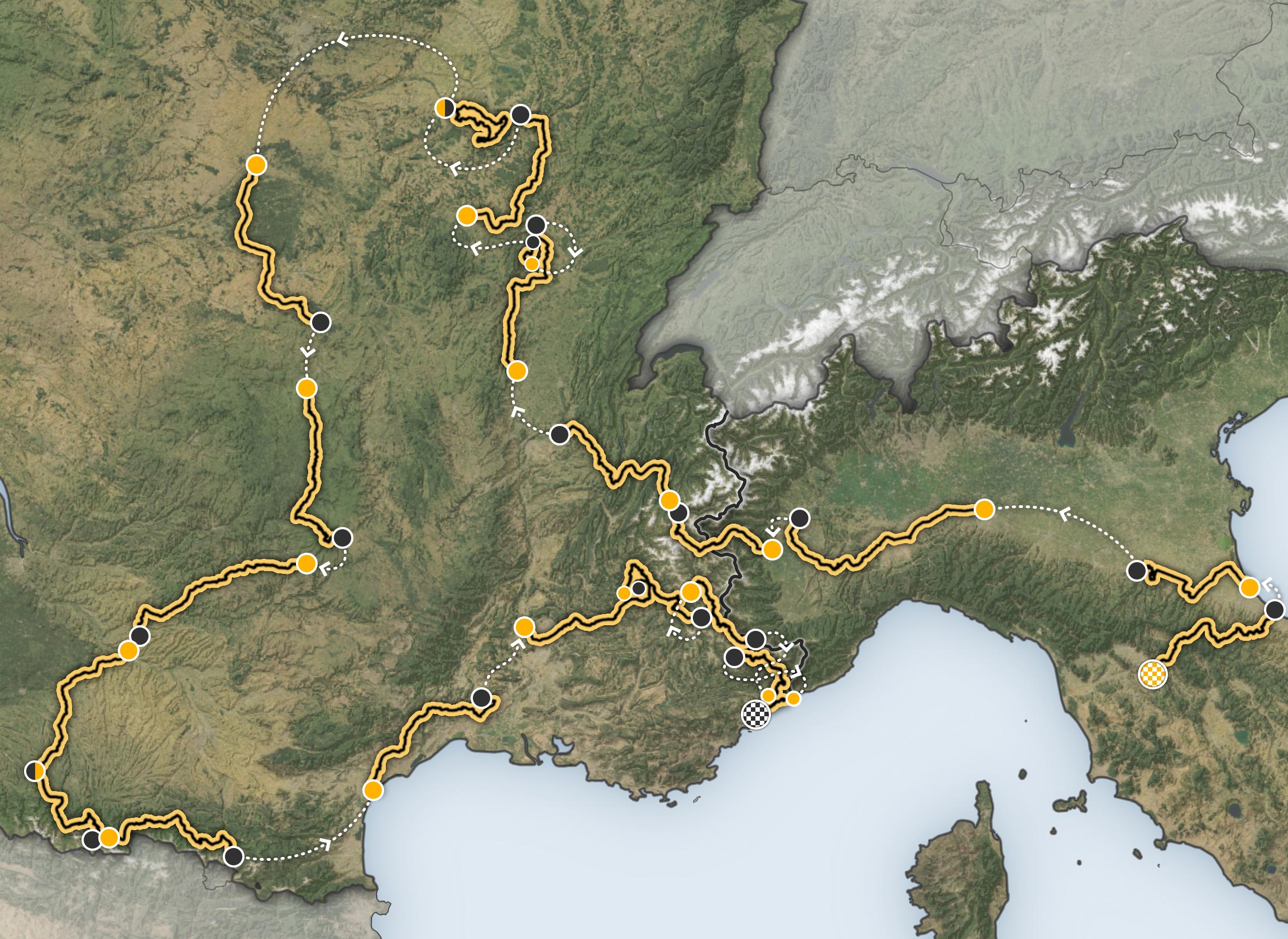
Over the course of three weeks, riders in the Tour de France traverse forests, vineyards, rolling hills, and steep mountain passes. In the summer of 2024, the 21-stage bicycle race kicked off in Florence, Italy, with routes wending through seven regions of France, dipping into San Marino and Monaco, and ending in Nice in the south of France. For the first time in its 111-year history, the race will not finish in Paris, the host city of the 2024 Olympic and Paralympic Games.
This image shows the route for the 2024 Tour de France. The race stages are overlaid on the Blue Marble: Next Generation July image, a composite of observations acquired by the MODIS (Moderate Resolution Imaging Spectroradiometer) on NASA’s Terra satellite. Yellow circles mark the start of each day’s stage, and black ones mark the finish. Dashed lines indicate motorized travel between stages.
Challenging Climbs and Scenic Views
In an event known for its merciless climbs, competitors in 2024 must power their way through the Apennines, Pyrénées, and Massif Central. In stages 19 and 20, the route ascends and descends through France’s Maritime Alps, in the western part of the range. The image below, acquired by the OLI-2 (Operational Land Imager-2) on Landsat 9 on July 11, 2023, shows the setting for these legs, which feature a combined 10,000 meters (32,800 feet) of climbing. The Landsat image was overlaid on digital elevation data from the SRTM (Shuttle Radar Topography Mission) to give a sense of the topography.
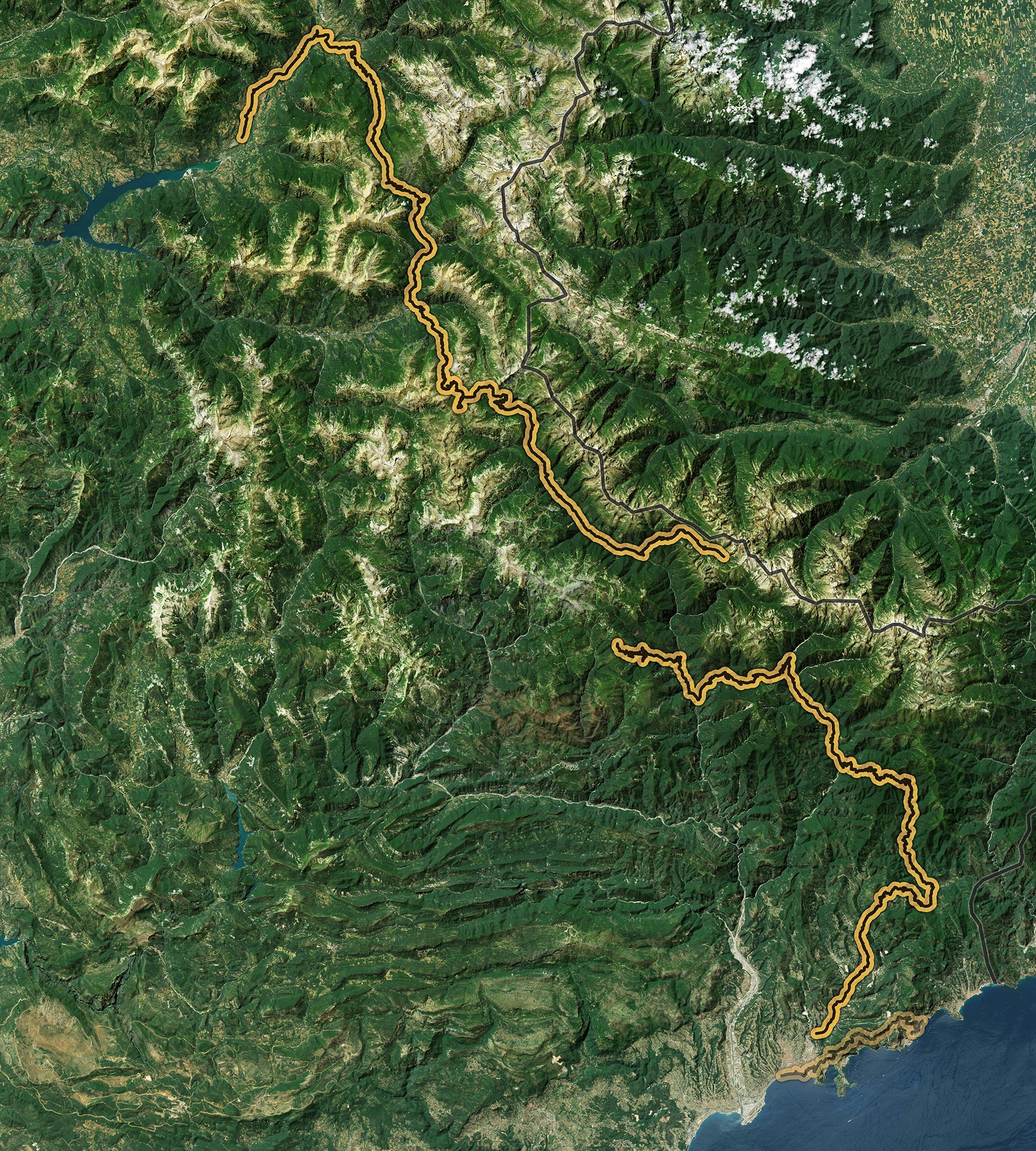
The roller-coaster-like routes owe to the topography created by colliding continental plates. The Alps, which arc from the Mediterranean coasts of Italy and France through Switzerland and Austria, formed when the European plate subducted beneath the African plate. The collision caused rocks to fold, fault, and stack up, resulting in the massive European mountain chain that persists today.
Epic Mountain Stages and Historic Climbs
In stage 19, cyclists tackle two climbs classified as hors catégorie, or “beyond categorization.” One of these ascents, too long and steep to fall within the race’s traditional categories of difficulty, culminates near the summit of La Bonette on the highest paved road in France and the highest point of the 2024 Tour de France at 2,802 meters (9,200 feet).
Stage 20, which starts close to sea level in Nice and ends at 1,678 meters (5,500 feet) elevation, crosses several mountain passes, including Col de Turini. The road’s dozens of tight, narrow hairpin turns have been featured in past Tours, as well as in the Monte Carlo Rally auto race held annually in January.
Nature and History Along the Ride
These routes cross Mercantour National Park and adjacent protected areas. The park encompasses a variety of habitats, including coniferous forests in the valleys; larch, Swiss pine, and rhododendron of the subalpine; and grasslands and heathlands in the harsh alpine environments above the tree line. Along with diverse landscapes, flora, and fauna, the area contains a number of “perched villages,” centuries-old settlements built into precipitous mountainsides.
The 2024 event concludes on July 21, when riders compete in an individual time trial between Monaco and Nice.
NASA Earth Observatory images by Michala Garrison, using MODIS data from Blue Marble: Next Generation, bike route data from the Amaury Sport Organisation, and Landsat data from the U.S. Geological Survey.
Never miss a breakthrough: Join the SciTechDaily newsletter.
Follow us on Google and Google News.